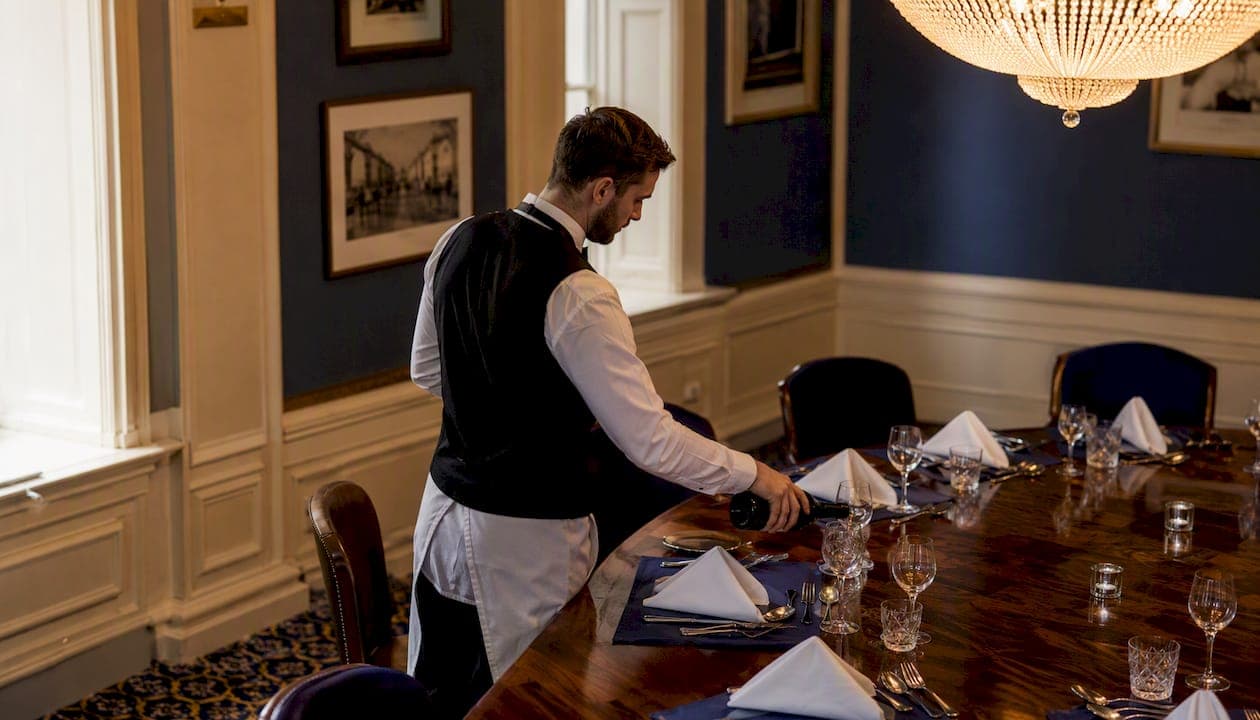
To plan a formal business dinner, follow these 11 steps: (1) define your vision and objectives, (2) set the budget and date, (3) build the guest list and manage RSVPs, (4) select and contract the venue, (5) plan the menu and catering, (6) design the evening program and run sheet, (7) arrange atmosphere, decor, and AV, (8) book entertainment and brief speakers, (9) create the seating plan and VIP handling, (10) execute day-of operations, and (11) close with follow-up and ROI measurement. Get all 11 right and you protect your company's reputation, keep relationships intact, and walk away with measurable outcomes.
Backwards planning timeline at a glance:
- 8–12 weeks out: Lock the date, confirm the budget, begin venue search
- 6–8 weeks out: Sign the venue contract, finalize the guest list
- 4 weeks out: Send formal invitations, collect dietary and accessibility needs
- 2 weeks out: Confirm final headcount, submit to catering
- 1 week out: Confirm all vendors, distribute run sheets, brief speakers
- Day of: Arrive 30+ minutes early, test AV, assign a point person to logistics
Planning a corporate dinner from zkipster recommends this exact milestone structure, and it holds up across event sizes from 20 to 200 guests.
Key Takeaways
Planning a formal business dinner requires 11 sequential steps, a backwards timeline starting 8–12 weeks out, and a printed run sheet distributed to every vendor before doors open.
| Point | Details |
|---|---|
| Start with a written objective | One sentence defining the business goal and guest type drives every venue, menu, and seating decision. |
| Budget with cost bands | Per-person costs range from $40–$75 for casual team dinners, $75–$150 for standard client dinners, $150–$300 for upscale events, and $300+ for executive/fine dining; always add a 10–15% contingency. |
| Distribute a printed run sheet | Every vendor and staff member needs a copy before load-in; this single step prevents most day-of coordination failures. |
| Pre-arrange payment | Settle the bill and gratuity before the event so no transaction appears in front of guests. |
| Ambassadorclubportsmouth | The 6,000 sq ft Portsmouth hall includes a commercial kitchen, built-in projector, and packages covering setup, cleaning, and security for up to 200 guests. |
Table of Contents
- What are the core steps to plan a formal business dinner?
- How do you build a realistic budget and planning timeline?
- How do you manage the guest list, invitations, and RSVPs?
- What should you check during a venue site visit?
- How do you plan the menu and finalize catering?
- What does a minute-by-minute run sheet look like?
- How do decor, lighting, and AV shape a formal dinner?
- How do you book entertainment and brief speakers?
- How do you handle seating plans, place cards, and VIP arrivals?
- What does day-of operations actually look like?
- How do you measure success and follow up after the event?
- Venue-ready checklist for Ambassador Club Portsmouth
- What planners get wrong at formal dinners
- Ambassadorclubportsmouth: a historic venue built for formal corporate dinners
- Sources
- FAQ
What are the core steps to plan a formal business dinner?
Every formal corporate dinner starts with a single, written sentence: what does success look like when guests leave? That sentence drives every decision that follows — the venue, the guest list, the menu format, the seating chart.
Defining your event objective and tone
Write your objective before you book anything. A useful template: "[Business goal] by hosting [number] [guest type] in a [tone] setting." For example: "Strengthen the Q3 client relationship by hosting 12 procurement leads in a private, formal dinner." That one sentence tells you the venue needs a private room, the tone is formal rather than celebratory, and the guest count is small enough for round tables.
Different objectives produce different events. A deal-closing dinner for six senior executives calls for a quiet private room, a prix-fixe menu, and minimal entertainment. A team recognition dinner for 80 employees needs a larger hall, a program with remarks and awards, and a more relaxed service style. An industry networking dinner for 150 contacts prioritizes flow between tables and a cocktail hour long enough for introductions. Treating the dinner as a trust-building environment rather than a transactional event, as Julie Helms frames it, reorients every detail toward relationship design.
Setting measurable success metrics
Set three to five KPIs before the event, not after. Useful ones: attendance rate against invited guests, number of follow-up meetings scheduled within 30 days, qualitative feedback scores from a post-event survey, and pipeline outcomes tied to attendees. Without pre-set metrics, "it went well" is the only data you have.
How do you build a realistic budget and planning timeline?
Budget before you book. The venue, menu format, and staffing level all flow from a per-head number, and that number needs to be set before vendors quote you.
Per-person cost bands from ChooseMyFood give a useful starting frame: casual team dinners run $40–$75 per person; standard client dinners $75–$150; upscale $150–$300; executive or fine-dining events $300 or more per person. Add a contingency buffer on top of your projected total, and expect typical service charges from most venues and caterers to be in the upper teens to low twenties percentage range.
Typical cost breakdown per event
| Cost Category | Typical Share of Budget | Notes |
|---|---|---|
| Venue rental | 25% | Varies by exclusivity and location |
| Food and beverage | 35% | Higher for prix-fixe or tasting menus |
| Staffing and service | 10–15% | Includes servers, bartenders, coat check |
| AV and technology | 5–10% | Projector, microphones, lighting |
| Decor and florals | 5–8% | Centerpieces, linens, place cards |
| Transportation | 3–5% | Shuttle, valet, or car service |
| Contingency buffer | 10–15% | Non-negotiable — always include it |
Payment and deposit milestone checklist:
- Sign a hold agreement and pay a deposit (typically 25–50%) to secure the date
- Confirm the menu and pay a second installment 4–6 weeks before the event
- Submit final headcount 10–14 days before; catering locks quantities at this point
- Settle the final balance 48–72 hours before, or arrange pre-payment to avoid a bill at the table
- Review cancellation policy clauses at signing — most venues charge 50–100% within 30 days of the event
Prix-fixe menus keep per-head costs predictable. À la carte ordering introduces variability that can blow a budget when guests order freely. For groups over 30, prix-fixe or a set family-style menu is almost always the smarter financial choice.
How do you manage the guest list, invitations, and RSVPs?
Guest list structure matters as much as guest count. A dinner of 40 where every table mixes hosts with clients produces better conversations than one where the client team sits together and the internal team clusters on the other side of the room. Aim for a host-to-guest ratio of roughly 1:3 at each table, and keep tables at 8–10 for natural conversation flow.
RSVP workflow and timeline:
- 6–8 weeks out: Send save-the-date with dress code and location
- 4 weeks out: Send formal invitation with RSVP link and dietary survey
- 2 weeks out: Close RSVPs; send one reminder to non-responders
- 10 days out: Send dietary and accessibility data to the venue and caterer
- 48 hours out: Confirm final headcount and any last-minute changes
Track RSVPs in a shared spreadsheet with columns for: name, company, dietary restrictions, accessibility needs, table assignment, and confirmation status. A simple Google Sheet or Airtable base works fine. The goal is a single source of truth that you can hand to the venue coordinator without a phone call.
Pro Tip: Plan your catering numbers at 95% of confirmed RSVPs. A 5% no-show rate is typical for corporate dinners, and over-ordering on a prix-fixe menu wastes budget. For last-minute additions, keep two or three seats unassigned at a flexible table near the back.
Collecting dietary profiles in advance is one of the highest-leverage things you can do before the event. A guest with a severe allergy who wasn't flagged is a crisis. One who was flagged is a five-minute kitchen conversation.
What should you check during a venue site visit?
A venue looks different on a Tuesday afternoon than it does during an event. Walk through it at the time of day your dinner will run, with the lights set to dinner mode, not overhead fluorescents.
Site-visit checklist:
- Acoustics and privacy: Can you hear the adjacent room? Is there a door that closes? Semi-private alcoves are rarely sufficient for confidential business conversations. A true private room with four walls and a door is the standard for executive dinners.
- Flow: Walk the path from arrival to coat check to cocktail area to dining room. Bottlenecks at the entrance or awkward transitions between spaces create friction guests notice.
- Kitchen capability: Can the kitchen handle your menu format and headcount simultaneously? Ask specifically about hot-holding capacity and plating speed for large tables.
- Parking and valet: Count spaces. For 100 guests, assume 50–60 cars minimum. If parking is limited, arrange a shuttle or valet service before you sign.
- ADA accessibility: Confirm ramp access, elevator availability, and accessible restrooms. Accessible venues directly improve attendance rates — this isn't a checkbox, it's a guest-count issue.
- Load-in access: Where do vendors enter? Is there a service elevator? Caterers and AV teams need a clear path that doesn't run through the guest entrance.
Contract clause checklist — confirm in writing:
- Payment schedule and deposit amounts
- Cancellation and force-majeure terms
- Service charges and gratuity policy
- Room exclusivity (no shared space with another event)
- Noise and privacy assurances
- Vendor access windows and load-in times
- Liability and insurance requirements
Understanding the difference between a banquet hall and a dedicated event venue affects which contract terms you negotiate hardest on. Banquet halls often have more flexibility on outside catering; dedicated venues may offer more built-in AV infrastructure.
How do you plan the menu and finalize catering?
Menu format is a strategic decision, not just a culinary one. Prix-fixe menus reduce decision fatigue at the table and keep service timing predictable. Family-style service encourages sharing and conversation but requires wider tables and more surface area. À la carte works for small groups where individual preference matters and timing flexibility is acceptable.
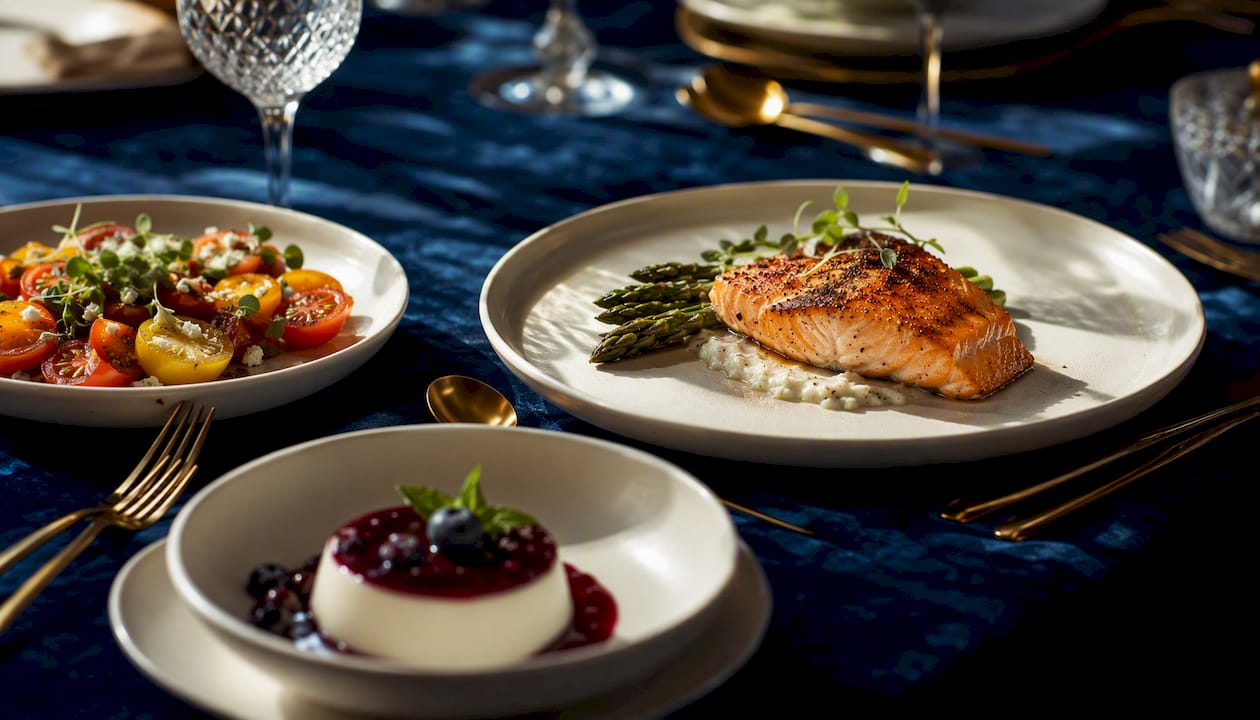
For groups over 50, prix-fixe is almost always the right call. For intimate executive dinners of 8–12, a curated tasting menu with sommelier-selected pairings signals intentional hospitality. Pre-selecting wines with a sommelier and agreeing on a per-head beverage budget removes awkward table-side decisions and keeps the conversation on business, not the wine list.
Dietary accommodation checklist:
- Collect dietary restrictions and allergies via the RSVP survey (not verbally at the event)
- Flag severe allergies separately from preferences — cross-contamination protocols differ
- Confirm the kitchen can prepare alternatives without cross-contamination
- Mark dietary accommodations on place cards discreetly (a small icon works; a large label does not)
- Brief servers on which guest at each seat has a substitution before service begins
Tasting appointment checklist:
- Schedule 4–6 weeks before the event
- Bring the event brief and the dietary accommodation list
- Taste each course in sequence at the pace you expect service to run
- Confirm plating time per course and discuss how to handle a slow table
- Lock the wine pairings and confirm corkage policy if bringing outside bottles
Formal dinner pacing matters as much as the food itself. A multi-course dinner where courses arrive too quickly feels rushed; too slowly and guests lose momentum. Aim for 20–25 minutes between courses for a three-course dinner, slightly longer for four or five courses.
What does a minute-by-minute run sheet look like?
A run sheet is the single document that keeps a formal dinner on track. Every vendor, server, and speaker should have a copy. Here's a sample structure for a 3-hour formal dinner:
Speaker cue sheet template: For each speaker, note the scheduled time, duration, AV requirements (slides, microphone type, clicker), the two or three themes to reinforce, and whether a rehearsal is needed. Speakers who haven't seen the room before the event are a common source of delays.
Coordinate service pacing directly with the kitchen. The run sheet should include a "kitchen cue" column so the chef knows when to fire each course based on the program, not just the clock.
How do decor, lighting, and AV shape a formal dinner?
Atmosphere is the first thing guests register and the last thing they consciously notice. Get it wrong and the evening feels off before anyone sits down.
Decor checklist:
- Table centerpieces should sit below eye level when guests are seated (under 14 inches) so conversation flows across the table
- Seasonal flowers, candles, and a layered tablescape add perceived effort without large budgets — local markets are often cheaper than florists for the same stems
- Linen color should complement the room, not compete with it; ivory or white for formal, deeper tones for intimate settings
- Place settings follow formal protocol: forks left, knives and spoons right, glassware upper right, bread plate upper left
Lighting guidance: Warm, dimmable lighting at 2700–3000K creates the right register for a formal dinner. Overhead fluorescents kill the atmosphere immediately. If the venue uses a projection wall or screen, test for glare at the seated eye level before the event. Spotlighting for a speaker podium should be bright enough to read notes but not so harsh it creates shadows on the face.
AV checklist:
- Confirm microphone type (handheld, lapel, or podium) and have a backup
- Test all HDMI and USB-C adapters before the event — bring your own
- Confirm projector resolution and aspect ratio match the presentation file
- Assign an on-site tech contact who stays through the program
- Have a printed backup of all slides in case of technical failure
Budget-friendly events can still impress when the lighting and table details are right. A $50 centerpiece in good light outperforms a $200 arrangement under fluorescents every time.
How do you book entertainment and brief speakers?
Entertainment at a formal business dinner should support conversation, not compete with it. Solo piano, a light string quartet, or a background jazz trio during the cocktail hour and early dinner service sets tone without demanding attention. Volume should stay low enough that guests at adjacent tables can hear each other without raising their voices.
Speaker briefing checklist:
- Confirm the objective of their remarks (inspire, inform, recognize, or close)
- Set a hard time limit and enforce it — 10–15 minutes maximum for a keynote during dinner
- Share AV specs and confirm slide format (16:9, PDF or PowerPoint)
- Brief them on the two or three themes the evening is built around
- Schedule a 15-minute walk-through in the room before guests arrive
Entertainer contract checklist:
- Arrival and setup time (at least 60 minutes before performance)
- Break schedule and total performance duration
- Technical rider (power requirements, stage dimensions, monitor needs)
- Payment schedule and cancellation terms
- Noise level agreement for background performance
For short keynotes during dinner, position them between the entrée and dessert. Guests are settled, the meal's momentum has paused naturally, and attention is at its peak. Speeches before the first course or during it are almost always a mistake.
How do you handle seating plans, place cards, and VIP arrivals?
Seating is relationship design. Where you place a decision-maker relative to the host, and who sits across from them, shapes the entire evening's conversation.
Round tables of 8–10 work best for formal dinners. They allow everyone to address the table without turning their back on anyone. Place the host at a position that gives clear sightlines to the room and easy access to the service team. Seat your most important client or VIP guest to the host's right. Alternate internal and external guests around the table rather than clustering them.
Place card best practices:
- Use tent cards with the guest's full name (first and last) in a legible font at 18pt or larger
- Add a small dietary icon on the back of the card for the server's reference, not the guest's
- For VIPs, include their title on the card if the event is formal enough to warrant it
- Laminate or use card stock heavy enough that cards don't fall over during service
VIP arrival checklist:
- Assign a dedicated welcome staff member to greet VIPs at the entrance
- Arrange staggered arrival windows for senior guests to avoid a lobby bottleneck
- Coordinate transportation pickup times 30 minutes earlier than the invitation states
- Handle payment and gratuity in advance so no bill appears at the table
Formal dinner etiquette is clear on one point: the host should never be seen handling money or a bill in front of guests. Pre-arrange payment with the venue before the event.
What does day-of operations actually look like?
Arrive at the venue at least 30–45 minutes before vendor load-in is complete. Your job on the day is to be present for guests, not to troubleshoot logistics. That only works if someone else owns the logistics.
Day-of vendor coordination checklist:
- Confirm all vendor arrival windows the morning of the event
- Walk the room with the venue coordinator and verify floorplan against the diagram
- Test AV: projector, microphones, slide deck, and backup files
- Confirm dietary substitutions are flagged at the correct seats
- Brief the service team on the run sheet and speaker cue times
- Assign a point person (not the host) to manage vendor questions during the event
- Confirm valet or parking arrangements are staffed and operational
- Check coat check setup and confirm capacity
Contingency plan for common problems:
- Late arrivals: Hold the seating announcement 10 minutes past the scheduled time; brief the kitchen to delay the first course fire accordingly
- Last-minute dietary needs: Keep two or three neutral plates (plain protein, no common allergens) in reserve with the kitchen
- AV failure: Have a printed slide backup and a handheld microphone as a fallback
- Unexpected weather: For events with outdoor components, have an indoor backup layout pre-confirmed with the venue
Designating a day-of point person is the single most effective operational decision you can make. The host who is also managing vendor calls during cocktail hour is not hosting — they're working.
How do you measure success and follow up after the event?
The follow-up starts the morning after, not a week later. A thank-you email sent within 24 hours lands while the evening is still fresh. One sent five days later reads like an obligation.
Post-event email timeline:
- Within 24 hours: Personal thank-you to each guest (not a mass email)
- Within 48 hours: Internal debrief email to the planning team with initial observations
- Within 1 week: Send any promised materials (presentations, introductions, next-step proposals)
- Within 30 days: Track follow-up meetings scheduled and pipeline movement tied to attendees
Sample KPI checklist:
- Attendance rate (confirmed RSVPs vs. actual attendees)
- Follow-up meetings scheduled within 30 days
- Qualitative feedback from a post-event survey (3–5 questions, sent within 48 hours)
- Cost per qualified lead or cost per relationship touchpoint
- Net Promoter Score from internal stakeholders
Document lessons learned in a shared debrief document within one week. Note what ran long, what vendors performed well, what the kitchen handled smoothly, and what you'd change. That document is worth more than any post-event report for the next event you plan.
Venue-ready checklist for Ambassador Club Portsmouth
A printable run sheet makes handoffs between client, venue, and vendors frictionless on the day. The checklist below is tailored to a 6,000 sq ft banquet hall with a built-in projector, full commercial kitchen, and dry bar.
Site-visit checklist for the 6,000 sq ft hall
| Area | What to Check | Status |
|---|---|---|
| Main hall | Confirm table layout matches floorplan; check sightlines from every seat to the projection wall | ☐ |
| Commercial kitchen | Walk through with the catering manager; confirm hot-holding capacity and plating stations | ☐ |
| Projection wall | Test built-in projector with your actual slide file; confirm resolution and aspect ratio | ☐ |
| Dry bar | Confirm bar setup, glassware inventory, and bartender arrival window | ☐ |
| Dance floor | Confirm whether it's in use or covered; note its effect on table spacing | ☐ |
| Storage and load-in | Identify vendor entrance, storage room for supplies, and breakdown staging area | ☐ |
| ADA access | Confirm ramp, elevator, and accessible restroom locations for guest communication | ☐ |
| Parking | Count spaces; confirm valet staging area if applicable | ☐ |
Printable run-sheet template keyed to the venue
Vendor arrival windows (load-in schedule):
- Caterer/kitchen team: 3 hours before doors open
- AV technician: 2 hours before doors open (projector and microphone test)
- Florist/decor team: 2 hours before doors open
- Bar staff: 90 minutes before doors open
- Event coordinator/host team: 60 minutes before doors open
Projection wall slot in the run sheet: Schedule the AV test at the same time as the decor setup so the room is in final configuration when you test. Confirm the projector throw distance matches your slide layout before guests arrive.
Pro Tip: At Ambassadorclubportsmouth, the built-in projector and projection wall eliminate the most common AV rental cost. Confirm the file format and resolution during your site visit, not the day of the event.
Venue contract checkpoint list:
- Room exclusivity confirmed in writing
- Load-in and breakdown windows specified
- Outside catering policy confirmed (Ambassadorclubportsmouth allows flexible outside catering)
- Cleaning and security included in the package
- Final payment schedule and cancellation terms signed
For event catering cost-saving strategies specific to this venue format, the Ambassador Club blog covers all-inclusive package options and staffing configurations that reduce per-event overhead.
What planners get wrong at formal dinners
The most common mistake isn't the menu or the decor. It's the run sheet that exists only in the planner's head.
When the schedule lives in one person's memory, every vendor question comes back to that person. The caterer asks when to fire the first course. The AV tech asks when the speaker goes on. The bar staff asks when to close service. The host ends up managing logistics instead of managing relationships, which defeats the entire purpose of the evening.
Practical dos and don'ts from the venue side:
- Do distribute a printed run sheet to every vendor and staff member before doors open
- Do pre-arrange payment and gratuity so no bill appears at the table in front of guests
- Don't schedule speeches before the first course — guests aren't settled and the kitchen loses its timing cue
- Don't rely on a semi-private alcove for confidential conversations; book a room with a door
- Do brief the kitchen on the program, not just the menu — they need to know when to hold and when to fire
- Don't skip the tasting appointment; a dish that reads well on paper can arrive at the wrong temperature or in the wrong portion size
On the client-vendor relationship: the venues and caterers that perform best on the night are the ones who received a clear brief two weeks before, not two days before. A detailed brief — headcount, dietary list, run sheet, AV specs, and a named point of contact — cuts the number of day-of calls in half. Hospitality service standards depend on preparation as much as execution; the best service teams work from information, not improvisation.
Pre-arranged payment is worth a specific note. Handling a bill at the table in front of clients signals that the evening wasn't fully planned. It introduces an awkward pause and, at worst, a negotiation over who pays. Settle it in advance, tip in advance, and let the evening end on conversation rather than arithmetic.
Ambassadorclubportsmouth: a historic venue built for formal corporate dinners
Ambassadorclubportsmouth's 6,000 sq ft hall in Portsmouth, VA, has a long history of hosting corporate events. For a formal business dinner, the venue offers a full commercial kitchen, a built-in projector and projection wall, a dry bar, and flexible outside catering policies that let you bring your own caterer or work with the venue's preferred partners. Packages include setup, cleaning, and security, so the day-of coordination burden on your team drops significantly.
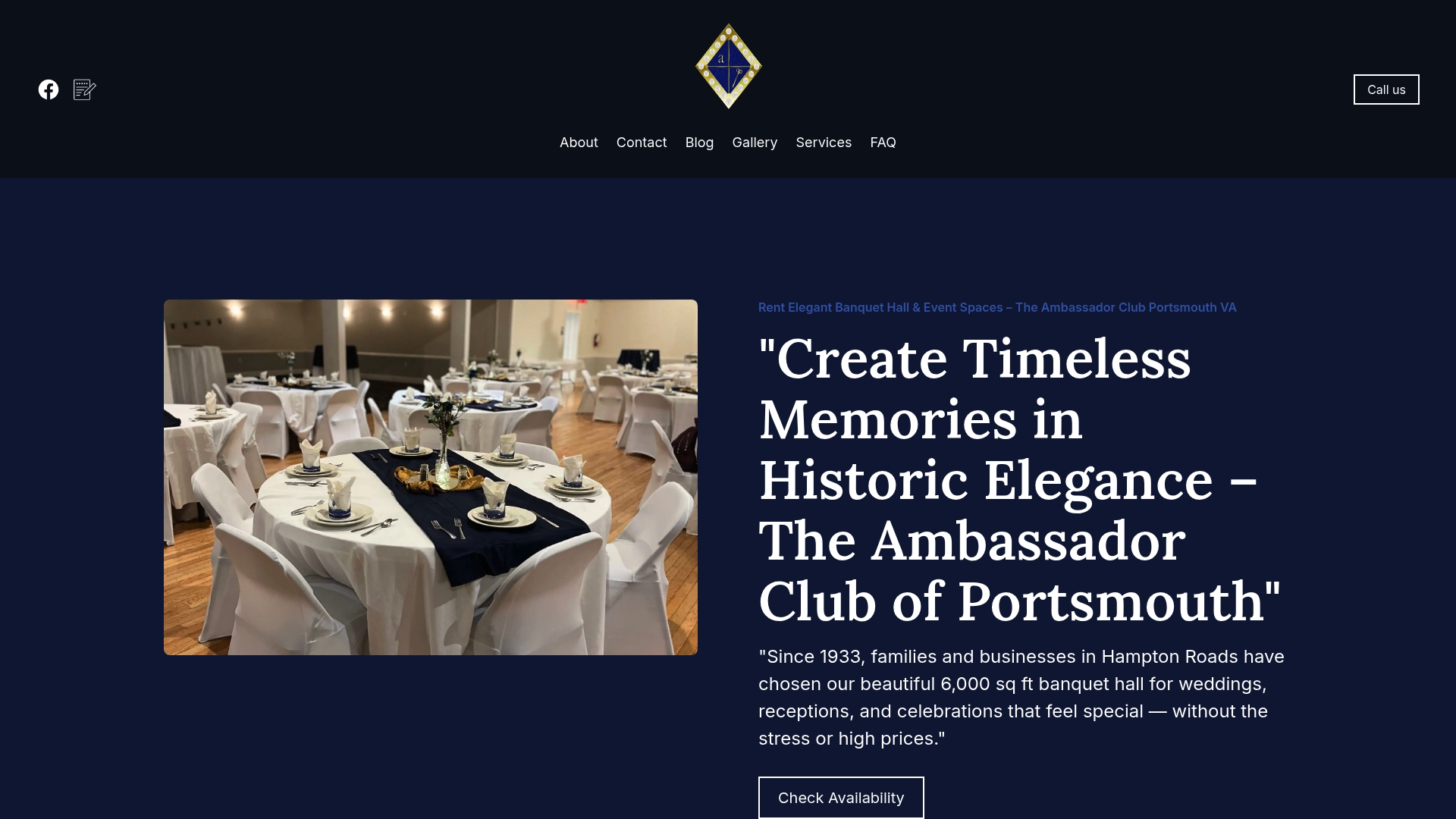
The hall accommodates up to 200 guests, making it suited for everything from an intimate executive dinner of 20 to a large client appreciation event. Optional transportation services are available for VIP guests. For planners in the Hampton Roads area, it's a venue where the infrastructure is already in place and the historic setting does the atmosphere work for you.
To schedule a site visit or check date availability, contact Ambassadorclubportsmouth directly at Ambassadorclubportsmouth.
Sources
- Planning a corporate dinner — zkipster
- Corporate Dinner Planning: The Complete Guide for Event Organizers (2026)
- Corporate team dinner — Take a Chef
- How to host a business dinner — Julie Helms
- How to Plan an Executive Business Dinner That Impresses Clients — Yorkshire Pudd
- Artfully host dinner party — ABC News / Good Morning America
FAQ
What are the stages of a formal dinner?
A formal dinner typically moves through five stages: cocktail reception, seating and welcome remarks, multi-course meal service (usually three to five courses), speeches or a keynote between the entrée and dessert, and a closing networking window before departure.
How do you plan a business dinner step by step?
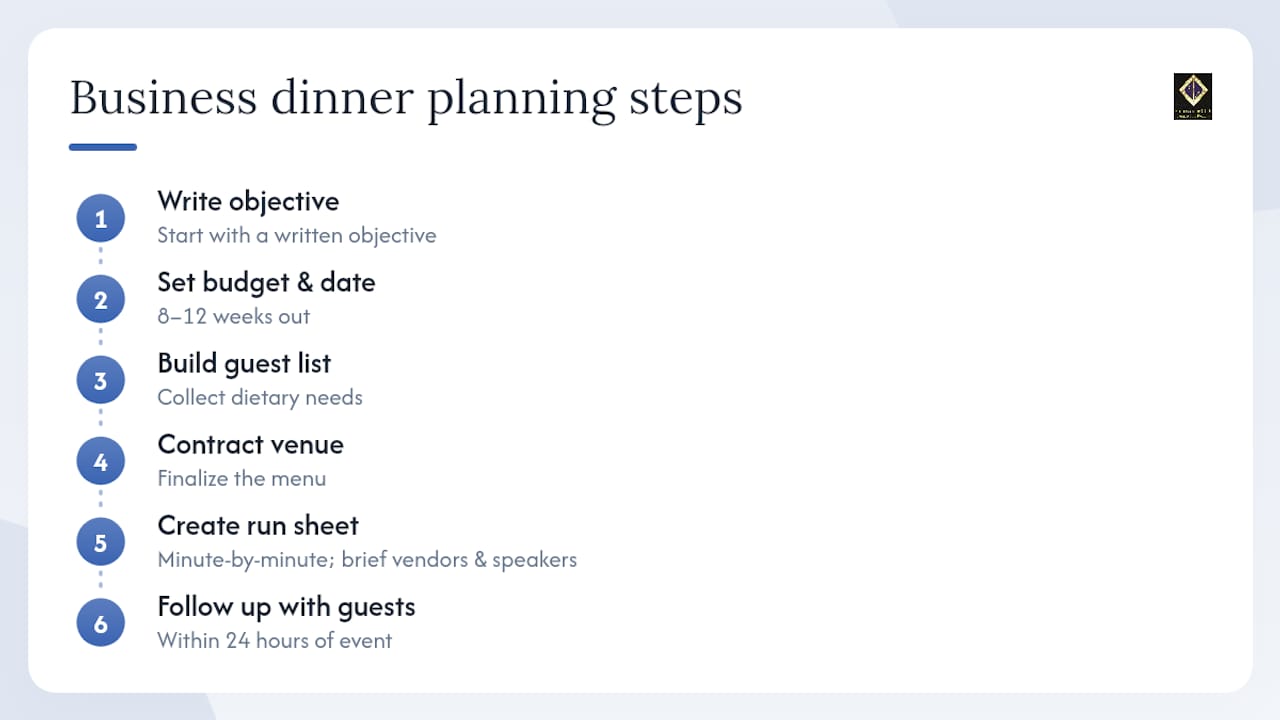
Start with a written objective, set the budget and date 8–12 weeks out, build the guest list and collect dietary needs, contract the venue, finalize the menu, create a minute-by-minute run sheet, brief all vendors and speakers, and follow up with guests within 24 hours of the event.
What are the 7 stages of event planning?
Event planning generally follows: (1) define objectives and scope, (2) set the budget, (3) select the venue and date, (4) plan the program and logistics, (5) confirm vendors and communications, (6) execute day-of operations, and (7) measure outcomes and debrief.
How far in advance should you plan a corporate dinner?
For a formal corporate dinner, begin planning 8–12 weeks before the event date. Venue contracts and deposits should be signed by week 6–8; invitations sent by week 4; final headcount confirmed 10–14 days before.
How do you handle dietary restrictions at a formal business dinner?
Collect dietary restrictions and allergies through the RSVP survey, flag severe allergies separately from preferences, confirm kitchen protocols with the caterer at the tasting appointment, and mark substitutions discreetly on place cards for the service team's reference.