
The highest-impact event catering cost saving strategies come down to five levers: choosing the right service style, locking in an accurate guest guarantee, controlling the bar, negotiating every line item on the Banquet Event Order (BEO), and selecting a venue that includes kitchen access and inventory. Get those five right and you can cut a catering budget by a meaningful margin before you ever touch the menu.
Start here — your quick-action checklist:
- Confirm your guest count early. Accurate registration numbers reduce over-ordering and the food waste that follows.
- Choose service style deliberately. Plated controls portions but raises labor; buffets look abundant but require 15–50% more food to maintain that appearance.
- Limit entrée choices. Fewer options mean less prep, less waste, and a cleaner kitchen operation.
- Control the bar first. Beverage spend is the single easiest line to trim without guests noticing.
- Negotiate the BEO before you sign. The guarantee count, service charge, and staffing minimums are all negotiable.
- Use venue inclusions. A venue with a full commercial kitchen, tables, and chairs already included removes entire rental line items.
- Schedule off-peak when possible. Weekday mornings and off-season dates consistently produce lower vendor rates.
Table of Contents
- 1. Simplify your menu to cut food cost immediately
- 2. Match service style to your actual event, not the default
- 3. Nail your guest count before anything else
- 4. Use timing and scheduling as a negotiation lever
- 5. Bundle services and negotiate package deals
- 6. Control labor costs with smart staffing choices
- 7. Reduce food waste with a post-event variance loop
- Which service style actually saves you money?
- How to cut beverage costs without guests noticing
- What to negotiate on your BEO — and how to ask
- How your venue choice directly lowers catering costs
- Key Takeaways
- The trade-offs planners get wrong
- Ambassadorclubportsmouth: a venue built for budget-conscious planners
- Useful sources and further reading
- FAQ
1. Simplify your menu to cut food cost immediately
Fewer entrée choices do more for your budget than almost any ingredient swap. When guests choose from two proteins instead of five, prep quantities become predictable, waste drops, and your caterer's labor time shrinks. A fixed-choice meal — where guests pre-select via RSVP — lets the kitchen prepare exact quantities rather than hedge with overproduction.
The ingredient swap conversation is worth having directly with your caterer. Braised short rib or a seasonal chicken thigh preparation can deliver the same plate presence as filet mignon at a fraction of the protein cost. Swapping a premium center-cut fish for a local, in-season catch works the same way. The key is asking your caterer which proteins are performing well at market right now, not which ones look best on a printed menu.
Pro Tip: Ask your caterer for a "market substitution list" at the time of quoting. This gives you pre-approved swaps for premium ingredients if prices spike before the event date, protecting you from last-minute cost overruns.
2. Match service style to your actual event, not the default
Plated service controls portions but increases staff costs. Buffet and cocktail formats reduce per-plate labor but require larger food contingency buffers: plated events typically need a 5–8% contingency, while buffet and cocktail service require 10–15% and 12% buffers respectively to maintain the appearance of abundance. That gap is where the "buffets are cheaper" assumption breaks down.

For a corporate lunch with 80 guests and a 90-minute window, a buffet often works. For a 200-person wedding dinner with a formal timeline, plated service may actually cost less once you account for the extra food volume a buffet demands. Service style should match guest behavior and event format — an unstaffed station works for casual networking; it creates chaos at a seated awards dinner.
| Service Style | Food Contingency Buffer | Labor Cost | Best For |
|---|---|---|---|
| Plated | 5–8% | High | Formal dinners, precise timelines |
| Buffet | 10–15% | Medium | Casual receptions, mixed groups |
| Cocktail/Passed | 12% | Medium-High | Receptions, pre-dinner hours |
| Family-style | 10–15% | Medium | Intimate gatherings, communal feel |
3. Nail your guest count before anything else
Every catering estimate is built on a headcount. Get that number wrong and every other saving you negotiate gets eroded. Precise guest numbers reduce over-ordering and the waste that follows, which is why locking your RSVP deadline at least two weeks before the event matters so much.

Yield-adjusted purchasing takes this further. Once you have a confirmed count, work with your caterer to calculate actual yield per protein or produce item, not just raw purchase weight. A 10-pound beef tenderloin yields roughly 7–7.5 pounds after trimming; buying to raw weight without accounting for that gap means you are paying for food that never reaches a plate. Treating headcount and yield as a combined planning task, rather than two separate conversations, is one of the more reliable ways to keep estimates from becoming expensive overproduction.
Pro Tip: Build your catering budget for business events around 90–95% of your expected attendance, not 100%. Most events run slightly under RSVP count, and caterers can typically accommodate a small overage from kitchen reserves.
4. Use timing and scheduling as a negotiation lever
Off-peak scheduling is one of the most underused budget event catering tips. Weekday mornings, afternoons, and off-season months consistently produce lower vendor rates than Saturday evenings in peak season. A Friday afternoon reception or a Sunday brunch can access the same caterers and menus at meaningfully lower labor and delivery rates.
Timing the food service window itself also matters. A cocktail-hour-only food service, or a brunch format that replaces a full dinner, removes entire course categories from the bill. If your event runs three hours, you do not need a four-course meal — a well-executed two-course service with a strong appetizer pass often reads as more generous to guests than a drawn-out formal dinner.
5. Bundle services and negotiate package deals
Vendors expect negotiation, and bundling food, beverage, equipment, and staffing into a single package deal commonly reduces costs compared with buying line items separately. The leverage increases when you can offer volume: a multi-event commitment, a confirmed date during a slow period, or a willingness to use the caterer's existing rental inventory rather than specifying custom items.
When getting quotes, ask three vendors to bid on the same spec sheet. That competition alone often produces better pricing than any single negotiation. Once you have competing bids, use the lowest as a floor and ask your preferred vendor to match or beat it on at least one line item.
6. Control labor costs with smart staffing choices
Labor is frequently the second-largest line item after food, and it is more flexible than most planners realize. Self-serve stations, replenishment-style buffets, and drink ticket systems all reduce the number of servers required without degrading the guest experience. For a 100-person casual reception, dropping from one server per 10 guests to one per 15–20 guests, combined with self-serve beverage stations, can remove several hours of staffing cost.
Waste and labor consistently produce larger savings than ingredient swaps alone, which is why staffing decisions deserve the same attention as menu choices. Ask your caterer for a staffing breakdown by role and hour, then challenge any line item that seems padded. Setup and breakdown labor, in particular, is often negotiable when the venue provides its own staff or when load-in windows are generous.
7. Reduce food waste with a post-event variance loop
Most planners focus entirely on pre-event cost control and skip the post-event reconciliation that compounds savings over time. After each event, compare your BEO estimates to the actual invoices, then do a quick waste audit: which dishes came back largely untouched, which ran out, and where did the kitchen over-prep? Building this variance loop into your process means each event improves the accuracy of the next one.
Passed appetizers and limiting options per course are two of the most reliable waste-reduction moves during the event itself. When a server controls the pace of appetizer distribution, guests take what is offered rather than loading a plate. That single change can reduce appetizer consumption by a noticeable margin without any guest feeling shortchanged.
Which service style actually saves you money?
The honest answer: plated service usually costs less per head than buffet when you account for the full picture. Buffet and family-style service often require 15–50% more food preparation to maintain the appearance of abundance, which erases the per-plate labor savings quickly. The correct choice depends on event duration, guest flow, and how tightly the kitchen can manage replenishment.
Here is a simple example. A 100-person dinner with a $40 food budget per head:
- Plated: $40 per head × 100 guests × 1.06 (6% contingency) = $4,240
- Buffet: $40 per head × 100 guests × 1.12 (12% contingency) = $4,480
- Cocktail/passed: $40 per head × 100 guests × 1.15 (15% contingency) = $4,600
The plated option comes out lowest on food cost alone. Add labor back in and the gap narrows, but for events where portion control is feasible, plated service is often the more cost-effective catering choice than the sticker price suggests.
Pro Tip: For events where you want the feel of abundance without buffet overproduction, consider a hybrid: plated first course and dessert with a single shared centerpiece dish family-style. You get the visual generosity of shared food with tighter portion control on the expensive proteins.
How to cut beverage costs without guests noticing
Beverage spend is the most common line item that inflates a catering total without planners realizing it until the invoice arrives. The fix is straightforward: control selection, limit the service window, and shift cost exposure with drink tickets or a cash bar for spirits.
Practical tactics that work:
- Wine and beer only for the main reception, with a champagne toast. Removing spirits entirely can cut bar cost by 30–40% depending on your guest profile.
- Two signature cocktails instead of a full open bar. Name them after the couple, the company, or the season. Guests remember a well-presented signature drink longer than a generic bar menu.
- Timed beverage windows: cocktail hour bar service only, then wine with dinner and a champagne close. Cutting two hours of open bar service removes a significant chunk of consumption.
- Premium non-alcoholic options as a genuine alternative, not an afterthought. A craft mocktail station or a local sparkling cider reduces per-head alcohol consumption without making non-drinkers feel like an afterthought.
- Drink tickets for a set number of alcoholic beverages per guest, with a cash bar for additional drinks. This transfers cost beyond the baseline to individual guests.
Pro Tip: Source two or three local craft beers and one regional wine for your limited bar. Local options often cost less than national brands, and guests perceive them as a deliberate, premium choice rather than a budget cut.
What to negotiate on your BEO — and how to ask
The BEO is where most catering costs are set in stone or left open for negotiation. Many contracts bill the higher of the guarantee count or actual guests served, which means your guarantee is a direct cost lever. Set it too high and you pay for food that was never served.
BEO checklist: items to negotiate before you sign
- Guarantee adjustment window — request the right to adjust your count 48–72 hours before the event, not 7–10 days out.
- Service charge breakdown — ask for a line-item split between the venue's administrative fee and the gratuity distributed to staff. These are often bundled at 20–22% but are separately negotiable.
- Staffing minimums — confirm the minimum server count and ask whether it can be reduced for self-serve stations or a shorter service window.
- Equipment and rental fees — identify every rental line item (linens, china, glassware) and ask which items the venue already owns. Paying rental fees for items sitting in the venue's storage room is a common hidden cost.
- Delivery, setup, and overtime charges — get these as flat fees, not hourly rates with open-ended windows.
- Cake-cutting fee — this is almost always negotiable or waivable when you are spending above a certain food minimum.
- Gratuity handling — confirm whether gratuity is included in the service charge or expected separately, and at what percentage.
Sample language to use:
- "Can we set the guarantee adjustment window at 48 hours rather than 7 days? We're tracking RSVPs closely and expect a firm number by then."
- "Can you break out the service charge so I can see what goes to staff versus administration?"
- "We're considering three vendors. If you can match [competitor's] staffing rate, we're ready to sign this week."
Pro Tip: Writing and managing the BEO carefully before the event is where most cost-control battles are won. A well-negotiated BEO is worth more than any single ingredient swap.
How your venue choice directly lowers catering costs
The venue is not just a backdrop. It is a cost variable. A venue with a full commercial kitchen eliminates the need for a caterer to bring in mobile cooking equipment, which shows up as a line item on every quote. Included tables, chairs, linens, and a built-in bar remove entire rental categories from the budget.
Questions to ask every venue before you book:
- Does the venue have a full commercial kitchen, and is it included in the rental fee?
- Are tables, chairs, and linens included, or are they a separate rental?
- Does the venue have a preferred caterer list, or can you bring your own?
- Is there a corkage fee if you supply your own wine or beer?
- What are the load-in and load-out windows, and is there a fee for extended access?
- Does the venue provide any AV equipment, and is it included?
A venue that answers "yes" to the first two questions removes two of the most common add-on costs from your catering quote. When a caterer does not need to rent a kitchen setup or transport tables, those savings pass through to your invoice.
Ambassadorclubportsmouth, located in Portsmouth, VA, includes a full commercial kitchen, tables, chairs, a dry bar, and a dance floor in its rental packages. For planners comparing community event hall advantages, those inclusions translate directly into fewer rental line items and a simpler caterer quote.
Pro Tip: Ask the venue for a complete inventory list before your caterer quotes. Share that list with your caterer so they do not price in rentals the venue already provides.
Key Takeaways
Controlling service style, guest guarantee, beverage spend, and BEO line items before the event date produces more savings than any single ingredient swap or format change.
| Point | Details |
|---|---|
| Service style drives food volume | Buffets require 15–50% more food than plated service to maintain abundance; choose based on event format. |
| Guarantee count is negotiable | Request a 48–72 hour adjustment window to avoid paying for guests who did not attend. |
| Beverage controls save the most | Limiting spirits or using drink tickets can cut bar costs by 30–40% without affecting guest experience. |
| BEO negotiation is pre-event leverage | Service charge, staffing minimums, and rental fees are all negotiable before you sign. |
| Ambassadorclubportsmouth reduces rental costs | The venue's included commercial kitchen, tables, and bar remove common add-on fees from catering quotes. |
The trade-offs planners get wrong
The conventional wisdom on catering savings points everyone toward the menu first. Swap the protein, cut a course, go buffet. Those moves matter, but they are not where the real money is.
The two highest-impact levers are beverage control and the BEO guarantee, and most planners treat both as fixed. They are not. A well-negotiated guarantee count and a limited bar program will save more on a 150-person event than switching from filet to chicken across the entire menu. The math is not close.
What is worth protecting? The quality of the main protein and one well-executed pairing. Guests remember the food they ate, not the number of courses. A single excellent dish served at the right temperature, at the right moment, does more for perceived value than a sprawling buffet that has been sitting for 45 minutes. Cut the luxury spirits before you cut the quality of the centerpiece dish.
The other thing planners consistently underestimate is the post-event variance loop. Collecting actuals after each event, comparing them to BEO estimates, and identifying specific waste drivers turns a one-time cost-cutting exercise into a compounding process. The second event is always cheaper than the first when you do this. Document what ran out, what came back, and what the kitchen over-prepped. That data is worth more than any generic catering guide.
Ambassadorclubportsmouth: a venue built for budget-conscious planners
Planning an event in the Hampton Roads area and trying to keep catering costs manageable? The single most effective structural move is choosing a venue that removes rental and kitchen fees from your caterer's quote before negotiations even start.
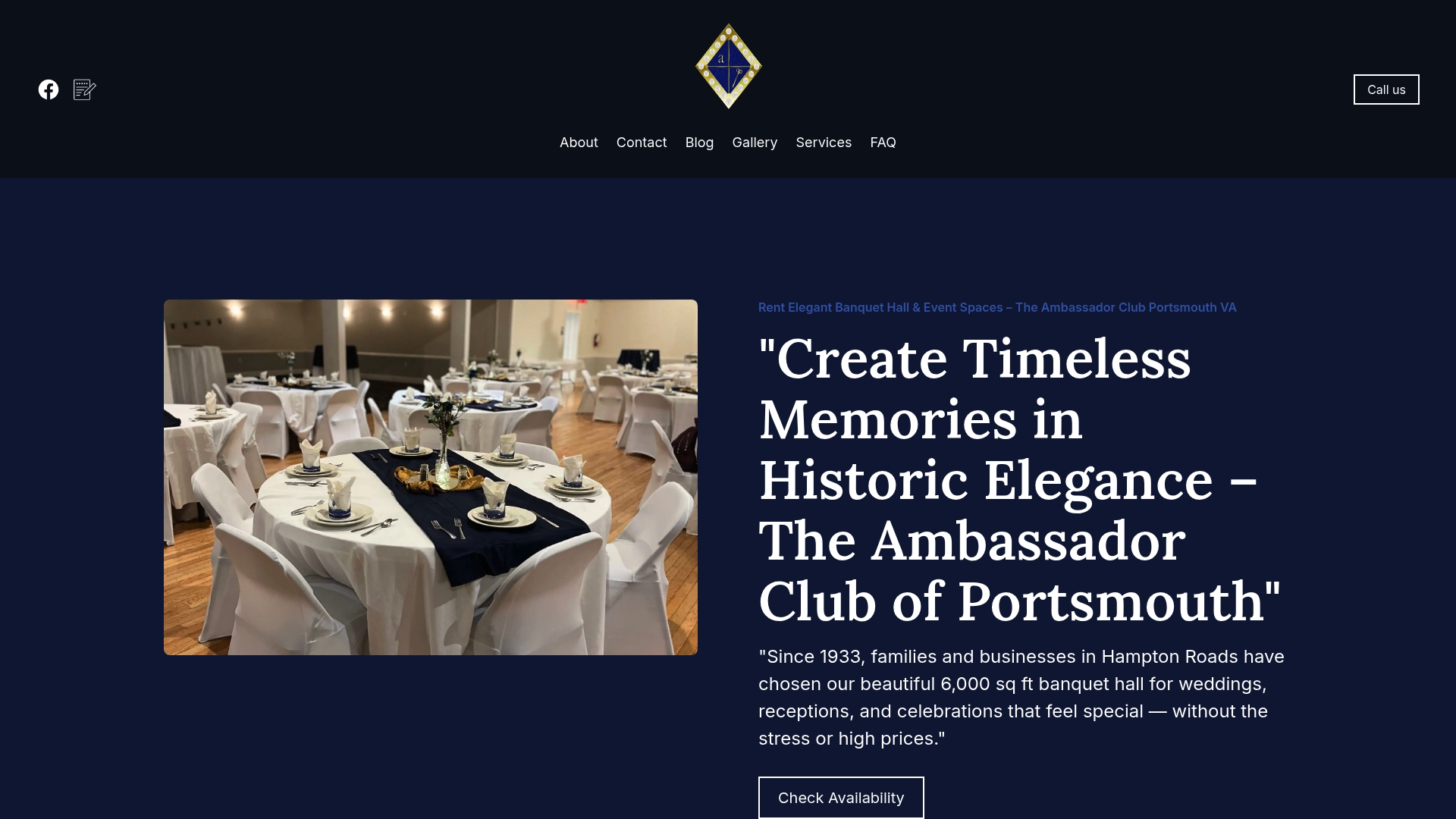
Ambassadorclubportsmouth has operated since 1933 in Portsmouth, VA, and its 6,000 sq ft hall includes a full commercial kitchen, tables, chairs, a dry bar, a dance floor, and a large projection wall. For planners working through the cost-saving tactics in this article, those inclusions mean your caterer arrives to a fully equipped space rather than pricing in mobile equipment, rental china, or setup labor. The venue accommodates up to 200 guests and offers flexible outside catering policies, so you retain control over your food vendor and menu choices.
For weddings, corporate events, memorials, or private celebrations, the included inventory directly reduces the line items your caterer needs to quote. Check available dates and included amenities to see how the venue's packages map to your event budget.
Useful sources and further reading
These are the primary references used throughout this article. Each covers a specific area of catering cost planning in more depth.
- Event catering on a budget — Skift Meetings: service-style cost comparisons and buffet vs plated analysis.
- What Is a Banquet Event Order (BEO) and Why It Matters — LegalClarity: guarantee mechanics and BEO contract structure.
- Affordable Catering Ideas for Event Planners — Eventbrite: headcount accuracy and alternative format cost ranges.
- 10 Cost-Saving Tips for Event Catering — BizBash: service style and labor guidance.
- Tips for Cutting Costs on Corporate Event Catering — Plan on a Penny: off-peak scheduling and package bundling tactics.
- How to Set a Catering Budget for Business Events — The Office Lunch: headcount planning and corporate catering budget frameworks.
FAQ
What is the single fastest way to reduce catering costs?
Negotiate the guest guarantee count and limit the bar to wine, beer, and one or two signature cocktails. These two moves typically produce more savings than any menu change.
Is buffet service always cheaper than plated?
No. Buffets require 15–50% more food to maintain appearance, which often erases the per-plate labor savings. Plated service with a 5–8% contingency buffer is frequently the lower total cost for formal events.
What BEO items are most negotiable?
The guarantee adjustment window, service charge breakdown, staffing minimums, and equipment rental fees are all commonly negotiable before signing. Ask for a 48–72 hour count adjustment window and a line-item service charge split.
How does venue selection affect catering costs?
A venue with an included commercial kitchen, tables, and bar removes rental and equipment line items from your caterer's quote. Ambassadorclubportsmouth includes all of these in its rental packages, which reduces total event spend.
When should I use passed appetizers instead of a buffet?
Passed appetizers work best for cocktail hours and receptions where you want to control consumption pace. They reduce waste compared with tray or table service because a server controls how much food circulates at any given time.