
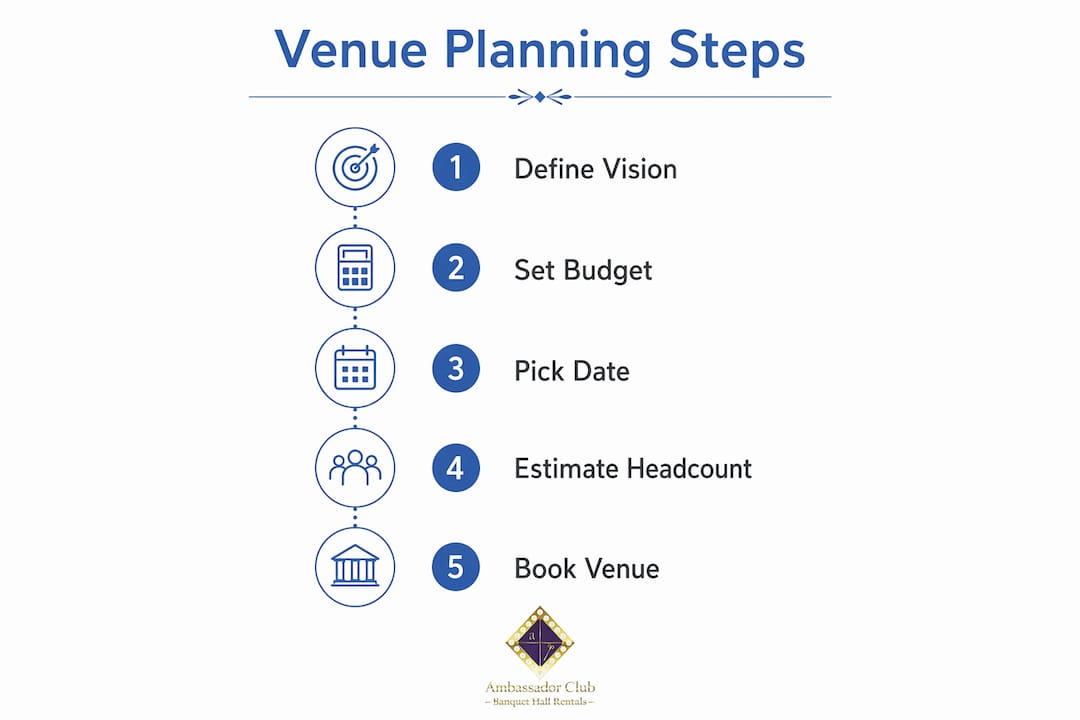
Start by defining the party vision, setting a budget, picking a date, estimating headcount, and shortlisting venues. Follow a chronological booking timeline to lock everything in before the best spaces fill up.
Here are the five things to do first:
- Define the vision: Who is this party for, what tone do you want, and what three things are non-negotiable?
- Set a budget: Decide the total number before you tour a single venue.
- Pick a tentative date and time: Give yourself two or three backup dates to stay flexible.
- Estimate headcount: Use the attendance rule: expect 70–80% of those invited to attend—if you invite 80, expect roughly 56 to 64 guests, but always book a venue that can hold the full invited number.
- Shortlist venues: Match each option against your vision and budget before scheduling tours.
Pro Tip: Write your five-step plan on a single index card and tape it somewhere visible. Every venue decision you make for the next six months should pass through those five filters.
Table of Contents
- What kind of party are you actually throwing?
- How much should you actually budget?
- When should you pick the date and book the venue?
- How does your guest count determine the venue you need?
- How do you evaluate and choose the right venue?
- When and how should you book caterers and other vendors?
- How do you plan decor without running over budget?
- When should you send invitations and manage RSVPs?
- What does a solid day-of timeline look like?
- What logistics do people forget until it is too late?
- What happens when things go wrong?
- Your chronological booking checklist from 6 months out to day-of
- How does a real venue hold up against the checklist?
- Key Takeaways
- The venue mistake most hosts make before they even tour a space
- The Ambassador Club is worth a look before you book anything else
- Useful sources
- FAQ
What kind of party are you actually throwing?
Before you compare venues or request quotes, you need a one-page event brief. Without it, you will tour spaces that look great but fail your actual needs, and you will waste time you do not have.
Your brief should answer four questions in plain sentences:
- Who: Age of the guest of honor, relationship to guests, any mobility or accessibility needs.
- What: Party type (kids' birthday, adult milestone, surprise party, casual backyard-style gathering) and the tone you want (relaxed, formal, festive, themed).
- Non-negotiables: Three things a venue must have or must allow. Common examples: a commercial kitchen, outdoor space, a specific capacity, or permission to bring outside catering.
- Rough budget: A single number, not a range. Ranges invite overspending.
Event planners consistently recommend writing this brief before scheduling any tours and rejecting venues that do not support the vision, regardless of aesthetics or price. That discipline is what keeps venue shopping from turning into an expensive detour.
The brief also drives downstream decisions. A kids' activity-zone party needs open floor space and easy restroom access. A formal adult dinner needs a room that flows from cocktails to seated service. A surprise party needs a venue with a back entrance or a staging area. Get the vision on paper first, and the right venue type becomes obvious.
Pro Tip: Share the brief with anyone helping you plan. A shared document beats a group text every time.
How much should you actually budget?
Set the total before you fall in love with a venue. Here is a realistic breakdown for three common party scales:
| Budget Category | Small (intimate gatherings) | Medium (mid-sized events) | Larger (large milestone events) |
|---|---|---|---|
| Venue rental | ranges lower for small gatherings, moderate for medium, and higher for large events | ||
| Food and drinks | expected to scale up with party size and formality | ||
| Decor | budget increases with event size and complexity | ||
| Entertainment | spend varies depending on event scale and requirements | ||
| Cake and desserts | allocation rises with guest count and customization | ||
| Rentals (tables, linens) | likely increase as event size grows | ||
| Contingency percentage typically recommended but exact amounts vary by event |
The contingency line is not optional. Venues routinely quote a base rental fee that excludes cleaning fees, security, overtime, and service charges. Always request a written line-item breakdown before you pay a deposit.
Hidden costs that catch hosts off guard:
- Cake-cutting fees (some venues charge per slice)
- Corkage fees if you bring outside wine or beer
- Mandatory gratuity added to catering totals
- Overtime charges if your event runs 15 minutes long
- Vendor corkage or "outside vendor" surcharges
- Security staffing required for events over a certain headcount
A lower base rental can easily become the more expensive option once these add-ons stack up. Compare total cost, not headline price.
When should you pick the date and book the venue?
Date and time are not just logistics. They affect venue availability, pricing, and how many guests actually show up.
Lead times by party size:
- Intimate gatherings (under 30 guests): Begin searching 3–6 months out.
- Mid-size events (30–75 guests): Start 4–6 months ahead; popular venues fill Saturday evenings fast.
- Larger milestone events (75–200 guests): Begin 6–12 months in advance, especially for 30th, 40th, or 50th birthdays that may involve out-of-town guests.
A few practical timing notes:
- Friday evenings and Sunday afternoons often cost less than Saturday nights at the same venue.
- Brunch and early-afternoon parties reduce bar costs and simplify staffing.
- Holiday weekends look appealing but reduce turnout and inflate vendor rates.
- Milestone birthdays that involve travel need 8–12 weeks minimum for guests to arrange logistics, so factor that into your save-the-date timing.
Lock the date before you send a single invitation. Changing a date after save-the-dates go out creates confusion and costs you RSVPs.
How does your guest count determine the venue you need?
Headcount is the single variable that most directly controls venue choice, layout, and food quantities. Get it wrong and nothing else works.

The math is straightforward. If you plan to invite 100 people, book a venue that holds 100, not 80. The 70–80% attendance rule is a reliable way to estimate turnout, so if you invite 100, plan for 70–80 to attend, but always book enough space for every person on your guest list. You cannot predict who will surprise you by showing up.
Translate your headcount into a layout type:
- Seated dinner: Needs roughly 12–15 sq ft per guest at round tables.
- Cocktail-style mingling: Can work at 8–10 sq ft per person with fewer chairs.
- Kids' activity zones: Require open floor space plus adult seating around the perimeter.
- Mixed layout (dinner + dance floor): Plan for 15–18 sq ft per guest to avoid a cramped feel.
For practical guidance on matching guest lists to room size, the venue size guide for family events walks through the math in detail.
Pro Tip: Add vendors, photographers, and any infants in arms to your capacity count. A room that fits 80 guests comfortably fits 75 when you account for a DJ setup, a photo booth, and a dessert table.
How do you evaluate and choose the right venue?
The goal is not to find a perfect venue in the abstract. The goal is to find the venue that fits your event with the fewest surprises. Score each candidate on five categories: capacity, location, included amenities, vendor restrictions, and total cost transparency.
What to observe during a tour
Visit every venue at the same time of day your party will occur. Lighting and ambient noise change by the hour, and a room that feels bright and quiet at 10 AM can feel dim and loud at 7 PM. Walk the load-in route, check the parking situation, and locate the restrooms relative to the main event space.
Specific things to note:
- Natural light and lighting controls (dimmers, uplighting options)
- Noise bleed from adjacent rooms, streets, or neighboring businesses
- Kitchen access and whether it is a prep kitchen or a full commercial kitchen
- ADA-accessible entrance, parking, and restrooms
- Flow from arrival to main space to restrooms and back
Questions to ask every venue in writing
- What is the maximum capacity for seated, standing, and mixed layouts?
- What is included in the rental fee (tables, chairs, linens, AV, staff)?
- How much setup and breakdown time is included, and what does overtime cost?
- Are there vendor restrictions for catering, DJ, florist, or balloon delivery?
- What are the cancellation and rescheduling terms?
- Is there a noise ordinance or end-time restriction?
- Who handles trash removal and post-event cleanup?
Location matters more than most hosts expect. A high-quality venue 45 minutes away will generally produce lower turnout than a convenient venue 15 minutes from most guests. Factor drive time and parking into your scoring rubric, not just the room itself.
Pro Tip: Ask the venue for a written list of every charge you might encounter. "Quoted rates often omit service charges, cleaning fees, security, and overtime," per venue selection guidance. Get verbal promises confirmed in writing before you pay the deposit.
When and how should you book caterers and other vendors?
Vendors book out faster than most hosts realize, especially photographers and DJs on Saturday evenings. Here is a practical hire window by vendor type:
- Photographer: 6–9 months out for milestone events; 3–4 months for smaller parties.
- DJ or live music: 4–6 months out; popular acts fill spring and fall weekends early.
- Caterer: 3–6 months out; confirm venue catering policies before you contact anyone.
- Rental company (tables, linens, specialty items): 2–3 months out.
- Cake or custom desserts: 6–8 weeks minimum; custom designs need more lead time.
Before you hire any vendor, confirm the venue's catering policy. Some venues require approved caterers or charge corkage and cake-cutting fees for outside food. A mandatory vendor list can eliminate your preferred caterer before you even ask. Check the venue's vendor policies early so you are not locked into options you did not choose.
Contract red flags to catch before signing
- Required-vendor lists with no pricing transparency
- Mandatory gratuity added to every catering invoice
- Vague overtime language ("additional fees may apply")
- No written cancellation or refund terms
- Insurance requirements that are mentioned verbally but not documented
Pro Tip: Coordinate vendor load-in times with the venue before you finalize any vendor contract. A caterer who needs two hours of setup time and a venue that gives you one hour of access is a conflict waiting to happen.
How do you plan decor without running over budget?
Focus decor spend on three high-impact areas: the entrance, the main table or dessert display, and one dedicated photo zone. Guests photograph those spots. Everything else is background.

Industry guidance recommends keeping decor to roughly 10–15% of your total budget and concentrating that spend on entrances and photo zones rather than decorating every surface. For a $3,000 party, that is $300–$450 on decor. Spend it where cameras point.
Before you order anything, check venue restrictions:
- Open flames (candles, sparklers) — many venues prohibit them outright
- Confetti and glitter — almost universally banned due to cleanup costs
- Wall mounting and ceiling installations — confirm what adhesives or hardware are allowed
- Balloon delivery windows — some venues restrict when outside vendors can access the space
Pro Tip: Order custom pieces (banners, signage, personalized favors) at least 4–6 weeks before the event. Same-day balloon installs need a confirmed access window with the venue at least two weeks out.
When should you send invitations and manage RSVPs?
Timing here directly affects your final headcount, which affects your caterer's order and your venue's room setup. Get the sequence right.
- Save-the-dates: Send 6–8 weeks before the event for local parties; 10–12 weeks if guests need to travel.
- Formal invitations: Send 3–4 weeks before the event.
- RSVP deadline: Set it 3–5 days before the event to give vendors final numbers without last-minute panic.
Digital RSVP tools like Evite, Paperless Post, or a simple Google Form automate dietary tracking and send automatic reminders to non-responders. That follow-up step matters. A significant portion of guests who intend to come simply forget to reply.
Pro Tip: Send a personal text or call to non-responders 48 hours before your RSVP deadline. Most will reply within the hour. Lock your vendor numbers the morning after the deadline, not the night before.
What does a solid day-of timeline look like?
A run sheet turns a chaotic morning into a manageable sequence. Build it at least two weeks before the event and share it with every vendor and helper.
Sample schedule for a 3-hour party (2:00 PM–5:00 PM)
- 11:00 AM — Venue access begins; decorators and rental delivery arrive.
- 12:30 PM — Caterer arrives; kitchen setup and food prep begin.
- 1:30 PM — Final walk-through with venue contact; confirm AV, seating, and access.
- 2:00 PM — Guests arrive; greeter at entrance, host circulates.
- 2:30 PM — Food service begins.
- 3:30 PM — Cake moment, photos, toasts.
- 4:15 PM — Cleanup begins; rental pickup scheduled.
- 5:00 PM — Venue handoff; final walk-through with venue manager.
Sample schedule for a 5-hour party (6:00 PM–11:00 PM)
- 3:00 PM — Venue access; DJ setup, decor install, caterer arrives.
- 5:00 PM — Final walk-through; confirm lighting, sound check, seating.
- 6:00 PM — Guests arrive; cocktail hour begins.
- 7:00 PM — Seated dinner service.
- 8:30 PM — Cake, toasts, dancing.
- 10:00 PM — Cleanup begins; vendors start breakdown.
- 11:00 PM — Venue handoff.
Assign four roles before the day arrives: a host liaison who communicates with the venue, a vendor lead who manages arrivals and setup, a greeter at the entrance, and a cleanup lead who tracks the breakdown timeline.
Pro Tip: Print two copies of the run sheet: one for you, one for the venue contact. A shared document on your phone is fine, but paper does not lose signal.
What logistics do people forget until it is too late?
Parking, AV, permits, and cleanup responsibilities are the four areas that generate the most last-minute stress. Confirm all of them in writing at least two weeks before the event.
Parking and arrival:
- Confirm the number of parking spaces and whether overflow lots are nearby.
- Arrange rideshare drop-off zones if the venue is in a dense area.
- For guests with mobility needs, verify accessible parking spots and the path to the entrance.
- If valet is required or expected, confirm who arranges and pays for it.
AV and power:
- Test every outlet you plan to use during your venue tour.
- Confirm Wi-Fi availability and password if you are streaming music or running a slideshow.
- Ask whether the venue provides a sound system or whether the DJ brings their own.
- Arrange power distribution strips or adapters for live music setups in advance.
Permits and cleanup:
- Check whether your city or county requires a permit for events over a certain headcount or for alcohol service.
- Confirm in writing who is responsible for trash removal and post-event cleanup.
- Ask whether the venue charges a cleaning fee or whether that is included in the rental.
Pro Tip: Walk the parking lot and entrance path yourself before the event. A loading zone that works for a delivery truck may block guest arrival. Catching that conflict a week early is far easier than managing it on the day.
What happens when things go wrong?
Every outdoor party needs a rain plan. Every event needs a vendor backup. Neither requires elaborate preparation, just a few confirmed answers before the event date.
Outdoor rain plan checklist:
- Is an indoor backup space included in the rental price, or does it cost extra?
- Does the indoor backup hold the same number of guests as the outdoor setup?
- What is the decision deadline for switching to the backup space?
- Who makes the call, and how will guests be notified?
Confirm these details in writing before you sign the outdoor venue contract. A verbal "we'll figure it out" is not a rain plan.
If a vendor cancels:
- Contact your backup vendor list immediately (keep two alternatives for caterers and DJs).
- Check your contract for the vendor's cancellation terms and any refund owed.
- Confirm whether the venue can recommend a replacement from their preferred list.
- Document all communication in writing for any deposit recovery.
Post-event tasks:
- Settle final invoices within 48 hours while details are fresh.
- Return rentals on the agreed schedule to avoid late fees.
- Send thank-you notes within one week.
- Run a brief debrief: what worked, what you would change, and any vendor you would book again.
Pro Tip: Keep a single notes document open on your phone during the event. Jot down anything that surprised you, good or bad. That 10-minute debrief note is worth more than a formal post-event meeting.
Your chronological booking checklist from 6 months out to day-of
Use this timeline as your master schedule. Adjust the windows based on your party size and whether you are planning a milestone event.
| Time Before Event | Key Actions |
|---|---|
| 6+ months | Write event brief, set budget, pick tentative dates, estimate headcount |
| 4–6 months | Tour and book venue, confirm catering policy, book photographer and DJ |
| 3–4 months | Send save-the-dates, book caterer, order custom cake, confirm vendor contracts |
| 6–8 weeks | Send formal invitations, book rental company, order custom decor and signage |
| 3–4 weeks | Follow up with non-RSVPs, confirm vendor arrival times with venue |
| 1–2 weeks | Finalize headcount, share run sheet with all vendors, confirm parking and AV |
| 2–3 days | Set RSVP deadline, lock final numbers with caterer and venue |
| Day-of | Execute run sheet, conduct venue walk-through, assign roles |
For milestone birthdays (30th, 40th, 50th), treat the timeline like a larger event and start at the 6-month mark regardless of guest count. Out-of-town guests need 8–12 weeks minimum to arrange travel.
Last-minute planning (under 6 weeks):
- Prioritize venue availability above everything else.
- Accept that some vendors may be unavailable; build a short list of alternatives before you start calling.
- Use digital invitations to compress the invitation-to-RSVP window.
- Simplify the decor plan to what you can source locally and quickly.
Pro Tip: For any event over 50 guests, budget-friendly venue options often have more availability on short notice than premium spaces. Check the benefits of budget-friendly venues before assuming you need to spend more to find something available.
How does a real venue hold up against the checklist?
Applying the scoring rubric to a specific venue makes the evaluation concrete. The Ambassador Club in Portsmouth, Virginia, is a useful example because it covers several common checklist requirements in one package.
Scoring the Ambassador Club against the rubric:
- Capacity: Accommodates up to 200 guests in a 6,000 sq ft hall, which covers most mid-size to larger birthday events.
- Catering flexibility: A full commercial kitchen on-site with flexible catering options, which eliminates the mandatory-vendor-list problem that drives up costs at many venues.
- Included amenities: Event packages that bundle key elements, reducing the number of separate vendor contracts to manage.
- Location: Portsmouth, VA, serving the Hampton Roads area, with accessible parking.
- Cost transparency: Competitive rates with packages designed to reduce surprise add-ons.
Contract items to verify with any venue before signing:
- Line-item fee breakdown (cleaning, security, overtime, kitchen use)
- Vendor restrictions and any approved-vendor requirements
- Rain plan details for outdoor or partially outdoor setups
- Insurance requirements for outside vendors
- Cancellation and rescheduling terms in plain language
For a deeper look at how venue types compare on amenities and restrictions, the banquet hall vs. event venue breakdown is worth reading before you finalize your shortlist.
Pro Tip: Visit any venue you are seriously considering at the exact hour your party will start. The room that looked perfect at noon may feel completely different at 7 PM when the lighting shifts and the adjacent event space fills up.
Key Takeaways
Locking a birthday venue starts with a one-page event brief, a firm budget, and a chronological booking timeline that begins at least 3–6 months before the event date.
| Point | Details |
|---|---|
| Start with five actions | Define vision, set budget, pick date, estimate headcount, and shortlist venues before anything else. |
| Use the 70–80% attendance rule | Expect roughly 70–80% of invitees to attend (for 80 invitations, plan on 56–64 guests), but always book a venue that holds the full guest list. |
| Budget for hidden costs | Request a line-item fee breakdown; cleaning, overtime, and service charges routinely add 10–15% to the base rental. |
| Book venues 3–6 months out | Intimate gatherings need 3–6 months; milestone events and larger parties need 6–12 months of lead time. |
| Ambassadorclubportsmouth as a venue option | The Ambassador Club in Portsmouth, VA, holds up to 200 guests in a 6,000 sq ft hall with a full commercial kitchen and flexible catering. |
The venue mistake most hosts make before they even tour a space
The most common planning error is not picking the wrong venue. It is touring venues before writing the event brief.
Hosts walk into a beautiful room, fall in love with the chandeliers, and then spend the next three weeks trying to make their party fit the space instead of finding a space that fits the party. The brief flips that dynamic. It takes 20 minutes to write and saves hours of backtracking.
The second mistake is treating the quoted rental price as the total cost. Cleaning fees, overtime, mandatory gratuity, and vendor surcharges are real and common. The contract review step is not bureaucratic caution; it is where the actual price of the venue becomes visible. Any venue that resists providing a written line-item breakdown before you pay a deposit is telling you something worth hearing.
The third mistake is underestimating how much location affects turnout. A stunning venue 45 minutes from most guests will produce a smaller, more tired crowd than a modest space 10 minutes away. Convenience is not a compromise. For most birthday parties, it is a feature.
The habit that fixes all three: write the brief, set the budget, then tour. In that order, every time.
The Ambassador Club is worth a look before you book anything else
Searching for a birthday party venue in the Hampton Roads area usually means choosing between spaces that are either too small, too expensive, or too restrictive on outside vendors. The Ambassador Club in Portsmouth, VA, has been hosting celebrations since 1933 and solves all three of those problems in one booking.

The hall is spacious and can accommodate mid-size to large birthday events effectively, which covers everything from a mid-size adult birthday dinner to a large milestone celebration. The full commercial kitchen means you are not locked into a mandatory vendor list or paying corkage fees on outside food. Flexible catering options and event packages keep the total cost predictable, which is exactly what the checklist in this guide asks you to confirm before signing anything.
To see whether the space fits your event brief, schedule a tour or request a booking packet directly at ambassadorclubportsmouth.com. Bring your rubric, your headcount, and your three non-negotiables. The venue either fits or it does not, and a tour will tell you in under an hour.
Useful sources
- Ultimate Party Decoration & Guest Management Checklist (2026) — Party Checklist — supports the 70–80% attendance rule, RSVP deadline guidance, decor budget allocation, and milestone lead times.
- 15 Critical Elements for Choosing the Perfect Party Venue (2026) — Party Checklist — supports venue lead times, line-item fee requests, and hidden cost warnings.
- How to Choose a Party Venue Before You Book — Celebrate.live (republished on Lemonvite) — supports the event brief framework, location-vs.-aesthetics trade-off, and venue scoring rubric.
- How to Plan a Birthday Party — Invyt blog — supports catering policy warnings, approved-vendor list risks, and contract red flags.
- Birthday Party Planning Checklist — PartyPilot — supports outdoor rain plan checklist and contract contingency items.
- How to Plan a Memorable Birthday Party — The H Center — general birthday party planning guidance and milestone event considerations.
- Five Tips for Throwing a Memorable Birthday Party — Central Park Place — practical tips on guest experience and celebration logistics.
- Vendor policies example — Cherrywood Ranch — illustrates how venue vendor lists work and what to confirm before signing.
FAQ
How do you plan a birthday party at a venue step by step?
Write your event brief first, then set a budget, pick a date, estimate headcount, and shortlist venues using a scoring rubric. Book the venue 3–6 months out, then hire vendors in order of demand: photographer, DJ, caterer, and rentals.
How far in advance should you book a birthday party venue?
Intimate gatherings need 3–6 months; mid-size events need 4–6 months; larger milestone celebrations need 6–12 months, especially when out-of-town guests are involved.
What questions should you ask a venue before booking?
Ask for a written line-item fee breakdown, confirm vendor restrictions and catering policies, clarify setup and breakdown time included in the rental, and get cancellation and overtime terms in writing before paying any deposit.
What is the 70–80% attendance rule for birthday parties?
The 70–80% attendance rule means you can typically expect 70–80% of those invited to actually attend; for example, if you invite 80 guests, anticipate 56 to 64 will show up. Always book a venue sized for your invited guest count.
How do you create a day-of timeline for a birthday party?
Build a run sheet that starts with vendor arrival and setup, moves through guest arrival, food service, and the cake moment, and ends with cleanup and venue handoff. Share it with every vendor and helper at least one week before the event.