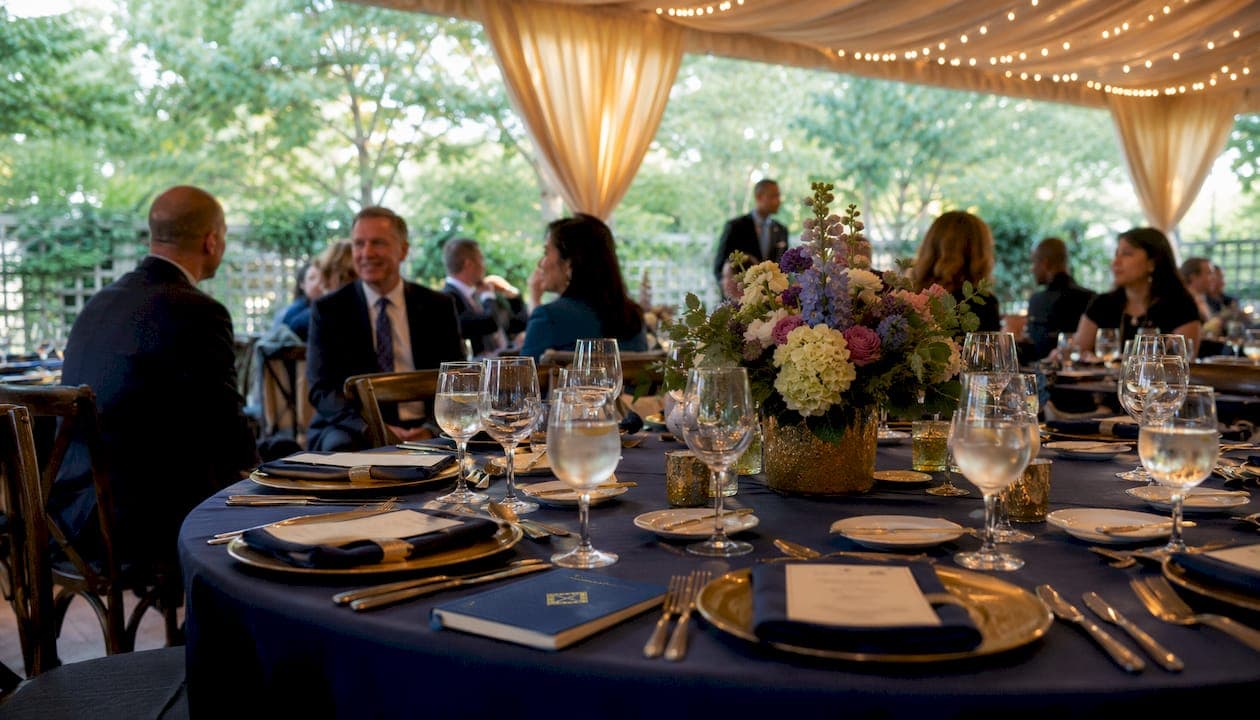
A company banquet dinner is a host-funded, structured evening event where employees, clients, or stakeholders gather for a formal or semi-formal multi-course meal paired with a timed program of speeches, awards, or presentations. The company covers the cost, assigns the seating, and drives the agenda. That last part is what separates it from a team dinner or a casual client lunch.
Companies hold them for a handful of recurring reasons:
- Awards and recognition nights honoring top performers or long-service employees
- Annual celebrations such as holiday parties or fiscal-year milestones
- Client entertainment aimed at deepening relationships or closing deals
- Fundraising galas where the meal is the vehicle for donor engagement
- Milestone announcements such as mergers, product launches, or anniversaries
The defining elements to check quickly: Is there a seated meal with a set menu? A timed program? Assigned seating? Company-paid tab? If yes to all four, you are looking at a corporate dinner event.
Table of Contents
- Why do companies hold banquet dinners?
- What formats work best for different company dinners?
- What does a typical company banquet dinner timeline look like?
- How do you plan a company banquet dinner step by step?
- What does a company banquet dinner cost in the U.S.?
- What is the right etiquette for a company banquet dinner?
- How should you align your venue and program flow?
- Common challenges during a banquet dinner
- What should you do after the banquet dinner?
- How do you choose and work with banquet vendors?
- Key Takeaways
- What planners consistently underestimate about banquet dinners
- Useful sources and further reading
- FAQ
Why do companies hold banquet dinners?
The strategic logic is straightforward. Business dinners build deeper professional connections than lunches precisely because no one is watching the clock to get back to the office. The Emily Post Institute frames evening meals as a premier relationship-building opportunity, and that holds whether the guest list is internal or external.
Beyond relationship-building, the goals split into two broad camps:
- Recognition and ceremony: awards galas, retirement dinners, tenure celebrations
- Revenue and relationship: client hospitality dinners, partner appreciation events, fundraising
The goal shapes everything downstream. A ceremony-driven event needs a tight script, a podium, and clear sightlines to a stage. A relationship-driven dinner needs round tables, a relaxed service pace, and enough white space in the program for real conversation. Getting this wrong is the most common planning mistake, and it shows up fast when guests are straining to hear a speaker across a noisy room or sitting through a 45-minute awards segment when they came to network.
What formats work best for different company dinners?
| Format | Best for | Key trade-off |
|---|---|---|
| Plated/seated banquet | Awards, ceremonies, formal client dinners | Highest cost per head; tightest timing control |
| Buffet | Large staff celebrations, casual milestones | Lower cost; harder to manage program flow |
| Cocktail reception | Networking, product launches, pre-dinner receptions | Minimal seating; guests may tire after 90 minutes |
| Hybrid (cocktail + plated) | Multi-phase events with networking then ceremony | Requires two room setups or a reset period |
| Dinner-and-dance | Staff rewards, holiday parties, milestone celebrations | Needs AV, DJ or band, and a dance floor footprint |
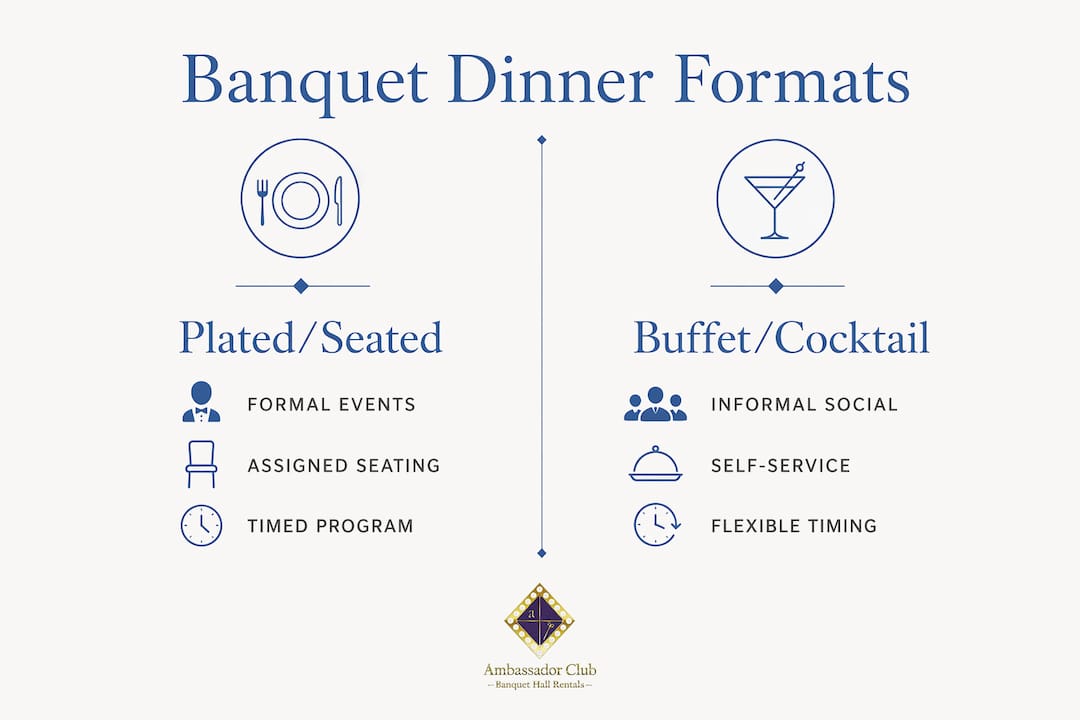
A cocktail-style dinner is more social and informal while a banquet is structured and ceremonial. Choose cocktail for networking; choose a seated banquet for awards and milestone recognition. The hybrid approach works well when you need both, but it adds logistical complexity and usually 30–45 minutes to the run time.
For guest counts above 150, a buffet or hybrid format often handles service better than a fully plated dinner. Below 80 guests, a plated banquet gives you the tightest control over timing and the most polished guest experience.
Pro Tip: If your program includes more than two speaker slots, go plated. Buffet lines and open bars create movement that competes with a microphone.
What does a typical company banquet dinner timeline look like?
A banquet dinner typically runs 2–4 hours, including both program segments and dining; the exact duration depends on the event format and content. Build a 10-minute buffer after the cocktail hour, as guests rarely move to their seats on cue.
How do you plan a company banquet dinner step by step?
Eight to twelve weeks out:
- Define the event's primary purpose and build the guest list from that goal
- Set a total budget with a per-person ceiling for catering
- Scout and book the venue; confirm capacity, kitchen access, and AV infrastructure
- Lock the date and send save-the-dates to key attendees
Six to eight weeks out:
- Finalize the menu with the caterer; collect dietary restrictions at RSVP
- Confirm AV and staging needs: microphones, screens, lighting cues
- Draft the seating plan and assign tables by role or relationship
- Send formal invitations with an RSVP deadline and dress code stated clearly
- Sign vendor contracts; confirm all-in pricing including service charges and taxes
Final week and event day:
- Distribute the run-of-show to every vendor and staff member
- Confirm headcount with caterer; adjust dietary counts
- Conduct a venue walk-through with AV technician and catering captain
- Designate one person as the program gatekeeper — the only one who can approve last-minute changes
- Have emergency contacts for every vendor on a single printed sheet
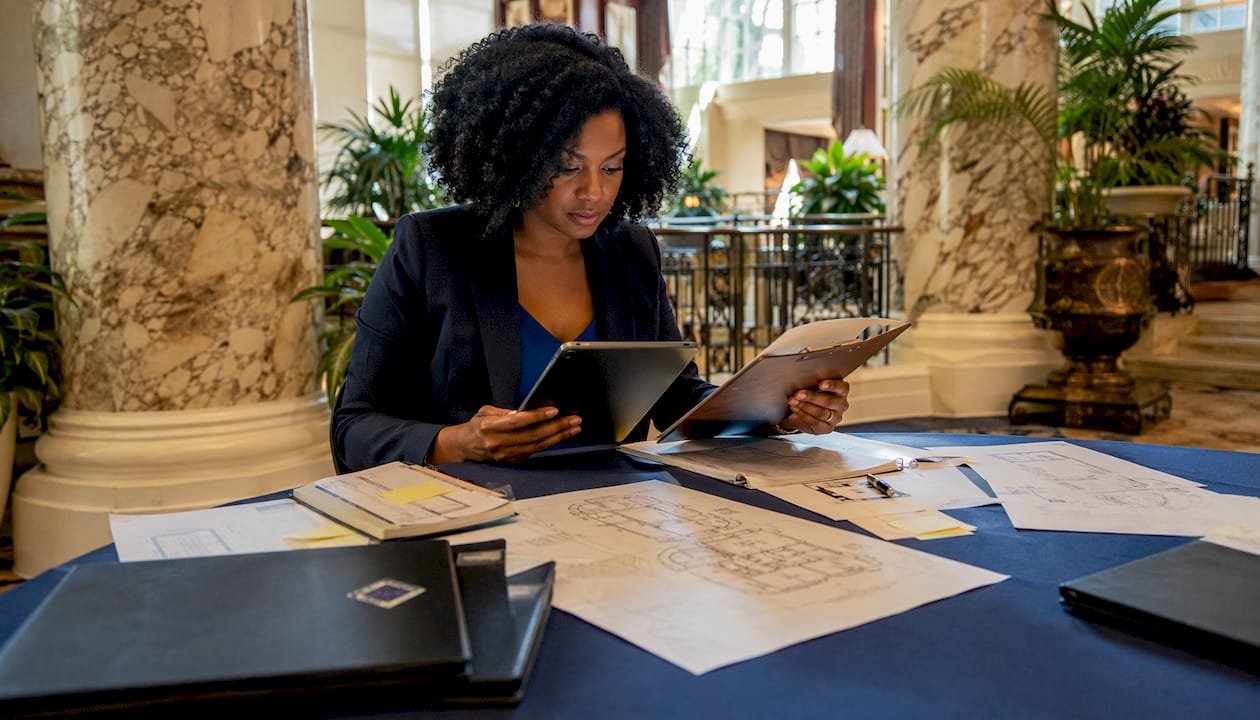
Venue choice signals company brand values; a room that is too casual or too noisy undermines the event's purpose before a single word is spoken. When you inspect a venue, check acoustics, sightlines, and staff flow, not just the photos on the website.
Pro Tip: Over-staff by one server per 15 guests for a plated dinner. The cost is modest; the difference in service pace is visible to every guest at the table.
What does a company banquet dinner cost in the U.S.?
Cost varies widely by market, format, and guest count. The primary budget lines to plan for:
- Per-person catering: plated dinners run higher than buffets; full-service venues often bundle this with the room
- Venue rental and minimum spend: many hotel ballrooms and event halls require a food-and-beverage minimum
- AV and staging: microphones, screens, and lighting can add meaningfully to the total, especially for larger rooms
- Staffing and service charges: most caterers add a service charge (commonly 18–22%) on top of the per-person rate
- Taxes and gratuities: factor these in from the start; they are not optional line items
- Decor and entertainment: clean tables and simple florals support the experience more than elaborate themes; good design keeps conversation and food at the center
A few practical rules: always ask vendors for all-in pricing rather than base rates. Build a contingency of at least 10% of the total budget for late RSVPs, last-minute dietary changes, or equipment rentals you did not anticipate. A buffet format typically costs less per head than a plated dinner, but the savings can disappear if you need additional staffing to manage the line.
What is the right etiquette for a company banquet dinner?
Dress code should appear on the invitation, not just the event website. The three most common codes for U.S. corporate events:
- Business formal: dark suits or tuxedos for men; formal gowns or cocktail dresses for women
- Cocktail attire: suits or sport coats; knee-length or midi dresses
- Business casual: slacks and a collared shirt; blouses and tailored pants
For hosts, the etiquette basics that get overlooked most often: welcome clients personally before the program starts, keep speeches under 12 minutes unless the event is specifically a keynote dinner, and manage the bar responsibly by offering non-alcoholic options with the same visibility as the wine list. Direct and simple communication about dietary restrictions is standard and professional at established venues; servers expect it.
For guests: RSVP by the deadline (a late RSVP genuinely disrupts catering counts), state dietary needs at registration rather than at the table, and keep phones off the table during the program.
How should you align your venue and program flow?
The single most impactful planning decision is matching your venue and service model to whether the night is relationship-driven or ceremony-driven. Event flow should align with the event's purpose: networking events need space for conversation, while ceremonies need a tightly timed program.
- Networking goal: round tables of 8–10, open floor plan, relaxed service pace, ambient music during dinner
- Awards/ceremony goal: theater-style or classroom rows for the program segment, clear sightlines to the stage, service paused during speaker slots
- Hybrid: designate a cocktail zone and a dining zone; reset the room between phases if the layout allows
Coordinate with your catering captain to pause service during every speaker slot. A plate arriving at the wrong moment is not just a distraction; it signals to guests that the program was not planned carefully. Test the microphone and room acoustics during the vendor walk-through, not five minutes before guests arrive.
Pro Tip: Ask the venue for a site visit at the same time of day as your event. Afternoon light and evening lighting are completely different rooms.
Common challenges during a banquet dinner
The problems that derail banquet dinners are almost always predictable. Late arrivals stretch the cocktail hour and compress the dinner service, which puts the kitchen under pressure and pushes speeches past the point when guests are still engaged. The fix is a hard call-to-seats time that the emcee enforces, not suggests.
AV failures are the second most common issue. A microphone that cuts out during an award presentation is embarrassing and hard to recover from. Always have a backup handheld mic tested and ready. Dietary mix-ups at the table happen when the catering captain does not have a seat-by-seat dietary map; build one and share it before service begins.
Program overruns are usually caused by speakers who were not briefed on their time limit. Give every speaker a written time allocation and assign someone to give a two-minute warning signal from the side of the room.
What should you do after the banquet dinner?
Send thank-you notes within 48 hours, personalized for clients and key guests. A generic mass email reads as an afterthought. For internal events, a brief all-staff message acknowledging the evening keeps the recognition momentum going.
Collect feedback within a week while the experience is fresh. A short survey (five questions or fewer) sent via email works well; ask about food, program flow, venue, and one open-ended "what would you change" question. That last answer is usually where the most useful planning intelligence lives.
For events with a business development purpose, follow up with any client or prospect conversations that started at the dinner. The relationship-building value of the evening depreciates quickly if no one follows through.
How do you choose and work with banquet vendors?
Start with caterers. Ask for a tasting before signing, confirm they have experience with your guest count, and get a written breakdown of every charge including service fees, overtime rates, and the cost of dietary substitutions. A caterer who cannot answer those questions clearly is a risk.
For AV technicians, the key question is whether they have worked in your specific venue before. Room acoustics vary dramatically, and a technician who knows the space will set up faster and troubleshoot better. For a venue size guide that helps you match room capacity to your program needs, that context matters when briefing any AV vendor.
Event planners earn their fee on logistics coordination, not just décor. The best ones have vendor relationships that get you better pricing and faster problem-solving on the day. Ask for references from events of similar size and format, and confirm they will be physically present for the full event, not just the setup.
Key Takeaways
A company banquet dinner succeeds when format, venue, and program flow are all built around the same clearly stated purpose.
| Point | Details |
|---|---|
| Definition | A host-funded, structured evening event with a seated meal, timed program, and assigned seating. |
| Format choice | Match format to purpose: plated for ceremonies, cocktail for networking, hybrid for both. |
| Timeline | Most banquets run 2–4 hours, including both program and dining; add a 10-minute buffer after the cocktail hour. |
| Budget planning | Ask for all-in vendor pricing and build a 10% contingency from the start. |
| Vendor coordination | Share the run-of-show with every vendor and test AV during the walk-through, not at showtime. |
What planners consistently underestimate about banquet dinners
The gap between a banquet that feels polished and one that feels chaotic is almost never the décor or the menu. It is the 20 minutes nobody planned for: the late table that holds up seating, the speaker who ran long, the dietary plate that went to the wrong seat. Those moments are invisible when they are handled well and unforgettable when they are not.
At Ambassadorclubportsmouth, the events that run smoothest are the ones where the organizer treated the run-of-show as a living document, not a formality. The 6,000 sq ft hall accommodates up to 200 guests, and the full commercial kitchen means catering coordination happens on-site rather than through a loading dock. That matters when a speaker runs 10 minutes over and the kitchen needs to hold a course without it showing.
One detail that has saved more than one event: a backup AV source staged and tested before guests arrive. A single handheld mic and a laptop with the presentation loaded on a second machine costs almost nothing to prepare and has rescued award segments that would otherwise have stalled in front of a room full of people.
If you are evaluating event spaces in Portsmouth, the combination of historic character, flexible layout, and in-house kitchen capacity is worth a site visit before you commit to a hotel ballroom.
Useful sources and further reading
- AnMeal: Understanding Corporate Dinners — best for definitions, duration guidance, and typical program structure
- Crafted Catering & Events: How to Plan a Corporate Dinner — best for flow alignment, staffing, and operational buffers
- Emily Post Institute: Business Meals — best for etiquette, relationship-building context, and host/guest conduct
- Cloudworks: Cocktail vs. Banquet Event — best for format comparison and choosing between cocktail and seated banquet
- ChooseMy.Food: Corporate Dinner Planning — best for venue selection, brand signaling, and site-visit checklist
- Talaera: Business Dinner Etiquette — best for dietary communication, alcohol service, and guest conduct
- Wikipedia: Banquet — historical and definitional context for the banquet format
- Ambassadorclubportsmouth: Banquet Hall vs. Event Venue — venue-type comparison for U.S. planners
- Ambassadorclubportsmouth: Elegant Banquet Hall Guide — aesthetics and amenities guidance for banquet atmosphere
FAQ
What does "banquet dinner" mean?
A banquet dinner is a formal or semi-formal group meal with a structured program, typically including speeches, awards, or presentations. At a company banquet, the employer funds the event and sets the agenda.
What is the difference between a dinner and a banquet?
A regular dinner is informal and unstructured; a banquet is organized around a timed program, assigned seating, and a specific purpose such as recognition or client entertainment.
What are the three main types of banquets?
The three most common formats are the plated/seated banquet, the buffet banquet, and the cocktail reception. Plated events suit ceremonies; buffets work for large casual gatherings; cocktail formats favor networking.
What do you wear to a corporate dinner?
Check the invitation for the stated dress code. Business formal means dark suits or gowns; cocktail attire means suits and knee-length dresses; business casual means neat slacks and a collared shirt or blouse.
How long does a company banquet dinner typically last?
A company banquet dinner usually lasts 2–4 hours, with the exact length determined by the number of program segments and courses.