
The fastest way to find a quality wedding venue on a tight budget: set your fully loaded venue budget first, lock in a guest-count range, then request itemized estimates from at least three venue categories before you tour a single property. Venue and catering typically represent about 25–30% of total wedding spend, so for a $30,000 wedding budget, you should plan to allocate $7,500–$9,000 for venue and catering combined before service charges. The Ambassador Club in Portsmouth, VA, is one example of a historic hall that fits that range while accommodating up to 200 guests. Industry standard service charges on food and beverage are a common budget surprise, so factor them in from day one.
Three actions to take this week:
- Pull your total wedding budget and estimate a portion as your venue ceiling, then subtract a buffer for service charges from that number.
- Request a fully itemized estimate for your exact guest count from at least three venue types (community hall, restaurant buyout, and a full-service hall). If a venue refuses to provide one before a tour, move on.
- Schedule three site visits and book a backup off-peak date at your top choice before you negotiate anything else.
Table of Contents
- How do you set a realistic venue budget and prioritize what matters?
- What are the most affordable venue types for a wedding?
- How do timing and search tactics lower your venue cost?
- What hidden fees and contract clauses blow wedding venue budgets?
- What should you ask at every venue tour?
- When should you book, and what deposit terms are standard?
- What does a realistic venue budget actually look like?
- How do you make a budget venue look high-end?
- Which tools and templates speed up venue vetting?
- What is the step-by-step venue selection process?
- Which contract clauses should you watch for?
- How do you maximize a budget venue within your timeline?
- How do you match venue size and style to your wedding vision?
- Key Takeaways
- What venue operators wish couples knew before they called
- The Ambassador Club, Portsmouth: historic elegance at a price that works
- Useful sources
- FAQ
How do you set a realistic venue budget and prioritize what matters?
Start with your total wedding budget and work backward. Venues, including catering, often consume a significant portion of total spend. If your all-in wedding budget is $25,000, plan to allocate $6,250–$7,500 for venue and catering combined before service charges. Write that number down before you open a single venue website.
Next, separate non-negotiables from nice-to-haves. Non-negotiables might include a minimum capacity for your guest count, an indoor backup option, ADA accessibility, or a location within 30 minutes of your ceremony site. Nice-to-haves are things like a bridal suite, a built-in dance floor, or a specific architectural style. Knowing the difference keeps you from falling for a venue that checks aesthetic boxes but fails on logistics.
Pro Tip: Request a fully itemized estimate for your exact guest count before you schedule any tours. Planners consistently report that couples who tour first and budget second end up emotionally attached to venues they cannot afford. The estimate forces a real comparison.
Run three guest-count scenarios before you start searching:
- Small (50–75 guests): Opens up restaurant buyouts, intimate historic halls, and garden spaces. Venue rental fees tend to drop significantly, and per-person catering costs are easier to control.
- Medium (100–125 guests): The most common range. Community centers, event halls, and mid-size hotel ballrooms become viable. This is where service charges start to matter most.
- Large (150–200 guests): Narrows your options considerably. Full-service halls and hotel ballrooms dominate. Per-person costs may drop slightly at scale, but rental fees and staffing costs climb.
Each scenario will shift which venue categories are realistic. Running all three before you tour means you walk into every conversation knowing exactly which scenario you are pricing.
What are the most affordable venue types for a wedding?
Public parks, community centers, and restaurant buyouts are among the most reliably budget-friendly categories. Here is a practical breakdown of each type, with the tradeoffs that actually affect your total cost.
- Public parks and gardens: Often the lowest rental cost, sometimes just a permit fee in the low hundreds. The catch: no climate control, noise ordinances, permit requirements, and you bring everything. Best for couples who want an outdoor ceremony and have a logistics-tolerant mindset.
- Community centers and municipal halls: Large indoor spaces with basic amenities at a fraction of hotel pricing. Most allow outside catering and have prep kitchens. The tradeoff is aesthetics; these spaces usually need significant décor work to feel wedding-ready.
- Restaurant private buyouts: Excellent value. You get a professional kitchen, wait staff, bar setup, and an established menu without renting a single table or chair. Best for guest counts under 100.
- Breweries and wineries: Increasingly popular for their built-in character. Many offer semi-inclusive packages. Watch for beverage minimums, which can quietly inflate the total.
- Church halls and religious spaces: Often the lowest-cost indoor option for members. Restrictions on outside alcohol and décor vary widely by congregation.
- Private residences and backyards: Eliminates the venue fee entirely, but rental costs for tents, tables, portable restrooms, and a generator add up fast. The true all-in cost of a backyard wedding typically runs $3,000–$8,000 once logistics are included.
- Farms and barns (off-peak): Photogenic and often priced lower in winter months. Most are dry-hire, meaning you coordinate every vendor separately.
- Municipal auditoriums and theaters: Underused option. Many cities rent these spaces at rates well below private venues, and the built-in staging and lighting can reduce your production costs.
Venues with inherent character, such as historic architecture or established gardens, reduce the need for extra décor and lighting. That savings compounds: less décor spend, fewer vendor hours, and a shorter setup window.
How do timing and search tactics lower your venue cost?
Date choice is your single biggest negotiating lever. Peak-season Saturdays in May through October command the highest rates at nearly every venue type. Shifting to a Friday evening, Sunday afternoon, or any date between November and March can unlock meaningfully lower rental fees or reduced food-and-beverage minimums.

Booking windows matter too. For a peak Saturday, venues in competitive markets fill 12–18 months out. Off-peak dates and weekdays are typically available 6–9 months before the event, which also gives you more negotiating room since the venue has more to gain from filling a slow date.
Pro Tip: When you send your first inquiry, skip "What is your rental fee?" and ask instead: "What is your total estimated cost for [guest count] guests on a Sunday in February, including all mandatory fees and service charges?" That single question filters out venues that hide costs and saves you from wasted tours.
Search tactics that actually work:
- Use Google with specific terms: "event hall Portsmouth VA 150 guests" beats "wedding venue near me" every time.
- Ask your photographer or caterer for referrals. They know which venues are easy to work with, which have hidden fees, and which are genuinely priced fairly.
- Check your city or county parks department website directly. Municipal parks and pavilions often rent for a fraction of private venue fees, and the listings rarely show up in venue search platforms.
- Filter venue platforms by total capacity first, then price. Sorting by base fee alone is misleading.
Negotiating for value-adds is almost always more productive than asking for a lower base fee. Venues protect their headline price but will often include extra hours, a complimentary rehearsal slot, or upgraded linens. Ask for those specifically.
What hidden fees and contract clauses blow wedding venue budgets?
The number on the brochure is rarely the number you pay. Hidden fees and vague contract language consistently push real venue costs 20–40% above the initial quote. Here is where the money goes.
Common hidden charges
| Fee Category | Typical Range | Notes |
|---|---|---|
| Service charge (F&B) | 20–25% of food & beverage | Confirm whether gratuity is included or additional |
| Administrative fee | $150–$500 | Often described vaguely; ask what it covers |
| Cake-cutting fee | $2–$5 per person | Applies when you bring an outside baker |
| Corkage fee | $10–$25 per bottle | Charged when you supply your own wine |
| Outside vendor surcharge | $100–$500 per vendor | Some venues charge for non-preferred vendors |
| Setup/breakdown fee | $200–$500 | Separate from rental; covers staff time |
| Overtime | $150–$500 per hour | Triggered by even a few minutes past end time |
| Security | $25–$50 per hour per guard | Often mandatory above a certain guest count |
| Parking/shuttle | Varies | Rarely included; can run $500–$2,000 |
| Event insurance | $150–$300 | Some venues require it; check your homeowner policy first |
Three questions to ask before signing
- "Can you provide a fully itemized estimate for [guest count] guests that includes every mandatory fee, service charge, and gratuity?"
- "What is your cancellation and postponement policy, and is any portion of the deposit refundable?"
- "Are there any vendor restrictions, and what is the surcharge for using outside caterers or bartenders?"
Contract red flags
- No itemized pricing. If a venue will only quote a package total, push back. Venues that resist itemized estimates often reveal hidden costs after you have signed.
- Vague cancellation terms. "Non-refundable deposit" is standard, but "all payments forfeited upon cancellation" is not. Look for partial refund language tied to rebooking.
- Required vendor exclusivity without price transparency. Exclusive caterer lists are common; the problem is when the venue will not share that caterer's pricing upfront.
What should you ask at every venue tour?
A structured checklist prevents the emotional haze of a beautiful space from clouding a bad financial decision. Use this on every call and site visit.
Phone screening questions (ask before scheduling a tour):
- What is your maximum capacity for a seated dinner?
- What is included in the base rental fee (tables, chairs, linens, AV)?
- Do you have an exclusive caterer, or can we bring our own?
- What is your service charge percentage, and does it include gratuity?
- What is your latest end time, and what is the overtime rate?
- Is event insurance required, and what is the minimum coverage?
On-site tour questions:
- Where does the ceremony take place, and what is the indoor backup if it rains?
- Where do vendors load in and out, and is there a freight elevator?
- How many restrooms are available, and are they ADA compliant?
- Is there a dedicated bridal suite or green room?
- What is the parking situation, and is there a shuttle option?
- What is the noise curfew, and are there sound restrictions?
Quick scoring template: Rate each venue 1–5 on five categories: budget fit, capacity, included items, location/logistics, and aesthetic. A venue that scores 4–5 on budget fit and capacity but 2 on aesthetics is almost always the better choice than the reverse. Matching venue size to your guest count is the single most practical filter in the whole process.
When should you book, and what deposit terms are standard?
For peak-season Saturdays, booking well in advance is common. Off-peak dates and weekdays generally have shorter booking windows, providing more flexibility. Waiting for a "better deal" on a Saturday in June rarely works; the venue fills before the discount appears.
Standard deposit expectations:
- Most venues require 25–50% of the total estimated cost to hold a date.
- Some charge a flat booking fee ($500–$1,500) separate from the rental balance.
- The remainder is usually due 30–90 days before the event.
Negotiation prompts for deposits and cancellation:
- "If we need to postpone due to circumstances outside our control, can we transfer the deposit to a new date?"
- "Is any portion of the deposit refundable if you rebook the date?"
- "Does your contract include force majeure language for government-mandated closures?"
Lock your vendors within two to four weeks of signing the venue contract. Your date determines your photographer's and caterer's availability, and the best ones fill quickly. Booking an event hall on an off-peak date also gives you leverage with vendors who prefer to fill slow weekends.
What does a realistic venue budget actually look like?
Venue costs vary dramatically by region. According to The Knot's 2026 Real Weddings Study, the national average venue cost is $12,900, with a median of $10,400. State averages vary widely, with community centers and church halls generally among the more affordable options, and hotel ballrooms priced higher on average.
Sample venue budget template: 100-guest wedding
| Line Item | Raw Space Estimate | All-Inclusive Estimate |
|---|---|---|
| Venue rental fee | — | $8,000 |
| Catering (food only) | — | Included |
| Service charge (20–25%) | — | Included |
| Table/chair/linen rentals | — | Included |
| Staffing/overtime | — | Included |
| Permits and insurance | — | Included |
The raw space looks cheaper at first glance. Once you add rentals, staffing, and permits, the all-inclusive option often wins on total cost. Building a side-by-side spreadsheet that includes every rental and staffing cost is the only reliable way to compare them. Confirm every line item directly with the venue and your caterer before treating any estimate as final.
How do you make a budget venue look high-end?
The venues that photograph best on a budget are the ones with built-in character. Historic architecture, established gardens, and distinctive permanent fixtures do the heavy lifting that décor dollars would otherwise cover. A venue with exposed brick, original woodwork, or a garden courtyard needs far less dressing than a plain community hall.
Practical styling tactics that keep costs low:
- Lighting first. String lights, uplighting, and candles are the highest-impact, lowest-cost upgrade available. An affordable lighting rental can significantly enhance the ambiance of a room.
- One statement installation. A single floral arch, a dramatic backdrop, or a styled sweetheart table draws the eye and photographs well without requiring full-room florals.
- Limit centerpiece variety. Choose one centerpiece design and repeat it. Mixing styles costs more and reads as inconsistent in photos.
- Batch rentals. Consolidate all linen, tableware, and furniture rentals through one local vendor to reduce delivery fees and setup time.
- Borrow locally. Candle holders, lanterns, and decorative items from friends or local Facebook groups eliminate shipping and rental fees entirely.
Pro Tip: Schedule your reception to end before 10 PM. Venues often charge overtime by the half-hour, and late-night staffing adds up. A 5–10 PM window covers cocktail hour, dinner, and dancing without triggering overtime.
Timeline choices reduce staffing costs too. A Sunday afternoon reception that ends by 8 PM typically costs less in venue overtime and catering staff hours than a Saturday night event running past midnight.
Which tools and templates speed up venue vetting?
A structured approach to your initial outreach saves hours of back-and-forth. Use these tools and templates to get comparable responses from every venue on your shortlist.
Useful platforms:
- Google Sheets or Excel for a side-by-side venue comparison (base fee, catering, service charge, rentals, total estimate per scenario)
- Your county or city parks department website for municipal rental listings and permit applications
- The WedStay wedding cost calculator for regional cost benchmarks by guest count and state
Initial inquiry message template:
Documents to request before touring:
- Full pricing menu or package sheet (not a summary brochure)
- Sample contract with cancellation and postponement terms
- Floor plan with dimensions and table layout options
- Preferred or required vendor list with contact information
If a venue cannot or will not provide these before a tour, that is useful information.
What is the step-by-step venue selection process?
A clear sequence prevents the most common and expensive mistakes.
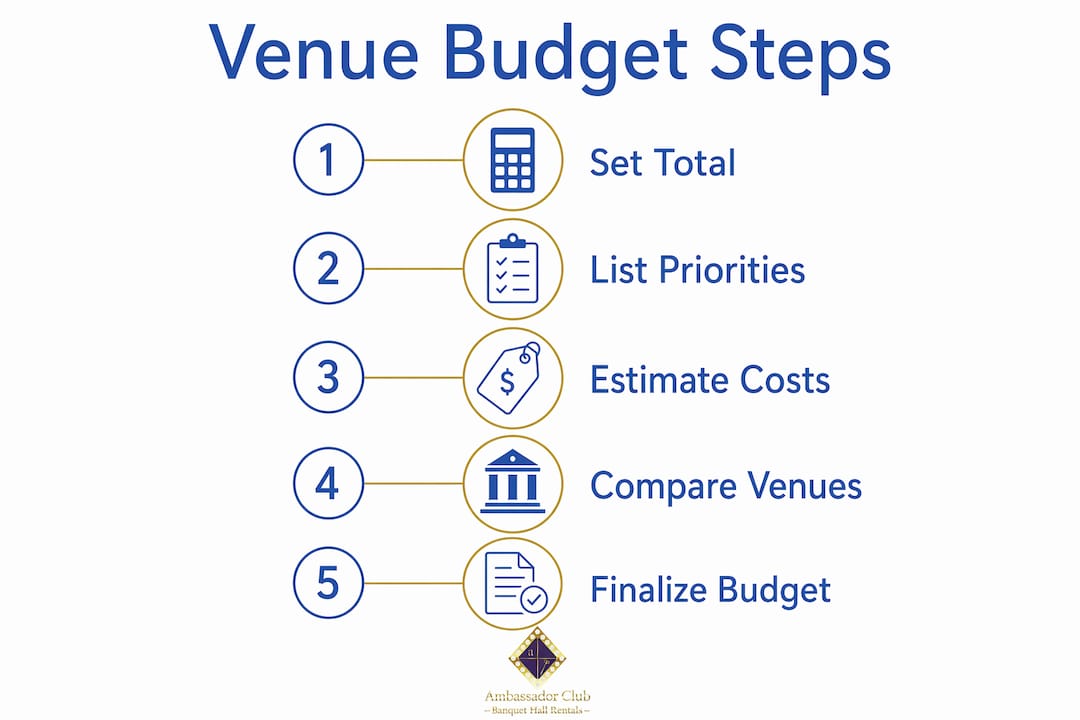
- Set your fully loaded venue budget. Calculate 25–30% of total wedding spend for your venue and catering budget, then subtract a 20–25% buffer for service charges.
- Fix your guest-count range. Run small, medium, and large scenarios. Your guest count determines which venue categories are even worth contacting.
- Build a longlist of 8–10 venues across at least three categories (community hall, restaurant, full-service hall, park).
- Send the inquiry template to every venue on your longlist. Eliminate any that will not provide itemized pricing.
- Score the responses using your five-category rubric (budget fit, capacity, inclusions, location, aesthetic). Shortlist your top three to five.
- Schedule tours only for shortlisted venues. Bring your checklist and score each one on-site.
- Build your side-by-side spreadsheet. Include every line item: rental, catering, service charge, rentals, staffing, permits, insurance, parking.
- Negotiate value-adds with your top choice before signing. Ask for extra hours, a rehearsal slot, or upgraded linens rather than a lower base fee.
- Review the contract for red flags: vague cancellation terms, no itemized pricing, mandatory vendor exclusivity without price transparency.
- Sign and pay the deposit. Lock your vendors within two to four weeks.
Which contract clauses should you watch for?
A few specific contract terms create outsized financial risk. Read every clause before signing, not after.
- "All payments are non-refundable." Standard deposits are non-refundable, but full payment forfeiture on cancellation is not standard. Push for partial refund language tied to the venue rebooking the date.
- "Venue reserves the right to adjust pricing." This clause allows the venue to raise catering minimums or service charges after you have signed. Strike it or cap the adjustment.
- "Client is responsible for all damages." Reasonable, but confirm whether the venue requires a separate damage deposit and what the claims process looks like.
- No force majeure clause. If the contract has no language covering government-mandated closures or natural disasters, add it before signing. Ask specifically about date-transfer rights.
- Exclusive vendor lists with no pricing disclosure. Required caterers and bartenders are common. The problem is signing before you know what those vendors charge. Request their pricing sheets before you commit to the venue.
- Vague overtime language. "Additional hours at venue discretion" is a blank check. The contract should state a specific per-hour rate and the exact trigger time.
How do you maximize a budget venue within your timeline?
Timing flexibility is the most underused cost lever available to couples. A venue that costs $3,500 on a Saturday in June may be available for $1,800 on a Sunday in January. That $1,700 difference funds your entire floral budget.
Specific moves that stretch venue value:
- Book a morning or afternoon slot. Many venues offer morning or afternoon time blocks at lower rates than full-day or evening bookings. A brunch reception or afternoon tea format works beautifully in a well-styled space and costs less in catering and staffing.
- Use the venue for both ceremony and reception. Eliminating a separate ceremony venue fee saves $500–$2,000 and simplifies guest logistics.
- Negotiate a longer setup window instead of a lower fee. More setup time means you can do more of the décor work yourself, reducing vendor hours.
- Ask about last-minute openings. Venues with cancellations sometimes offer significant discounts to fill a date. If your timeline is flexible, this is worth asking about directly.
- Off-peak months deliver the most consistent savings. January, February, and November are the slowest months at most venues. Weekday evenings in any month are the next tier down.
Venue location also affects your total spend in ways that go beyond the rental fee. A venue that is inconvenient for guests drives up transportation costs and can reduce attendance, which affects your per-person catering spend.
How do you match venue size and style to your wedding vision?
A venue that is too large for your guest count feels empty and requires more décor to fill. A venue that is too small creates discomfort and limits your vendor options. The right size is one where your guest count fills roughly 70–80% of the seated capacity, leaving room for a dance floor and vendor stations without feeling crowded.

Style alignment matters for budget reasons too. A rustic barn wedding in a hotel ballroom requires significant décor investment to bridge the gap. A modern minimalist wedding in a historic hall with ornate details fights the architecture instead of using it. Choose a venue whose existing aesthetic is at least 70% aligned with your vision, and you will spend far less on décor.
Formality level should match your guest experience goals. A casual backyard reception with lawn games and food trucks is a completely legitimate choice for the right couple. A formal seated dinner in a historic hall signals a different kind of celebration. Neither costs more or less by definition, but mismatching formality and venue creates a disconnect that no amount of styling fixes.
Historic venues are particularly effective for budget-conscious couples because the architecture does the decorating. Exposed beams, original woodwork, and period details photograph beautifully and require minimal supplemental décor.
Key Takeaways
The most effective approach to affordable venue selection is to calculate your fully loaded venue budget before touring, run three guest-count scenarios, and compare total costs across venue types using an itemized spreadsheet.
| Point | Details |
|---|---|
| Set a fully loaded budget first | Allocate 25–30% of total wedding spend to venue and catering, then subtract a 20–25% service charge buffer. |
| Fix guest count before touring | Running small, medium, and large scenarios prevents emotional attachment to venues that cannot fit your list. |
| Request itemized estimates upfront | Venues that refuse to provide itemized pricing before a tour are a red flag for hidden costs. |
| Compare total cost, not base fee | Raw spaces often match or exceed all-inclusive venue costs once rentals, staffing, and permits are added. |
| The Ambassador Club, Portsmouth | A 6,000 sq ft historic hall accommodating up to 200 guests with a full commercial kitchen and flexible catering options. |
What venue operators wish couples knew before they called
Most couples arrive at their first venue tour with a Pinterest board and a vague sense of budget. The ones who get the best deals show up with a specific guest count, a fully loaded budget number, and a list of questions about fees. That preparation signals to the venue that you are a serious buyer, and it changes the conversation.
The single biggest waste I see is couples falling in love with a space before they have confirmed it fits their guest count. A venue that seats 80 for a seated dinner is not going to work for 120 guests, no matter how beautiful it is. Confirm capacity for your specific layout (seated dinner with a dance floor, not just maximum occupancy) before you schedule a tour.
On negotiation: asking for a lower base fee almost never works. Asking for an extra hour of venue time, a complimentary rehearsal slot, or upgraded linens almost always does. Those concessions cost the venue very little and give you real value. Focus there.
The Ambassador Club in Portsmouth is a good example of what to look for in a budget-friendly full-service hall: a historic space with built-in character, a full commercial kitchen, and flexible catering options that let you control food costs without coordinating a dozen separate vendors. Venues like that reduce the number of moving parts, which reduces both stress and surprise costs.
The Ambassador Club, Portsmouth: historic elegance at a price that works
Couples who want a full-service hall without the full-service price tag should look at The Ambassador Club in Portsmouth, VA. The club has operated since 1933 and offers a 6,000 sq ft hall that accommodates up to 200 guests, a full commercial kitchen, and flexible catering options that let you bring your own caterer or work with the venue's preferred vendors.

What makes it practical for budget-focused couples is the combination of built-in character and included amenities. The historic architecture reduces décor spend, the commercial kitchen gives your caterer a professional workspace, and the comprehensive packages mean fewer surprise line items. For Hampton Roads couples comparing community halls and hotel ballrooms, it is worth requesting a fully itemized estimate to see how the total cost stacks up against your other shortlisted options.
To get started, contact the venue with your guest count, preferred date range, and a request for a fully itemized estimate that includes all mandatory fees and what is included in the rental. You can schedule a tour directly through the website.
Useful sources
- Wedding Venue Decision Guide for the Perfect Day — Venue budget allocation guidance and itemized estimate advice.
- How to Find an Affordable Wedding Venue — Planner-sourced tips on guest count, budget sequencing, and avoiding wasted tours.
- Cheap Wedding Venues Near Me — Category breakdowns for parks, community centers, restaurants, and negotiation tactics.
- Pix Wedding: Venue Cost and Comparison Tool — Side-by-side venue cost comparison methodology and raw vs. all-inclusive analysis.
- Pix Wedding: Wedding Venue Cost by Type and Region — National average venue costs, state-by-state ranges, and venue type pricing from The Knot's 2026 Real Weddings Study.
- WedStay Wedding Cost Calculator — Regional cost benchmarks by guest count and state.
- Tulle Together: Venue Comparison Template — Side-by-side venue comparison template and guidance on evaluating total cost vs. base fee.
- Your city or county parks department website for municipal pavilion rental rates and event permit applications.
- Your state's department of consumer affairs or attorney general's office for sample event contract language and consumer protection guidance.
Reminder: Keep a PDF copy of every itemized estimate and sample contract you receive. When you are comparing three or more venues, having the documents side by side is the only reliable way to catch discrepancies between what was quoted verbally and what appears in writing.
FAQ
How much of a wedding budget should go to the venue?
Venue and catering combined typically represent about 25–30% of total wedding spend. For a $30,000 budget, you should plan to allocate $7,500–$9,000 for venue and catering combined before service charges.
Is $5,000 a reasonable budget for a wedding venue?
Yes, in most U.S. markets. Community centers, church halls, restaurant buyouts, and municipal parks are among the most reliably budget-friendly options, often well below average venue costs, and some well-appointed historic halls offer competitive packages.
What is the 50/20/30 rule for weddings?
It is a general budget framework where roughly 50% of the wedding budget covers venue and catering, 20% covers photography and entertainment, and 30% covers everything else. It is a starting point, not a rule; your priorities should drive the actual allocation.
What is the 80/20 rule for weddings?
The 80/20 principle applied to weddings suggests that 80% of your guests' experience comes from 20% of your decisions, typically venue, food, and music. Spending more on those three and less on everything else is the most common planner recommendation for couples on a tight budget.
How do I avoid hidden fees when booking a wedding venue?
Request a fully itemized estimate for your exact guest count before touring, and confirm whether the service charge (typically 20–25%) includes gratuity or is charged separately. Review the contract for vague cancellation terms, mandatory vendor exclusivity, and open-ended overtime language before signing.