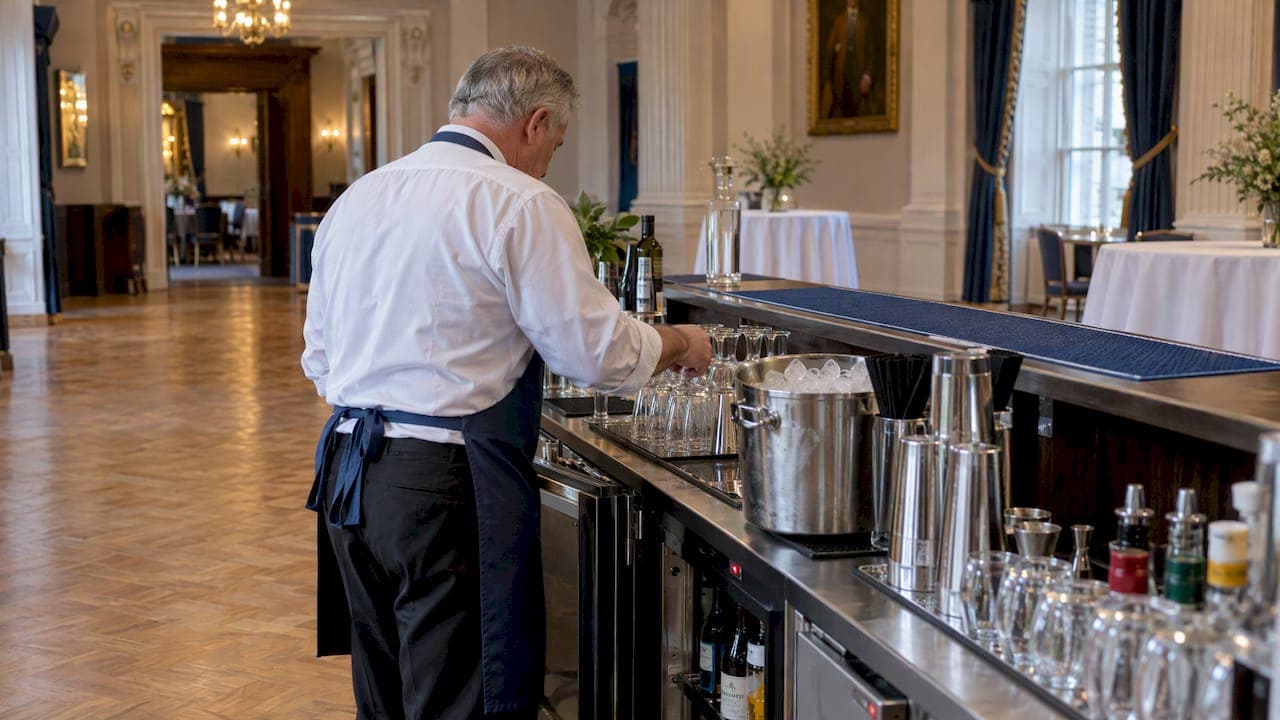
A venue's dry bar setup gives you a dedicated bar area with basics like glassware, ice staging, and pour tools, but it rarely includes the actual alcohol. Before you book, pull up the contract and check two things: the venue's outside alcohol policy and whether bartending staff and liquor-liability insurance are required. Those two lines determine your entire plan.
TL;DR:
- A dry bar setup provides the physical infrastructure but typically does not include alcohol, mixers, or specialty glassware, which must be supplied separately.
- Confirm whether the venue's outside alcohol policy applies to vendors and whether liquor-liability insurance and permits are required before booking.
- For a four-hour reception with 80 guests, plan for approximately 320 drinks, roughly requiring 21 bottles of wine and additional spirits and beer based on your menu.
- Choose between dry-hire, which saves costs by buying your own alcohol, and full-service, where the venue or vendor supplies alcohol and charges per drink.
- Proper planning includes a clear event timeline for setup, service, last call, cleanup, and ensuring sanitation and safety protocols, especially for self-serve setups.
Table of Contents
- What a venue dry bar setup typically includes
- Who provides what: dry-hire vs full-service and staffing options
- Permits, insurance, venue rules and safety to confirm before booking
- Host checklist: what to buy, quantities to estimate, and supplies to arrange
- Event timeline and run-of-show checklist for the bar
- Types of events suited for a dry bar setup
- How to design a functional and space-efficient dry bar layout
- Choosing the right equipment and barware for different drink styles
- Tips for drink recipes and menu planning for self-serve bars
- Health and safety considerations for self-serve alcohol setups
- A note from the venue floor
- How Ambassador Club packages simplify your dry bar setup
- FAQ
- Sources
What a venue dry bar setup typically includes
When a hall advertises a dry bar, you're getting the physical infrastructure for serving drinks, not the drinks themselves. Most venues provide a fixed or portable bar counter, a baseline set of glassware, ice staging or buckets, access to refrigeration, basic pour tools, and a small garnish and napkin station.
What's usually missing is the part that actually fills the glasses. Alcohol bottles, specialty glassware (think coupe glasses for a signature cocktail), and mixers are commonly left to the host or a hired vendor unless the venue's package explicitly says otherwise.
Sanitation details matter more than hosts expect. Venues typically require potable water access, a separate bin of ice reserved only for drinks, a dedicated scoop that never touches anything else, and a clear answer to who hauls out melted ice and empty containers at the end of the night.
Before you sign anything, confirm:
- Whether the bar counter is fixed in place or needs to be set up and broken down by your team
- What glassware is provided versus what you need to rent or bring
- Where the ice staging area is and whether it includes refrigeration
- Who supplies basic tools like shakers, jiggers, and bottle openers
- Who is responsible for removing drink ice and waste after the event
Who provides what: dry-hire vs full-service and staffing options
The biggest decision you'll make is between dry-hire and full-service bar arrangements, and it changes your budget significantly.
In a dry-hire setup, you buy the alcohol yourself and a bartending vendor supplies everything else: the bar structure, bartenders, mixers, ice, garnishes, glassware, tools, and insurance. This model is popular because it separates alcohol purchase from service, and buying retail from a store like Costco or Total Wine instead of paying venue markup on every pour tends to save hosts a meaningful amount compared to full-service pricing.
Full-service flips that: the venue or a contracted vendor supplies the alcohol and charges per drink or applies a markup. Some venues require this model outright, especially if their liquor license doesn't allow outside alcohol.
Either way, staffing details need to be nailed down in writing:
- Confirm the bartenders are TIPS-certified or carry an equivalent training credential
- Ask about bartender-to-guest ratios so service doesn't bottleneck during peak hours
- Clarify whether bartenders also handle bussing and restocking, or strictly pour
- Get the vendor's insurance certificate and check it against the venue's required coverage
Pro Tip: Ask the venue directly whether "outside alcohol" clauses apply to dry-hire vendors too, since some venues treat vendor-supplied bars differently from guest-brought liquor.
Permits, insurance, venue rules and safety to confirm before booking
Before you commit to a date, get these items in writing. Most venues require liquor-liability insurance, often with a $1 million minimum, naming the venue as an additional insured party. Venue bartending guidelines commonly specify a bar-readiness check before guests arrive, a last call roughly 30 minutes before the event ends, and no open containers in the final stretch of the night.
Permits are the part hosts forget. Depending on your venue and local jurisdiction, you may need a temporary permit or banquet license if alcohol is being sold, if the event is ticketed or open to the public, or if the venue lacks a standing liquor license. Ask early who is responsible for securing that paperwork, the venue or you.
Confirm in writing:
- Required insurance coverage amount and additional-insured language
- The approved bartender list and any credential requirements
- Last-call and cleanup timing
- Who handles potable water access, handwashing stations, and waste disposal
Host checklist: what to buy, quantities to estimate, and supplies to arrange
Once you know your service model, the shopping list comes down to guest count and event length. A conservative starting point is 3 to 5 drinks per guest for a four-hour reception, then converting that total into bottles with help from your bartending vendor.
Say you're hosting 80 guests for four hours. At a conservative 4 drinks per guest, that's 320 total drinks. A standard 750ml bottle of wine pours about 5 glasses, so if a third of your drinks are wine, you'd need roughly 21 bottles. The rest splits across beer, spirits, and mixers, and your vendor can refine those numbers once they know your bar menu.
- Alcohol bottles sorted by type (spirits, wine, beer) and labeled by category for transport
- A backup supply of water and non-alcoholic drinks for guests who aren't drinking
- Ice, if the venue or vendor doesn't supply it, plus a separate scoop for drink ice only
- Garnishes (citrus, olives, herbs) matched to your drink menu
- Disposable cups or extra glassware if your guest count exceeds what the venue provides
Add a 10% buffer on mixers and ice to cover spillage and last-minute requests, per dry-hire budgeting guidance. Label every box clearly (spirits, beer, wine, mixers) and stage them near the bar's refrigeration access so your bartending team can set up fast without hunting through unmarked boxes.
Event timeline and run-of-show checklist for the bar
A bar that runs smoothly follows a simple sequence, and it's worth writing into your event run sheet.
- Vendor arrives during the agreed setup window and completes a bar-readiness check before any guests arrive
- Service begins at the scheduled start time, with a clear plan for who restocks spare bottles and ice mid-event and where those supplies are staged
- Last call happens about 30 minutes before the contracted end time, giving guests time for a final pour
- Open containers are cleared in the final stretch, and cleanup and waste removal responsibilities are assigned before the event, not during it
Avoid asking bartenders to double as bussers mid-service. Coordinating a separate staff role for restocking and cleanup keeps the bar line moving and keeps pours accurate.
Types of events suited for a dry bar setup
A dry bar setup works across almost any event type where drinks are a secondary feature rather than the main event, which covers most of what fills a banquet hall calendar. Weddings and receptions are the most common use case, where a cocktail hour bar paired with efficient high-top placement keeps guests moving while the bridal party photos wrap up.
Corporate events lean on dry bars for networking mixers and holiday parties, often with a full-service model since company-hosted events typically carry stricter liability expectations. Birthday parties and anniversary celebrations tend to favor dry-hire, since hosts already have a guest list they know well enough to estimate drink preferences accurately.
Charity events and fundraisers benefit from a dry bar when a cash bar isn't permitted locally, since a flat-fee dry-hire vendor avoids the legal complications of selling individual drinks. Memorial gatherings and bridal showers often skip alcohol almost entirely, running the same bar setup with a mocktail-focused menu instead, which mobile bar vendors note they can execute with identical presentation and service standards.
The common thread across all of these is scale: a dry bar setup flexes from a 30-person shower to a 200-guest wedding reception using the same basic infrastructure, just with different staffing ratios and inventory.
How to design a functional and space-efficient dry bar layout
Layout determines whether your bar moves guests through quickly or creates a bottleneck at the worst possible moment. Start with placement: position the bar away from the main entrance so arriving guests don't create a crowd at the door, but close enough to the dance floor or seating area that it doesn't require a long walk.
Give the bar three functional zones: a pour station where bartenders work, a garnish and napkin station guests can reach without crossing behind the bar, and an ice and backup supply area kept out of guest sightlines. Keeping these separate prevents the bartender's workspace from getting cluttered during a rush.
For larger halls, consider a second small station during cocktail hour so the main bar doesn't absorb all the early traffic. If your venue offers AV coordination for power and refrigeration access, loop that into your bar placement conversation early, since extension cords running across a dance floor are both a safety hazard and an eyesore.
Leave enough clearance behind the bar for two bartenders to work without colliding, roughly 3 feet of workspace per person, and make sure the layout doesn't block fire exits or main walkways, since venue safety rules typically require clear egress regardless of floor plan creativity.
Choosing the right equipment and barware for different drink styles
Your bar menu should dictate your equipment list, not the other way around. A beer-and-wine-only bar needs minimal gear: wine openers, a few carafes, and enough glassware to avoid constant washing. Add spirits and cocktails to the mix, and the equipment list grows fast.
For classic cocktails, you'll want shakers, jiggers for accurate pours, a muddler, strainers, and a citrus press. Specialty drinks like a classic martini or an old fashioned benefit from specific glassware that many venues don't stock as part of their baseline dry bar amenity, so check what's included before assuming you're covered.

If your menu leans toward a signature cocktail or two rather than a full bar, you can simplify equipment needs significantly by pre-batching those drinks and serving from pitchers, which also speeds up service at a self-serve or lightly staffed bar.
Glassware is the detail most hosts underestimate. A venue's baseline set might cover standard wine and rocks glasses but skip coupe glasses, copper mugs, or champagne flutes. Vendors who specialize in barware and glassware can fill those gaps if your cocktail menu calls for something specific.
Tips for drink recipes and menu planning for self-serve bars
Self-serve bars work best with a short, intentional menu rather than an open bar with unlimited options. Three to five drinks, covering a spirit-based cocktail, a wine option, a beer selection, and a non-alcoholic choice, keeps the line moving and keeps your shopping list manageable.

Batch cocktails ahead of time whenever your menu allows it. A pre-mixed pitcher of a classic like a whiskey sour or a vodka lemonade lets guests serve themselves without needing a bartender present for every pour, which matters if your venue or budget doesn't support full staffing throughout the event.
Printed menu cards at the bar help guests understand their options at a glance and reduce the number of "what do you have?" questions your staff fields during a rush. Include a mocktail or two on the card even if most of your guest list drinks, since vendor guidance confirms alcohol-free options can run through the same setup with no difference in presentation.
Keep garnish and mixer quantities proportional to your drink menu rather than buying a little of everything. If your signature cocktail uses fresh lime, buy limes in bulk rather than splitting your citrus budget across four different garnishes you'll barely use.
Health and safety considerations for self-serve alcohol setups
A self-serve or lightly staffed bar carries more responsibility than a fully bartended one, since there's less oversight on individual pours. Sanitation basics matter here: potable water access, a strict separation between ice used for drinks and ice used to chill bottles or cans, and a dedicated scoop that never touches anything but drink ice.
Handwashing access near the bar area isn't optional from a food-safety standpoint, and wastewater disposal needs a clear answer before the event, not during cleanup. Assign these responsibilities in writing between the venue, the vendor, and your event staff so nothing falls through the cracks.
If your event skews toward a younger crowd or includes guests you don't know well, consider keeping at least one staffed checkpoint even in a self-serve setup, simply to watch for overserving. A last-call cutoff roughly 30 minutes before your event's contracted end time, paired with a clear point where open containers stop being refilled, gives your team a clean way to wind down service without an awkward confrontation at the door.
A note from the venue floor
Running events at a banquet hall with a full commercial kitchen has taught us one thing above all: confirm last-call timing in writing before the big day. It's the single detail that prevents an awkward scramble at the end of the night.
— MARTIN
How Ambassador Club packages simplify your dry bar setup
Booking a hall shouldn't mean guessing what's included at the bar. Our packages pair the dry bar amenity with kitchen access and coordination support, so you spend less time chasing down logistics and more time planning the event itself.

- Dry bar amenity included as part of event hall rental
- Kitchen access for flexible catering arrangements
- Coordination support and optional staffing add-ons available on request
Review our available event packages and start a booking conversation with our team today.
FAQ
What does a venue's dry bar setup actually include?
A dry bar setup typically includes a bar counter, baseline glassware, ice staging, refrigeration access, and basic pour tools. It usually does not include the alcohol itself, which is supplied by the host or a contracted bartending vendor depending on the venue's policy.
Is dry-hire cheaper than a full-service bar?
Dry-hire tends to cost less because you buy alcohol retail instead of paying venue markup on individual drinks, as outlined in dry-hire cost comparisons. The vendor charges a flat service fee for bartenders, equipment, and insurance instead.
Do I need a permit to serve alcohol at a rented hall?
It depends on your venue and local jurisdiction. A temporary permit or banquet license may be required if alcohol is being sold, the event is public or ticketed, or the venue lacks its own liquor license, so confirm with the venue early.
How much alcohol should I buy for a wedding reception?
A conservative estimate is 3 to 5 drinks per guest for a four-hour reception, then convert that total into bottles with guidance from your bartending vendor. Add a buffer of roughly 10% on mixers and ice to avoid running short.
Does the Ambassador Club provide a dry bar with its venue rental?
Yes, our event hall rental includes a dry bar amenity alongside full commercial kitchen access. Details on packages and coordination support are available on our services page.
Sources
- Bartending Company Guidelines- MJH
- Dry-Hire vs Full-Service Bartending | Cost Comparison | Heavy Pour
- Mobile Bar FAQ Metro Detroit | Sips & Co.
- Dry-Hire Mobile Bar | Greene Olives