
Most venues require a certificate of insurance showing general liability coverage, commonly at minimum levels around one million dollars per occurrence and two million dollars aggregate, with the venue listed as an additional insured. If alcohol will be served, expect a liquor liability requirement too. The moment you sign your rental agreement, contact your insurance agent and start the paperwork, since venues typically want that certificate in hand at least several weeks before your event.
TL;DR:
- Most venues require a minimum of one million dollars per occurrence and two million dollars in total coverage, with the venue named as an additional insured.
- Vendors and activity details such as alcohol service, high-risk entertainments, or equipment rentals often trigger additional insurance requirements and early disclosure deadlines.
- A certificate of insurance must be verified against the contract's specific wording, coverage limits, dates, and endorsements, with endorsement pages providing legally binding proof.
- Insurance paperwork should be initiated immediately after signing the contract, ideally at least 30 days before the event, to avoid cancellation or last-minute issues.
- Homeowners or renters policies typically do not satisfy venue requirements, making dedicated event liability coverage and proper endorsements essential for compliance.
Table of Contents
- What Does a Venue Typically Require for Event Liability Insurance?
- What Should You Check on a Certificate of Insurance Before Sending It?
- What Do Additional Insured and Waiver of Subrogation Actually Mean?
- What Special Requirements Come Up With Alcohol, Vendors, or High-Risk Activities?
- When Do You Need to Submit Proof, and What Happens If You Miss It?
- A Step-by-Step Checklist for Getting Your COI Right
- What Does a Historic Venue Actually Expect From Hosts?
- Event Liability Insurance vs. Venue Insurance Requirements: What's the Difference?
- How Does Venue Liability Insurance Protect Both Sides?
- What Do Event Liability Policies Typically Exclude?
- How Can You Verify a Policy Actually Meets Venue Requirements?
- Why Timing Beats Everything Else in This Process
- Ready to Book a Venue That Makes This Process Simple?
- Where to Verify Specific Insurance Wording
- Sources
- FAQ
What Does a Venue Typically Require for Event Liability Insurance?
General liability is the floor, not the ceiling. Nearly every venue contract sets a minimum, and $1,000,000 per occurrence with a $2,000,000 aggregate cap is the number you'll see most often, according to insurance guidance from LendControl. Upscale venues, or those hosting larger crowds, sometimes push that number higher, so read your contract's insurance clause word for word rather than assuming a standard figure applies.
Beyond the baseline, several other coverages come into play depending on what your event actually involves:
- General liability: covers bodily injury or property damage claims from guests or the venue itself.
- Liquor liability or host liquor coverage: required anytime alcohol is served or sold, whether by a licensed bartender or self-serve setup.
- Vendor insurance: caterers, bartenders, AV technicians, and rental companies typically need to carry and provide their own certificates.
- Damage to rented premises: covers accidental harm to the venue's walls, floors, or fixtures during your event.
- Commercial auto and workers' compensation: may apply if vendors bring trucks, generators, or paid staff onto the property.
Not every event needs every item on that list. A quiet daytime memorial service has a different risk profile than a 200-guest wedding reception with an open bar and a live band, and venues generally scale their requirements accordingly. The rental agreement for your event should spell out exactly which of these apply to your booking, so treat that document as your master checklist before calling your agent.
What Should You Check on a Certificate of Insurance Before Sending It?
A certificate of insurance, often shortened to COI, is your proof that coverage exists on paper. It is not the policy itself, and it doesn't change what your policy actually covers, a distinction Travelers explains clearly in its guidance on how certificates work. Before you forward a COI to any venue, run through this sequence:
- Confirm the named insured matches the person or business that signed the rental agreement, not a spouse, parent, or unrelated company.
- Check the coverage types listed against what the venue's contract requires, line by line.
- Verify the policy limits meet or exceed the contract's stated minimums, both per occurrence and aggregate.
- Match the effective and expiration dates to your actual event, including setup and teardown time, not just the hours guests will be present.
- Review the certificate holder box to make sure it lists the venue's exact legal name and mailing address.
Venues sometimes ask for the actual endorsement page rather than just the certificate, especially when they need to confirm additional insured status. That's a reasonable request. A COI summarizes coverage, but the endorsement is what legally extends protection.
What Do Additional Insured and Waiver of Subrogation Actually Mean?
These terms confuse almost everyone booking a venue for the first time, but the distinctions matter more than the jargon suggests. A certificate holder is simply the party receiving proof of your coverage. An additional insured is a different thing entirely: that party is actually added to your policy and gains direct protection if a claim arises from your event, a distinction VTM Miami walks through in its venue insurance overview.
Two other phrases show up constantly in venue contracts:
- Primary and noncontributory: this wording means your policy pays first on a covered claim, before the venue's own insurance gets involved at all. Venues like this because it keeps their premiums and claims history clean.
- Waiver of subrogation: this prevents your insurer, after paying out a claim, from turning around and suing the venue to recover that money. Some venues require it as standard practice; others only ask for it with higher-risk events.
Pro Tip: Not every insurance carrier issues primary and noncontributory language the same way, so ask your agent directly whether your policy supports it before you promise a venue you'll have it in place.
What Special Requirements Come Up With Alcohol, Vendors, or High-Risk Activities?
Certain event details trigger extra scrutiny from both venues and insurers. Alcohol is the most common trigger. If you're serving or selling drinks, plan on liquor liability or host liquor coverage, and expect your caterer or bartending service to carry their own certificate rather than relying solely on yours.
Vendors working on-site create a second layer of requirements:
- Rental companies delivering tables, linens, or staging often need to show a COI before they're allowed to load in.
- AV technicians, photo booth operators, and inflatable or bounce house vendors frequently carry their own general liability policies, and some venues require those vendors to name the venue as additional insured too.
- Confirm each vendor's certificate before the event, not the morning of.
High-risk elements deserve early disclosure. Pyrotechnics, live animals, or drone photography can require special endorsements, permits, or even a different insurance carrier altogether, so raise these details with your venue and agent as soon as you plan them, not after you've booked.
When Do You Need to Submit Proof, and What Happens If You Miss It?
Thirty days before the event is the deadline you'll encounter most often, a timeline reflected in municipal special-event insurance policies like Seattle's. Some venues push that window even earlier if your event requires a specific endorsement that takes time to process.
Missing that deadline carries real consequences. Venues have canceled bookings and kept deposits over late or missing paperwork, treating it as a breach of the rental agreement rather than a minor oversight. If anything changes after you submit your original COI, a new vendor, a policy switch, a canceled endorsement, send an updated certificate right away. A day-of insurance gap is the fastest way to have your event turned away at the door.
A Step-by-Step Checklist for Getting Your COI Right
Getting from "I signed a contract" to "the venue accepted my paperwork" takes four concrete moves.
- Pull the exact wording from your venue contract. Copy the venue's legal name, address, required coverage types, limits, and submission deadline word for word.
- Send that language to your insurance agent, along with your event date. Ask specifically for an additional insured endorsement and any other wording the venue requires.
- Review the COI PDF before forwarding it. Check the dates, limits, and certificate holder name and address against your contract one more time.
- Build a vendor folder. Collect every vendor's certificate in one place and confirm each one meets the venue's requirements before load-in day, a practice eWed Insurance recommends for exactly this reason.
Pro Tip: Name each file "EventName_VendorName_Date" so your folder stays organized even if you're juggling insurance paperwork for multiple vendors at once.
What Does a Historic Venue Actually Expect From Hosts?
Ambassador Club has hosted weddings, receptions, and community gatherings in Portsmouth since 1933, and that history has taught its team exactly where insurance paperwork tends to break down. The most common fix: start the COI process the day you sign your rental agreement, not the week before your event.
Provide your agent with the venue's exact legal name and your event dates, including setup and teardown, then submit your certificate by the stated deadline. For related planning details, the venue's rental guide covers additional contract logistics worth reviewing alongside your insurance requirements.
Event Liability Insurance vs. Venue Insurance Requirements: What's the Difference?
These two phrases get used interchangeably, but they describe different things. Event liability insurance is the actual policy you or your vendor purchases, either a standalone per-event policy or coverage under an existing annual policy, that pays out if someone gets hurt or property gets damaged during your event.
Venue insurance requirements are the rules a specific venue sets for what that policy must include before they'll let you through the door. One venue might accept $1,000,000 in general liability with no additional insured endorsement. Another might require $2,000,000, liquor liability, primary and noncontributory wording, and a waiver of subrogation, all for the same size event.
In other words, your policy is the product. The venue's requirements are the specification sheet that policy has to match. Confusing the two causes real problems: a host who assumes their existing renters or homeowners policy automatically satisfies a venue's requirements often discovers, too late, that it doesn't cover commercial events at all. Homeowners and renters policies typically exclude events where you're charging admission, serving alcohol commercially, or hosting more than a handful of guests.
That's why reading your venue contract's insurance section before shopping for a policy matters more than picking a policy first and hoping it fits. Whether you buy per-event coverage or rely on an existing annual policy depends partly on how often you host events, but either way, the venue's specific list of requirements is what determines whether that coverage actually clears the door.
How Does Venue Liability Insurance Protect Both Sides?
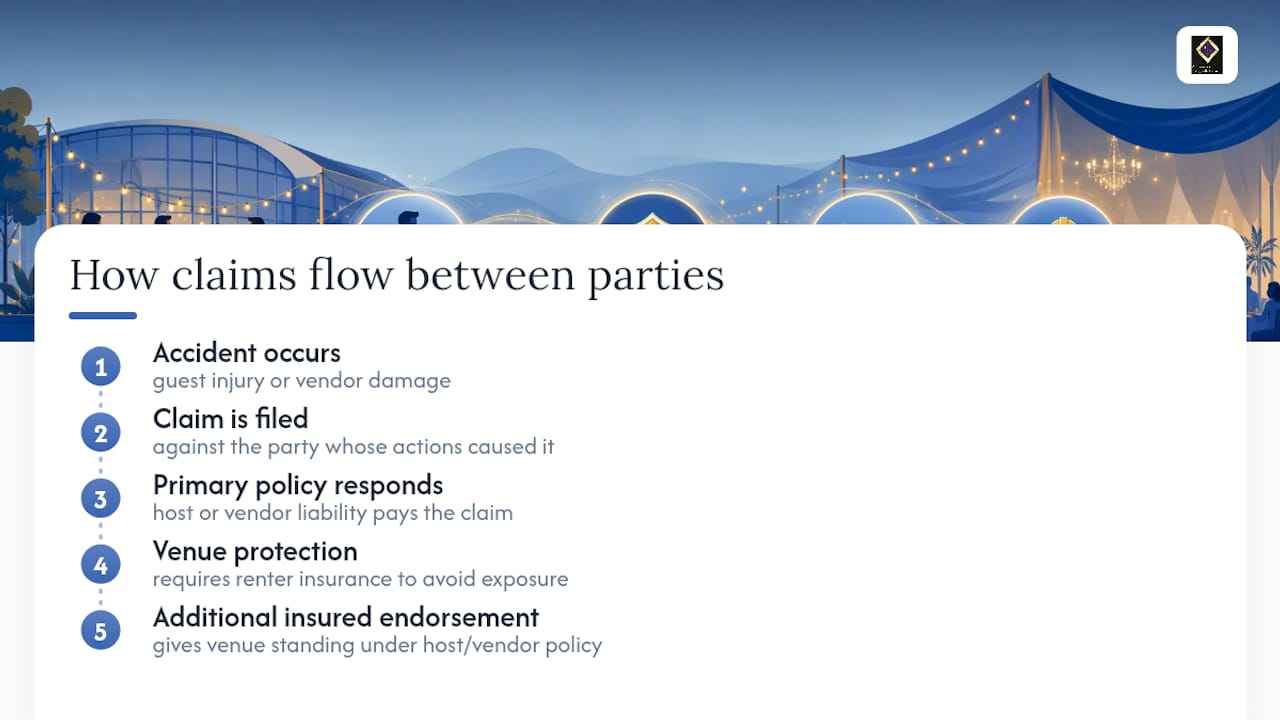
The protection runs in two directions, which is easy to miss when you're focused on just checking a box for the venue. For the venue owner, requiring proof of insurance from every renter means they're not left financially exposed if a guest slips on a dance floor or a vendor's equipment damages a wall. Without that requirement, the venue would be forced to rely entirely on its own policy for claims that had nothing to do with its own operations.
For you, the host, that same insurance requirement works as a shield. If a guest at your reception trips over a cord and breaks an ankle, your liability policy, not your personal savings, is what responds to that claim. Vendor insurance requirements extend the same logic one layer further: if your caterer's equipment causes a kitchen fire, their policy, not yours, should carry that risk.
This is also why additional insured endorsements matter so much to venues specifically. Being named as additional insured doesn't just give the venue a certificate to file away. It gives them actual standing under your policy if a claim touches both parties, which is a meaningfully stronger position than simply being a certificate holder. Insurance education resources from providers like Diamondback Insurance break down why general liability functions as the foundation venues build every other requirement on top of. When both sides carry appropriate coverage, a single incident doesn't turn into a lawsuit that drags on for years or a dispute over whose insurance should have paid first.
What Do Event Liability Policies Typically Exclude?
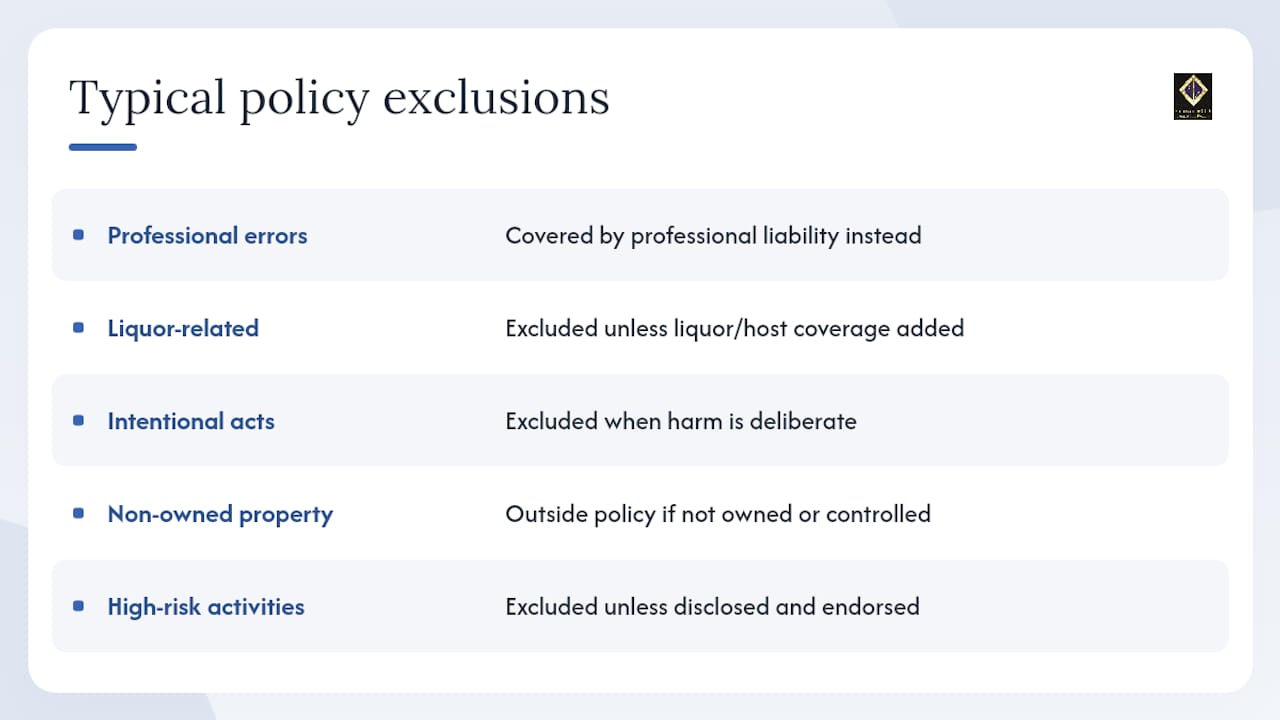
Every policy has boundaries, and knowing them before your event, not after a claim gets denied, saves a lot of frustration. General liability policies typically exclude professional errors, meaning if you hired a wedding planner or event coordinator and they gave you bad advice that led to a loss, that's usually a separate professional liability issue, not something your general liability policy touches.
Liquor-related claims often sit outside standard general liability too, unless you've specifically added liquor liability or host liquor coverage. This trips up more hosts than any other exclusion, because people assume "liability insurance" covers everything liability-related. It doesn't automatically include alcohol-related incidents.
Intentional acts are excluded across the board. If a fight breaks out and someone gets hurt because of deliberate action rather than an accident, most policies won't pay that claim. Property you don't own or control, like a neighboring building or a public sidewalk beyond the venue's boundary, typically falls outside your policy's scope as well, even if the incident happened during your event.
High-risk activities carry their own exclusion patterns. Pyrotechnics, certain motorized equipment, and some entertainment acts, like mechanical bull rentals, are frequently excluded unless you've disclosed them upfront and secured a specific endorsement. This is precisely why disclosing anything unusual about your event early matters. An exclusion you discover after signing your policy is far more expensive than a conversation with your agent beforehand.
How Can You Verify a Policy Actually Meets Venue Requirements?
Don't take a certificate at face value just because it looks official. A few verification steps catch the mistakes that cause rejections at the door.
Start by comparing the COI line by line against your venue's contract language, not your memory of what the contract said. Names get misspelled, addresses get typo'd, and dates get transposed more often than you'd expect, and venues frequently reject certificates over exactly these small mismatches rather than actual coverage gaps.
Call your insurance agent directly if anything looks ambiguous rather than guessing. Ask them to confirm, in writing, that the policy includes any additional insured endorsement, primary and noncontributory wording, or waiver of subrogation the venue requires, since a COI alone sometimes doesn't display every endorsement clearly.
If the venue allows it, ask to see the actual endorsement page rather than just the certificate summary. This single step resolves more disputes than any other verification method, because the endorsement is the binding language, while the COI is just a snapshot.
Finally, confirm your event dates on the certificate cover setup and teardown, not just guest hours. A policy that starts at 6 PM does you no good if your vendors are on-site building a stage at noon.
Why Timing Beats Everything Else in This Process
Every insurance headache I've seen traced back to one root cause: someone waited too long to start. The paperwork itself isn't complicated once you have the right contract language in hand, but agents need time to process endorsements, and venues need time to review what you send them.
Reach out to your insurance agent the same week you sign your rental agreement, not the week before your event. Keep every COI and vendor certificate in one shared folder labeled by event name, so nothing gets lost in a scattered email chain when the venue asks for confirmation at the last minute.
— MARTIN
Ready to Book a Venue That Makes This Process Simple?
If you're weighing your options after reading through all these requirements, Ambassador Club removes a lot of the guesswork that comes with newer or less established venues. Six thousand square feet of historic hall space, room for up to 200 guests, a full commercial kitchen, and flexible outside catering policies mean your insurance conversation stays straightforward instead of tangled up in unusual venue restrictions.

Since the club has operated in Portsmouth since 1933, its team has walked hundreds of hosts through exactly what a certificate of insurance needs to say and when it needs to arrive. Reach out to confirm the exact wording your policy should carry and the preferred way to submit it, then check available dates on the Ambassador Club booking page to lock in your event before your ideal date is gone.
Where to Verify Specific Insurance Wording
For city-specific rules, municipal special-event insurance pages, like Seattle's policies and compliance page, show how local governments structure their own insurance and permit requirements. Insurer resources on certificates and endorsements, along with practical industry breakdowns of venue insurance requirements, fill in the details your specific venue contract may not spell out.
Sources
- Seattle special-events insurance — policies and compliance
- Certificate of insurance — Travelers resources
- Event rental insurance: what venues require — LendControl
FAQ
Do I Need Wedding Insurance if the Venue Already Has Coverage?
Yes. The venue's own policy protects the venue's property and operations, not your liability as the event host, so you'll still need your own general liability coverage and a COI naming the venue as additional insured.
What Is a Typical Minimum Liability Limit Venues Require?
Most venues require a baseline of around one million dollars per occurrence and two million dollars aggregate, though some venues demand higher limits depending on guest count and event type.
How Far in Advance Should I Submit My COI to the Venue?
Submit your certificate at least 30 days before your event, since many venues, including municipal special-event programs, set that as their standard deadline.
What's the Difference Between a Certificate Holder and an Additional Insured?
A certificate holder simply receives proof of your coverage, while an additional insured is actually added to your policy and gains direct legal protection under it.
Does Ambassador Club Require a Specific Insurance Submission Process?
Ambassador Club asks hosts to begin the insurance process as soon as the rental agreement is signed and to submit the venue's exact legal name, event dates including setup and teardown, and required endorsements before the stated deadline.