
The single most important step: name one person (usually you, the host, or your designated event lead) who owns the Banquet Event Order (BEO) and confirms venue access with the caterer before anything else moves. Get that wrong and everything downstream drifts.
Three actions prevent most day-of failures in a catering workflow for large events:
- Confirm the BEO's final numbers 72 hours out and again at load-in.
- Hand every vendor a printed contact sheet with arrival windows and backup phone numbers.
- Walk the load-in path yourself, or have someone who has, before trucks arrive.
Venues that run large events routinely, including Ambassador Club, lean on a full commercial kitchen and a documented BEO process so ServSafe-trained staff and outside caterers work from the same plan instead of guessing at each other's assumptions.
Key Takeaways
A large-event catering workflow succeeds when one owner manages the BEO, the timeline runs backward from service start, and every role has a named backup contact.
| Point | Details |
|---|---|
| Assign one BEO owner | A single person should confirm and reissue the BEO after every change. |
| Build backward from service time | Fix the start time first, then set truck arrival and staging windows. |
| Measure the load-in path early | Check door widths and elevator size against your largest equipment before booking. |
| Match staffing to service style | Plated dinners need tighter ratios than buffets or stations. |
| Choose a venue built for this | Ambassador Club's commercial kitchen and 200-guest capacity remove common layout guesswork. |
Table of Contents
- At-a-Glance Checklist: What to Confirm and When
- Who Owns What: Venue vs. Caterer vs. Host
- Hour-by-Hour Timeline From Load-In to Cleanup
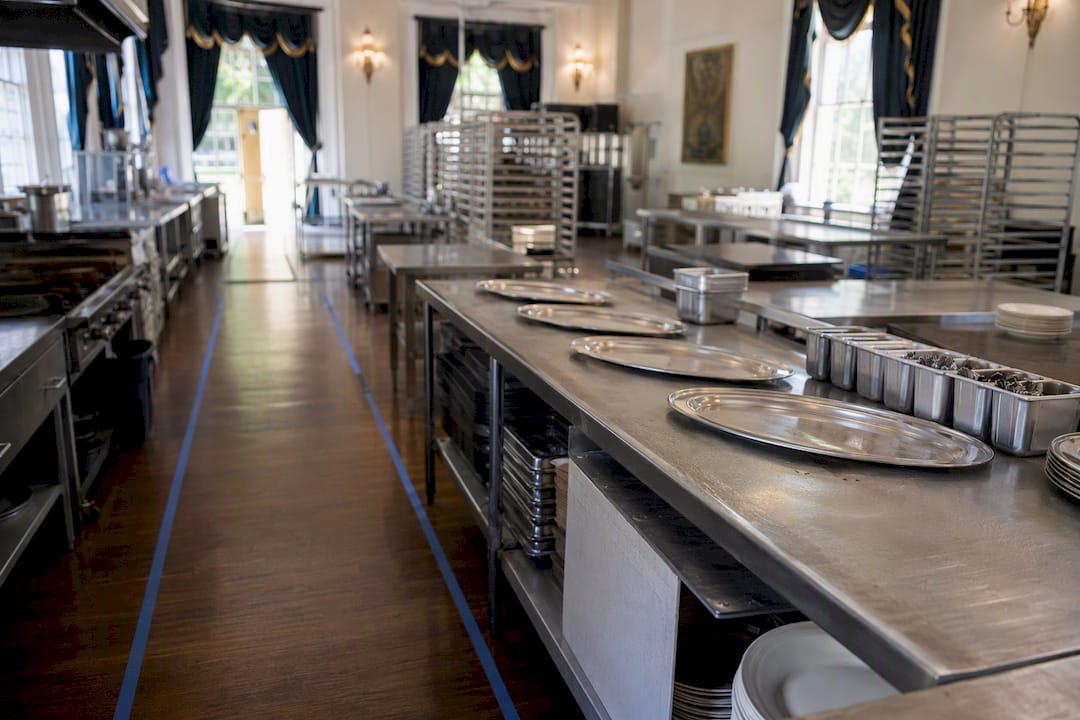
- Kitchen Access, Layout, and Staging Areas
- Load-In and Load-Out: Parking and Vendor Traffic
- Staffing Plan and Service Flow by Meal Style
- Food Safety, Temperature Control, and Allergy Labeling
- Contact Sheets, Walkthroughs, and Contingency Plans
- Reusable Checklist and Timeline Template
- Day-Of Problems and Quick Fixes
- Ambassador Club Simplifies Catering Coordination
- Sources
- FAQ
At-a-Glance Checklist: What to Confirm and When
A large-event catering workflow runs on deadlines, not vibes. Miss the guest-count cutoff, and your caterer is ordering blind; miss the elevator reservation, and your entrées sit cold in a hallway.
Work backward from three checkpoints:
- Three months out — lock the menu, confirm dietary categories, and finalize the BEO draft with the venue.
- Two weeks out — confirm final guest count, review the run sheet with both venue staff and the caterer, and secure any permits.
- 24 to 72 hours out — confirm delivery windows, service elevator reservations, and kitchen access times in writing.
Guest-count and menu changes ripple through ingredient orders, staffing, and equipment needs, so the event record needs version control, not a string of email replies nobody rereads. A reusable planning checklist helps you track which items are locked versus still open.
Who Owns What: Venue vs. Caterer vs. Host
Nothing wastes more time on event day than two people assuming the other one handled something. Split responsibility clearly, in writing, before the event.
Venue owns: access windows and door codes, utility hookups, HVAC and lighting, waste removal logistics, and security staffing.
Caterer owns: food production, kitchen staffing, temperature control from prep through service, allergy labeling, and returning rented equipment.
Host owns: final guest count, a written dietary-restriction summary, a single point of contact for VIP guests, and payment or gratuity arrangements if the venue package requires them.
A signed agreement should spell out exclusivity terms, referral arrangements, and how disputes get resolved, the same way convention centers and caterers formalize their partnerships to avoid friction at scale.
Pro Tip: Next to every task on your responsibility list, write a name and a backup name with a cell number. "Venue" and "caterer" are not contacts. A person answering a phone at 4 p.m. is.
Hour-by-Hour Timeline From Load-In to Cleanup
Start with your service time and work backward. If dinner starts at 6:00 p.m., that decision drives your truck departure time, not the other way around. Building the timeline backward from service start with real buffers for traffic and elevator waits is what separates a smooth event from a scramble.
A sample run of show for a 200-guest evening event:
- 1:00 p.m. — Truck arrives, staging begins at the loading dock.
- 1:30 p.m. — Equipment and cold items move to designated staging areas.
- 3:00 p.m. — Cook and finish work begins in the commercial kitchen.
- 5:00 p.m. — Final plating setup, chafers lit, bar stocked.
- 6:00 p.m. — Service begins.
- 8:30 p.m. — Dessert service and coffee.
- 9:30 p.m. — Breakdown starts as guests transition to dancing or closing remarks.
- 10:30 p.m. — Full load-out complete.
Buffer time matters most in three spots:
- Freight elevator waits, especially in multi-tenant or multi-event buildings.
- Security or ID checks at loading docks.
- Room changeovers if the same space hosts a ceremony and reception back to back.
Kitchen Access, Layout, and Staging Areas
Site visits exist to catch problems before they become event-day emergencies. Bring a tape measure, not just a checklist.
Confirm these on your walkthrough:
- Service entrance width and freight elevator dimensions, measured against your largest rental item.
- Distance from the loading dock to the kitchen and to the service floor.
- Available prep space versus what your caterer's crew actually needs.
- Refrigeration and hot-holding capacity inside the venue's kitchen.
- Designated zones for plating, waste, and staff breaks, kept separate from guest sightlines.
| Equipment or Zone | What to Confirm |
|---|---|
| Chafers and warmers | Power source location and outlet count |
| Pass-through window | Height and width match caterer's carts |
| Dish return point | Distance from dining floor to wash station |
| Waste staging | Separate from guest and photo areas |
Layout gaps like undersized staging or a narrow service corridor are exactly what a pre-booking venue walkthrough is meant to catch. A commercial kitchen checklist built for venue hosts covers most of this in one pass.
Load-In and Load-Out: Parking and Vendor Traffic
Multiple vendors arriving at once is how loading docks turn into gridlock. Stagger arrivals by 20 to 30 minute windows: florist, then AV, then catering, then rental drop-offs.
Confirm with the venue ahead of time:
- Truck size limits at the loading dock and any height restrictions.
- Whether parking or dock space is reserved or first-come.
- Overnight equipment hold policy if breakdown runs past close.
Pro Tip: If your venue serves multiple events on the same day, ask specifically about elevator scheduling conflicts. A double-booked freight elevator is the single most common cause of a delayed catering start.
Staffing Plan and Service Flow by Meal Style
Large-event staffing scales with service style, with seated dinners typically requiring more servers per table than buffets, where guests self-pace.
Core roles to plan for:
- On-site catering manager or captain, coordinating the kitchen and floor.
- Servers and bussers, scaled to your service style.
- Food runners, bridging kitchen and floor during peak service.
- Plated service needs the tightest staffing ratio and the most rehearsed timing since every course lands at once.
- Buffet service needs fewer servers but more attention to line replenishment and station monitoring.
- Stations spread guests out, which eases congestion but complicates AV cues since there's no single "everyone is seated" moment.
Keeping stations stocked through peak periods takes a tighter replenishment plan than plated service does. Reviewing how catering shapes the pace of business events helps when your event mixes formal remarks with open service.
Food Safety, Temperature Control, and Allergy Labeling
Hot food needs to stay at 140°F or above; cold food stays at 40°F or below. Confirm on-site that your caterer has a plan for holding both through the entire service window, not just at the start.
Ask specifically about:
- Allergy labeling on every station or buffet item, not just plated meals.
- A collected written list of guest dietary restrictions, passed to the caterer at least a week before the event.
- Confirmation that on-site staff carry current food-handling certification, such as ServSafe, and that any required temporary food permits are filed.
Standardized plating and station protocols keep quality consistent even when volume climbs past 150 or 200 guests.
Contact Sheets, Walkthroughs, and Contingency Plans
Everyone on site should carry the same contact sheet: names, roles, on-site cell numbers, backup contacts, and expected arrival windows for every vendor.
The BEO functions as your single source of truth. Reissue it after any change to guest count, menu, or timing, and confirm every party has the current version before the walkthrough. Large conferences that manage this well run a pre-event walkthrough and a run sheet or command center that tracks live issues as they surface.
Build in contingency items ahead of time:
- A small buffer of extra meals for last-minute headcount changes.
- An alternate plating plan if a rental item arrives damaged.
- Emergency supplier contacts in case of a delivery failure.
Reusable Checklist and Timeline Template
Adapt this framework to your own event rather than starting from a blank page:
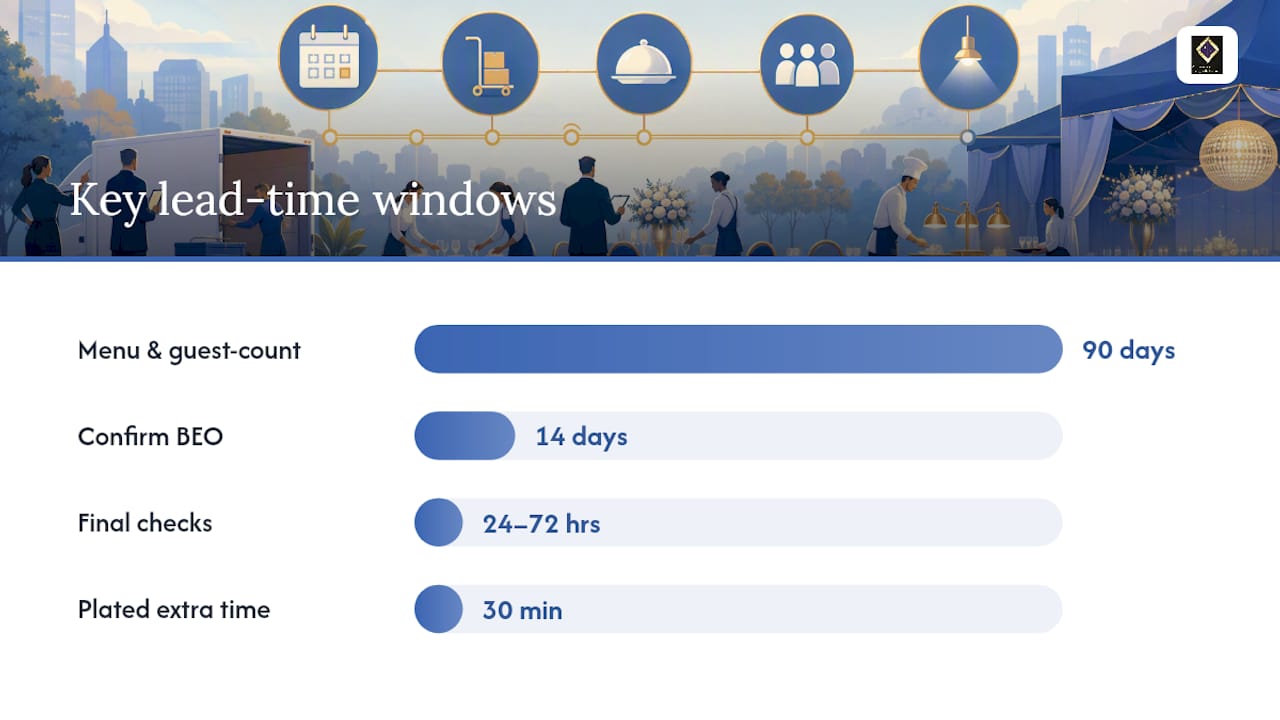
- Lock menu and guest-count deadlines 90 days out.
- Confirm BEO details 14 days out.
- Reconfirm delivery windows, elevator access, and kitchen hours 24 to 72 hours out.
- Walk the load-in path with your caterer before the event, not the morning of.
A sample timeline structure: truck arrival, staging, cook and finish, service start, dessert, breakdown. For a plated dinner, add 30 extra minutes to the plating window. For a wedding with a separate ceremony, add a full changeover block between events. Corporate dinners with a program or speeches need a fixed cue point built into the run sheet so catering doesn't collide with the agenda. A venue known for hosting large events with a documented process, like Ambassador Club's 6,000 sq ft hall and commercial kitchen, gives you a working example instead of a theoretical one.
| Point | Details |
|---|---|
| Fix service time first | Every other timeline decision, including truck departure, follows from this. |
| Reissue the BEO on any change | Guest count or menu changes should trigger a new version, not a side email. |
| Match staffing to service style | Plated needs tighter ratios; buffets and stations need stronger replenishment planning. |
Day-Of Problems and Quick Fixes
Late delivery, a staffing no-show, or a broken chafer will happen eventually. What matters is how fast someone decides and acts.
- Late delivery: Call the caterer's kitchen manager first, not the driver. Ask for a revised ETA and adjust the service start if needed.
- Missing equipment: Check the venue's on-site inventory before assuming a rental failure.
- Staff no-show: The catering captain should have a backup roster; escalate to the venue's operations contact if coverage runs short.
Escalation order: catering manager first, venue operations second, host's designated lead as the final decision-maker. Keep hot food moving and protect the VIP table's experience while back-of-house issues get resolved out of guest sightlines.
A Venue Host's Note: Lessons Learned From Running Large Events
The lesson that stuck with me: measure the load-in path yourself, and own the BEO personally rather than delegating it. Every serious delay I've seen traces back to one of those two things. A historic hall with a real commercial kitchen and room for 200 guests, like Ambassador Club's, makes this easier, but the discipline still has to come from someone.
Ambassador Club Simplifies Catering Coordination
Ambassador Club removes the guesswork that trips up most hosts coordinating outside catering: a full commercial kitchen already on site, flexible policies for bringing in your own caterer, and staff who have run this exact workflow for events up to 200 guests. Instead of negotiating kitchen access and layout with an unfamiliar space, you're working inside one built for it since 1933.
Expect standard fee items like a kitchen usage fee, cleaning charges, and possible overtime if your event runs past the booked window. If you're planning a large event and want a venue where the catering workflow is already worked out, check availability and packages at Ambassador Club.
Sources
For deeper reference, review service-entrance and load-in guidance, the step-by-step catering workflow breakdown, and a corporate catering timeline guide. For a venue with the layout and kitchen already sorted, see Ambassador Club's packages.
- How Convention Centers and Caterers Can Build Better Partnerships
- Catering Operations Workflow: Events, Orders, Menus & Staffing
FAQ
What Is a BEO in Catering Coordination?
A Banquet Event Order is the working document listing guest count, menu, timing, room setup, and staffing that both venue and caterer follow as the single source of truth.
How Far in Advance Should I Confirm Catering Details?
Lock the menu and guest-count estimate three months out, finalize numbers two weeks out, and reconfirm delivery and kitchen access 24 to 72 hours before the event.
Who Handles Equipment Return, the Venue or the Caterer?
The caterer typically owns returning rented equipment like chafers and serving pieces, while the venue handles waste removal and facility cleanup.
Does Ambassador Club Allow Outside Catering?
Yes, Ambassador Club offers flexible policies for outside catering alongside its full commercial kitchen, supporting hosts who want to bring in their own caterer for events up to 200 guests.
What Causes Most Delays in Catering Load-In?
Narrow service entrances, undersized freight elevators, and unstaggered vendor arrivals cause most load-in delays, which is why mapping the load-in path during a site visit matters.