
A catering coordinator is the operations manager for every food-service element at your event: the person who aligns your menu, vendors, venue logistics, staffing, and food-safety requirements so service runs on time and guests never notice the machinery behind it. Think of the role as a project manager for the entire food-service ecosystem, not a backup chef. The coordinator's central tool is the Banquet Event Order (BEO), a single document that locks in timeline, staffing, dietary notes, and loading schedules for every party involved. At a venue like Ambassadorclubportsmouth, with a full commercial kitchen and up to 200 guests, that kind of structured oversight is what separates a smooth reception from a chaotic one.
Key Takeaways
A catering coordinator is the operations manager for all food-service logistics at an event, and the BEO is the document that makes that management executable.
| Point | Details |
|---|---|
| Core definition | A catering coordinator aligns vendors, venue logistics, staffing, and food-safety requirements so service runs on time. |
| When to hire | Engage a coordinator when you have multiple food vendors, complex dietary needs, or an unconventional venue. |
| Top three responsibilities | BEO management, dietary restriction mapping, and on-site service supervision are the highest-impact duties. |
| Cost signal | Pricing models include flat fees, a percentage of catering spend, hourly rates, and multi-day retainers. |
| Hiring red flag | A coordinator who cannot describe a specific BEO process or name references from site-based events is a risk. |
Table of Contents
- What does catering coordination mean in practice?
- When should you hire a catering coordinator?
- How does a catering coordinator differ from other event roles?
- What does the catering coordination timeline look like?
- How is catering coordination priced?
- What skills and qualifications should you look for?
- What tools and templates does a coordinator use?
- How Ambassadorclubportsmouth uses catering coordination
- One thing most hosts get wrong about coordination
- Sources
- FAQ
What does catering coordination mean in practice?
Catering coordination is the discipline of managing all food-service logistics between a client, a venue, and one or more catering vendors. It covers everything from the first menu conversation to the final vendor invoice. The coordinator does not cook the food; that is the caterer's job. The coordinator makes sure the caterer, the venue, the rental company, and the service staff are all working from the same plan at the same time.
Core responsibilities include:
- Menu planning liaison: Translating client preferences and dietary restrictions into a workable menu with the chef or catering company
- Vendor coordination: Scheduling and communicating with every food-service vendor, from the main caterer to the cake supplier
- BEO creation and management: Drafting, versioning, and getting sign-offs on the Banquet Event Order
- Staffing plan: Determining server-to-guest ratios, scheduling setup crews, and briefing front-of-house staff
- Logistics: Mapping loading dock access, refrigeration needs, equipment placement, and waste removal
- Dietary restrictions mapping: Tracking individual guest needs and communicating them to each relevant station
- Food-safety compliance: Verifying that hot-holding temperatures, allergen protocols, and local health codes are met per FDA food-safety guidance
- On-site supervision: Running the service timeline from first course to last plate
- Breakdown and billing review: Confirming vendor invoices match the agreed scope after the event
The coordinator's scope stops at the kitchen pass. What happens inside the kitchen, including cooking technique and recipe execution, belongs to the caterer or executive chef. Core duties also include budget tracking and post-event evaluation, which is where the coordinator's project-management role becomes clearest.
Pro Tip: Map kitchen access routes and freight elevator schedules before you finalize the menu. A three-course plated dinner requiring hot transport from a basement kitchen to a third-floor ballroom needs a completely different service plan than the same menu served from an adjacent prep kitchen.
When should you hire a catering coordinator?
Not every backyard barbecue needs one. The role earns its cost when the event has complexity that a single caterer or venue contact cannot absorb alone. Catering services tie together staffing, equipment setup, service timing, food-safety management, and post-event cleanup; coordination is the layer that keeps those pieces synchronized.
Common use cases where a dedicated coordinator pays off:
- Weddings with multiple vendors (caterer, cake, bar service, late-night snack station)
- Corporate conferences requiring breakfast, lunch, and dinner across different rooms
- Multi-vendor festivals or charity galas with several food stations
- Multi-course plated dinners where timing between courses is critical
- Off-site or unconventional venues that lack in-house catering infrastructure, like historic halls or outdoor spaces
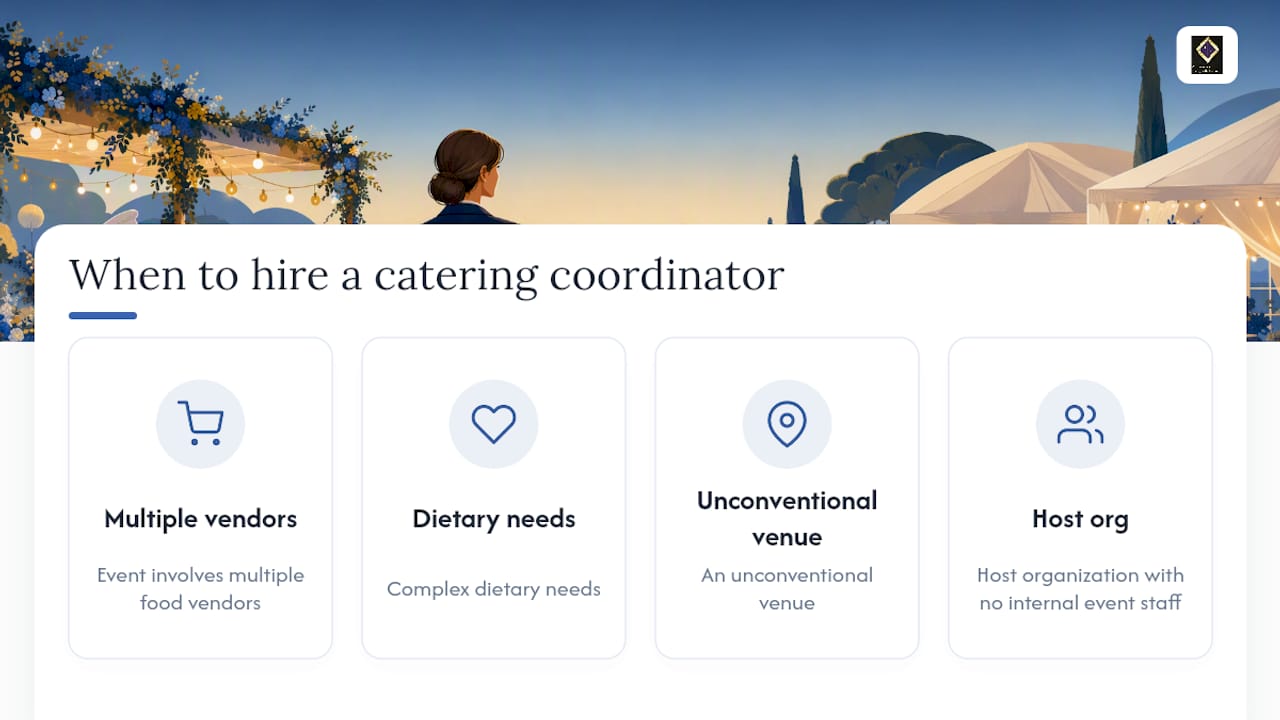
Hire a coordinator when you see three or more of these signals: multiple food vendors, complex dietary needs across a large guest list, an unusual venue layout, multi-day programming, or a host organization that has no internal event staff. The budget wedding venue selection guide from Ambassadorclubportsmouth shows how venue choice directly shapes the coordinator's scope.
How does a catering coordinator differ from other event roles?
Coordinators manage cross-vendor logistics, timeline alignment, and venue-specific compliance that caterers typically do not cover. The table below maps the four roles you are most likely to encounter.
| Role | Primary focus | Who hires them | Core responsibilities | When engaged | Typical billing |
|---|---|---|---|---|---|
| Catering coordinator | Food-service logistics end-to-end | Client or venue | BEO, vendor scheduling, dietary mapping, on-site supervision | 6–12 weeks out | Flat fee or % of catering spend |
| Caterer / catering company | Food production and delivery | Client | Menu execution, cooking, transport, basic setup | 8 weeks out | Per-head or package price |
| Event planner | Full event production | Client | Venue, décor, entertainment, overall timeline | 6 months out | Flat fee or % of total budget |
| Banquet manager | Venue's food-service operations | Venue | In-house staff, room setup, venue compliance | Assigned by venue | Salaried (venue employee) |
| Venue coordinator | Venue logistics and policies | Venue | Room access, AV, parking, vendor load-in rules | Assigned at booking | Salaried (venue employee) |
Key contract points to nail down in writing:
- Who owns the BEO and who has authority to approve changes
- Which role manages dietary restriction communication to each vendor
- Who is the single point of contact on event day for service timing calls
- Whether the venue coordinator's scope covers catering logistics or only room access
What does the catering coordination timeline look like?
| Timeframe | Key tasks |
|---|---|
| 12 weeks out | Initial needs assessment; venue walk-through; vendor shortlist |
| 6 weeks out | Menu finalization; dietary restriction collection; vendor contracts signed |
| 3–4 weeks out | Draft BEO circulated; staffing plan confirmed; equipment list locked |
| 1–2 weeks out | Final BEO sign-off; loading schedule confirmed; staff briefing scheduled |
| 48–72 hours out | Final walk-through; confirm refrigeration, power, and waste arrangements |
| Event day | Coordinator on-site 2–3 hours before guests; staff brief; service supervision |
| Post-event | Breakdown supervision; vendor invoice review; post-event debrief |
Confirming kitchen access, power, refrigeration, and waste arrangements early is one of the most effective ways to prevent day-of delays. A final coordination meeting with all vendors 48–72 hours before the event, using a single agreed communications channel (group message or two-way radios), cuts real-time confusion significantly.
Day-of checklist for the coordinator:
- Confirm all vendor arrival times and check them in at load-in
- Walk staging areas and verify equipment placement matches the BEO diagram
- Brief service staff on course timing, dietary flags, and emergency contacts
- Verify hot-holding temperatures before first service
- Confirm plate timing with the kitchen for each course
- Monitor service flow and adjust staffing positions as needed
- Supervise breakdown and confirm all rental equipment is accounted for
How is catering coordination priced?
Pricing varies widely by market, event complexity, and the coordinator's experience level. Four common billing models:
- Flat fee: A fixed amount for a defined scope, common for single-day events with one primary caterer; typical for weddings and corporate dinners
- Percentage of catering spend: Usually 10–20% of the total catering contract; scales naturally with event size
- Hourly or day rate: Common for shorter engagements or day-of coordination only; rates vary by market and experience
- Retainer for multi-day events: A monthly or project retainer for conferences or festivals that span several days
The main cost drivers are guest count, the number of vendors to coordinate, venue complexity (a historic building with a freight elevator is harder to work than a purpose-built banquet hall), required food-safety certifications, and total on-site supervision hours. Practical strategies for controlling catering costs can offset coordinator fees when applied early in the planning process.
What skills and qualifications should you look for?
Core skills for a catering coordinator:
- BEO creation and version control
- Timeline and project management
- Food-safety knowledge (ServSafe certification is a common baseline in the U.S.)
- Vendor negotiation and contract review
- Clear written and verbal communication
- Familiarity with event management software (Tripleseat, Planning Pod, or similar)
Sample job description clause: "Seeking a catering coordinator to manage all food-service logistics for events of 50–200 guests. Responsibilities include BEO drafting and sign-off management, dietary restriction mapping, vendor scheduling, staffing supervision, and on-site service oversight. Preferred qualifications: ServSafe certification, two or more years of event catering coordination, demonstrated BEO experience, and strong vendor negotiation skills." A full responsibilities template is available from Workstream.
Interview questions to ask:
- Walk me through how you build and version a BEO for a 150-person plated dinner.
- How do you handle a vendor who arrives late on event day?
- Describe how you map dietary restrictions across multiple food stations.
- What is your process for confirming kitchen access and load-in logistics with a venue you have not worked before?
- How do you communicate service timing to kitchen and front-of-house staff simultaneously?
Red flags to watch for: no documented BEO process, inability to name specific vendors they have coordinated, vague answers about dietary restriction handling, and no references from site-based events.
What tools and templates does a coordinator use?
Essential tool categories:
- Event management software: Tripleseat, Planning Pod, or Cvent for BEO creation, guest lists, and vendor communications
- Dietary mapping tools: A shared spreadsheet or dedicated software that tracks each guest's restrictions and maps them to specific stations
- On-site communications: Two-way radios or a dedicated group messaging thread; one channel, agreed in advance
- Equipment and inventory checklists: A line-item list of every piece of rental equipment tied to the BEO diagram
BEO required fields:
| BEO Section | Contents |
|---|---|
| Event summary | Date, venue, client name, guest count, event type |
| Timeline | Setup start, service windows, breakdown end |
| Staffing | Roles, headcount, call times, supervisor contacts |
| Menu | Courses, portion sizes, dietary variants |
| Dietary notes | Guest-level restrictions mapped to stations |
| Equipment | Tables, linens, chafing dishes, AV, rental items |
| Loading access | Dock times, elevator schedule, parking for vendors |
| Contact list | Client, venue coordinator, each vendor's day-of contact |
| Sign-off | Client signature, coordinator signature, date, version number |
Treat the BEO as a living document with controlled change windows. Lock critical logistics early, allow versioned amendments up to one week before the event, and require a fresh signature on any change that affects staffing, timing, or dietary protocols.
How Ambassadorclubportsmouth uses catering coordination
Picture a 180-person wedding reception at Ambassadorclubportsmouth's 6,000 sq ft hall in Portsmouth, VA. The couple has hired an outside caterer, a separate dessert vendor, and a bar-service company. Three vendors, one kitchen, one loading dock, one event timeline.
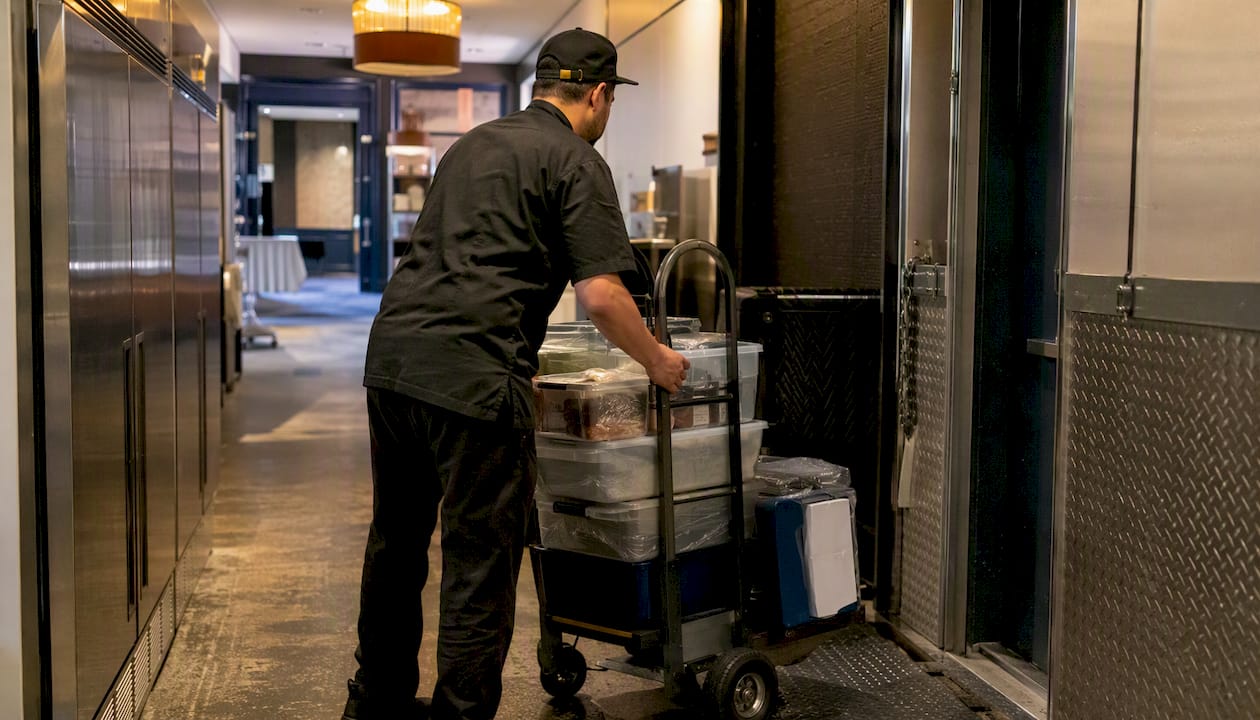
The coordinator's work starts eight weeks out with a venue walk-through to map the commercial kitchen layout, confirm the freight access schedule, and identify refrigeration capacity for each vendor. That walk-through feeds directly into the BEO, which gets drafted, circulated to all three vendors, and signed off four weeks before the event. When the dessert vendor requests a later load-in time two weeks out, the coordinator issues a versioned BEO amendment and confirms it does not conflict with the bar setup window.
On event day, the coordinator arrives two hours before guests, briefs the 12-person service staff on course timing and the four guests with severe nut allergies, and runs a hot-holding temperature check before the first course goes out. The result: all three courses served within the planned windows, zero dietary incidents, and a clean vendor breakdown by 11:00 PM.
Key lessons from this scenario:
- An early walk-through prevented a refrigeration conflict that would have forced one vendor to arrive three hours earlier than planned
- A versioned BEO sign-off process absorbed a late vendor change without disrupting the day-of timeline
- Mapping nut allergies to specific plating stations, not just flagging them generically, gave service staff clear instructions at the point of service
Booking an event hall for a wedding involves more logistics decisions than most couples anticipate; a coordinator is the professional who turns those decisions into an executable plan.
One thing most hosts get wrong about coordination
The most common mistake is treating catering coordination as a luxury add-on rather than a risk-management function. When something goes wrong at a catered event, it is almost never the food itself. It is a timing gap, a dietary error, a vendor who did not know where to unload, or a staffing brief that never happened. Those are coordination failures, not catering failures.
Service excellence in hospitality consistently comes down to the quality of the handoffs between teams, not the quality of any single team in isolation. A coordinator is the person who owns those handoffs.
The practical tip: lock the BEO and confirm loading windows before you finalize the menu. Most hosts do it in the opposite order, which means the menu gets built before anyone knows whether the kitchen can actually support it. Get the logistics confirmed first, then let the menu follow.
Contract a coordinator at the same time you sign your venue agreement. By the time most hosts think to hire one, the vendor contracts are already signed and the leverage to negotiate a workable logistics plan is gone.
Sources
- Catering Coordinator overview
- Catering and food service coordination (Event Planner Expo)
- Catering coordination: avoiding delays through venue coordination (Bullseye Saloon Catering)
FAQ
What does catering coordination mean?
Catering coordination is the management of all food-service logistics at an event, covering vendor scheduling, BEO creation, dietary mapping, staffing, and on-site supervision. The coordinator acts as the liaison between the client, the venue, and every food-service vendor.
How is a catering coordinator different from a caterer?
A caterer produces and delivers the food; a catering coordinator manages the logistics that allow multiple vendors, the venue, and service staff to operate from a single synchronized plan. The two roles are complementary, not interchangeable.
When should you hire a catering coordinator?
Hire one when your event involves multiple food vendors, complex dietary needs, an unconventional venue, or a host organization with no internal event staff. The earlier you bring a coordinator in, ideally at the same time you sign the venue agreement, the more leverage they have to build a workable logistics plan.
What is a Banquet Event Order (BEO)?
A BEO is the single source of truth for catering coordination: a signed document that contains the event timeline, staffing plan, menu, dietary notes, equipment list, loading schedule, and contact list for all parties. Every vendor works from the same BEO version.
How much does a catering coordinator cost?
Pricing depends on event complexity, guest count, and market. Venue complexity and the number of vendors to coordinate are the biggest cost drivers.