
A venue that pairs a full on-site commercial kitchen with turnkey catering and setup is the fastest way to guarantee hot food, on-time service, and a single point of contact on event day. Ambassadorclubportsmouth in Portsmouth, VA, has operated since 1933, holds a 6,000 sq ft hall with a full commercial kitchen and accommodates up to 200 guests. Book a site visit now to see the kitchen, confirm your package, and lock in your date.
At a glance:
- On-site commercial kitchen means food is prepped and held on-site, not trucked in cold
- Capacity up to 200 guests in a 6,000 sq ft hall
- Packages include setup, cleanup, and security so you are not sourcing those separately
- Banquet hall vs. event venue distinctions clarify exactly which services come with your rental
Key Takeaways
A venue with a full on-site commercial kitchen and turnkey catering/setup reduces vendor count, controls food timing, and keeps total costs more predictable than sourcing kitchen and catering separately.
| Point | Details |
|---|---|
| Inspect the kitchen first | Walk the service corridor, cold storage, and staging area before signing any contract. |
| Budget about 25% above base | Service charges, security, and overtime routinely add 25–30% to the quoted package price. |
| Confirm staffing in writing | Get the server-to-guest ratio and culinary team lead named in the contract, not just "staff as needed." |
| Verify health and insurance docs | Request the health permit, ServSafe certification, and liability certificate before your deposit clears. |
| Ambassadorclubportsmouth | Portsmouth, VA venue operating since 1933 with a 6,000 sq ft hall, commercial kitchen, and capacity for 200 guests. |
Table of Contents
- What does a commercial kitchen event catering setup actually include?
- How do you evaluate a venue's kitchen and catering setup on a tour?
- How are venue catering packages typically priced?
- What does the day-of timeline look like?
- What health and safety documents should you request?
- Why Ambassadorclubportsmouth fits this checklist
- What will the total cost actually be, including hidden fees?
- What does the booking process look like from inquiry to event day?
- A planner's honest take on venue kitchen catering
- Ambassadorclubportsmouth: book your kitchen and catering walkthrough
- Sources
- FAQ
What does a commercial kitchen event catering setup actually include?
When a venue advertises "on-site commercial kitchen and catering/setup," that phrase covers a lot of ground. Here is what it should mean in practice.
Kitchen equipment and staging: A proper commercial kitchen includes commercial ranges, convection ovens, a walk-in refrigerator and freezer, a prep area with stainless work surfaces, hot-holding equipment (chafing stations, heat lamps), and a plating/staging counter adjacent to the service corridor. Without that staging counter, servers are crossing paths with prep cooks, and hot food sits too long.
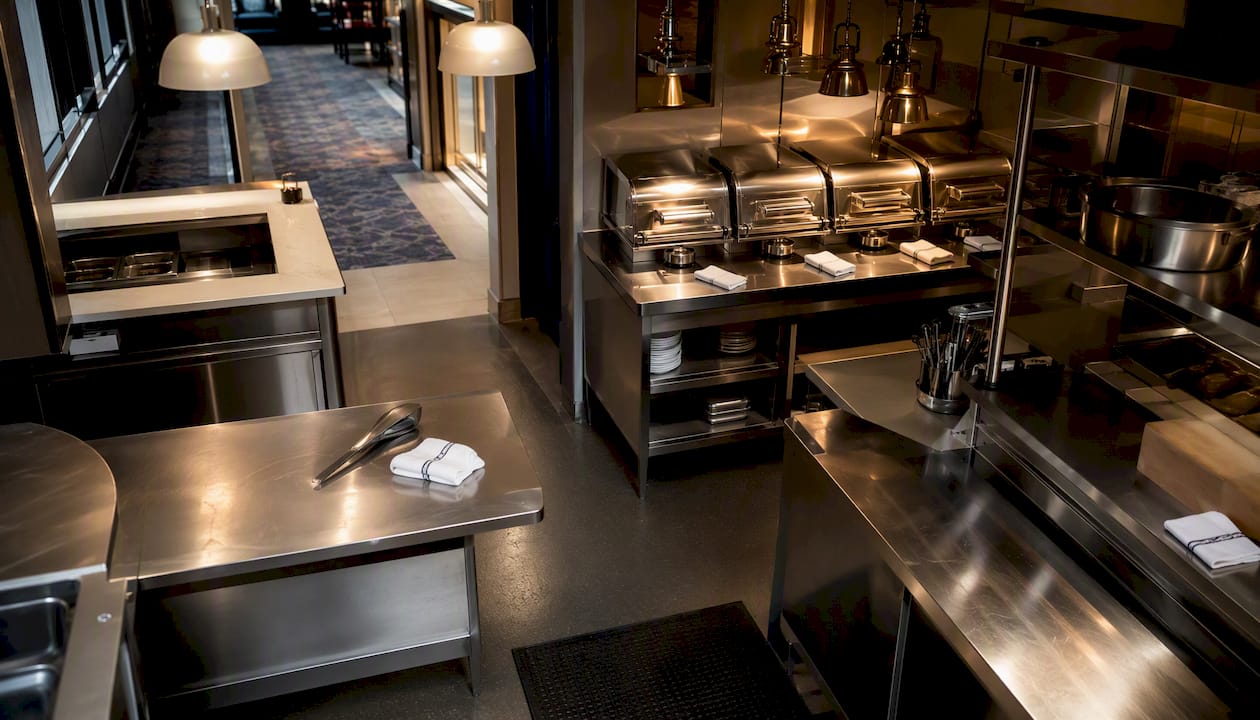
Service staff: A full catering package typically covers a culinary team (head cook plus prep staff), servers for the dining room, and a cleanup crew. Bartenders are often separate, either included in a beverage package or billed hourly.
Service styles and how they affect flow:
- Plated service requires the most staff per guest and the tightest kitchen timing
- Buffet reduces server count but demands more chafing equipment and a wider staging area
- Food stations spread traffic across the room and lower peak kitchen pressure
- Passed hors d'oeuvres work well for cocktail hours and need minimal hot-holding
Optional extras to confirm: cake-cutting service, late-night snack stations, acceptance of outside vendor deliveries (florist, bakery), specialty equipment like high-volume coffee urns, and additional linen or place-setting upgrades. Festive menu options and standard portioning guidelines help kitchen teams maintain speed and consistency, especially at high-volume events.
How do you evaluate a venue's kitchen and catering setup on a tour?
Walk the kitchen before you sign anything. Flip that ratio.
Must-see items during the walk-through:
- Service corridor from kitchen to dining room (width, distance, door clearance for trays)
- Cold and dry storage capacity relative to your guest count
- Loading dock or service entrance for vendor deliveries
- Ventilation and fire suppression (visible hood system over cooking equipment)
- Separate handwashing sinks from prep sinks (a basic health code requirement)
Contract red flags: vague staffing language ("staff as needed" with no ratio), cleanup scope that excludes kitchen reset, equipment fees buried in addenda, and blanket bans on outside caterers with no approved-vendor list provided.
Ask these questions before you leave the tour: What is your server-to-guest ratio for plated service? How do you handle a last-minute menu substitution? Who manages the kitchen on event day, and can I meet that person? What is your policy on leftover food? If a piece of equipment fails the morning of my event, what is the backup plan?
A venue that hesitates on any of those questions is telling you something. A clear booking checklist going into a tour keeps you from leaving without the answers you need.
How are venue catering packages typically priced?
Pricing for a venue with an on-site kitchen usually stacks several components. Knowing each one prevents sticker shock when the final invoice arrives.
Common package components:
- Base hall rental (flat fee, often tiered by day/time)
- Per-person food cost (the catering package itself)
- Service staff fees (sometimes per-person, sometimes hourly)
- Beverage package (non-alcoholic, beer/wine, or full bar)
- Linen and place-setting rentals if not included
- Service charge or gratuity (commonly 18–22% added to food and beverage)
- Security and cleanup fees
Pricing models vary: some venues quote a flat per-person rate that bundles food, staff, and basic rentals. Others use tiered packages (bronze/silver/gold) with à la carte upgrades. Minimum spend requirements are common for weekend dates.
Bundled venue-plus-catering packages often reduce overall expense compared with hiring separate vendors, because you avoid transportation markups and duplicate staffing fees. In-house catering eliminates the cost of a caterer trucking equipment and staff from an off-site kitchen.
Cost-saving moves that actually work:
- Choose a buffet or station format over plated service to reduce server hours
- Trim the guest list before upgrading the menu; per-person costs compound fast
- Book a Friday evening or Sunday afternoon instead of Saturday
- Select a beverage package with a consumption cap rather than an open bar
Menu planning and portion control directly shape kitchen flow and per-person spend. Planners who finalize their menu four to six weeks out give the kitchen team time to source ingredients at better prices.
What does the day-of timeline look like?
| Event Phase | Typical Window | Who Handles It |
|---|---|---|
| Vendor load-in / kitchen setup | 3–4 hours before guests arrive | Venue kitchen team + outside vendors |
| Food prep and hot-holding | 2–3 hours before service | Culinary team |
| Cocktail hour / passed apps | First 60–90 minutes of event | Servers, kitchen on standby |
| Dinner service | 90 minutes | Full kitchen and floor staff |
| Cake cutting / dessert | about 20 minutes post-dinner | Servers, minimal kitchen |
| Teardown and cleanup | 60–90 minutes post-event | Cleanup crew |
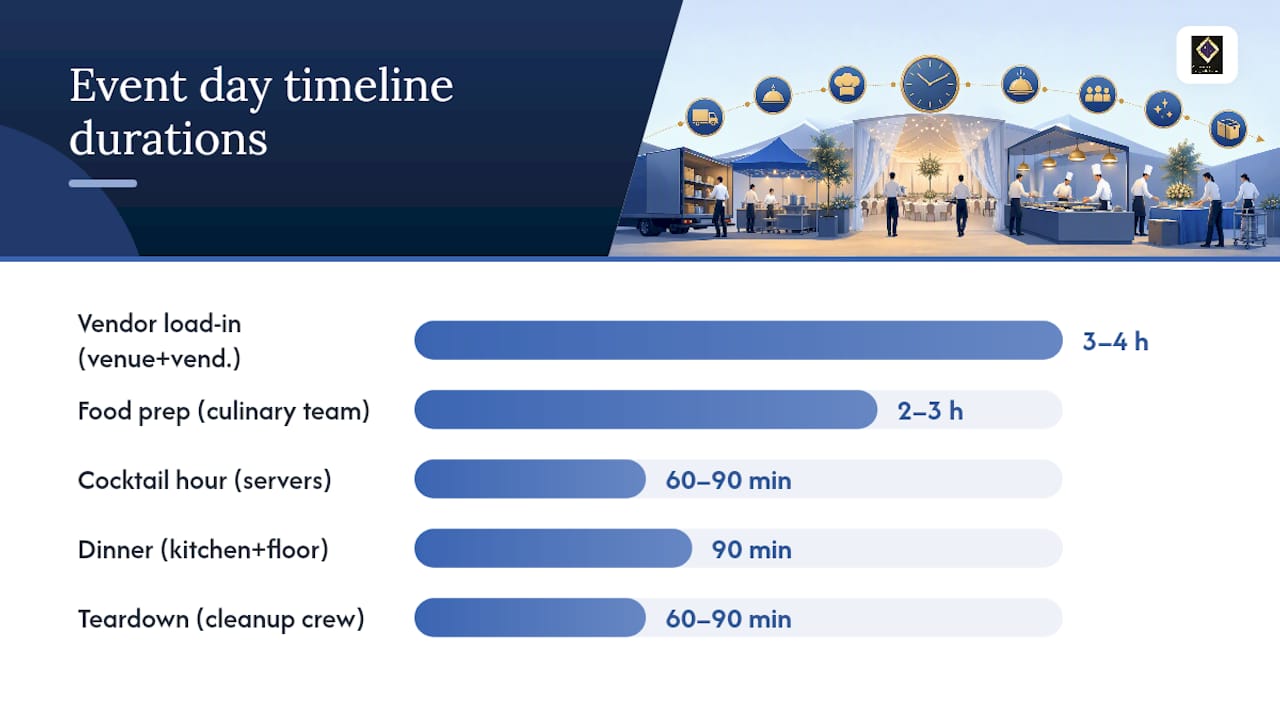
Service style shifts the whole clock. Plated service requires plates to leave the kitchen within a tight window (usually 10–15 minutes per course) or food temperature drops. Buffet gives you more flexibility but needs replenishment staff watching chafing dishes throughout service.
Confirm these access rules before event day:
- What time can outside decorators enter the event room?
- Is there a dedicated parking area for caterer vehicles?
- What is the venue's policy on leftover food removal?
A venue with an integrated kitchen and catering team handles trash removal, kitchen reset, and lost-and-found internally. When you hire an outside caterer, those responsibilities often fall on you to coordinate.
What health and safety documents should you request?
Before signing, ask for these in writing:
- Local health department permit for the commercial kitchen (current, not expired)
- ServSafe or equivalent food handler certification for the culinary team lead
- General liability insurance certificate naming the venue (and ideally the renter as additional insured)
- Liquor license or alcohol permit if the venue is serving alcohol
- Allergen management plan or written policy for common allergens (gluten, nuts, shellfish, dairy)
A venue that cannot produce these documents within 24 hours of your request is a liability risk. An absent health permit means the kitchen has not been inspected to the standards your guests' safety depends on. The allergen plan matters most for corporate events and family gatherings where dietary restrictions are common.
Why Ambassadorclubportsmouth fits this checklist
Ambassadorclubportsmouth checks every item on the list above. Operating since 1933, the club's 6,000 sq ft hall in Portsmouth, VA, includes a full on-site commercial kitchen, tables and chairs, a dry bar, a dance floor, and a large projection wall with a built-in projector. Capacity reaches 200 guests.
What that means on event day:
- Food is prepped on-site, so service timing is controlled by one team
- Setup, cleanup, and security are included in packages, cutting your vendor list significantly
- Flexible outside-catering policies that mean you can bring a preferred caterer if you choose
- One contact manages space and kitchen logistics, not two separate vendors
The club serves weddings, corporate events, family celebrations, memorials, and charity functions. To request a tour, sample menu, or itemized quote, contact the venue directly through the landing page.
What will the total cost actually be, including hidden fees?
The number on a venue's website is rarely the number on your final invoice. Common additions:
- Service charge/gratuity: 18–22% on food and beverage, often non-negotiable
- Security fee: flat rate per event, sometimes per guard per hour
- Overtime charges: if your event runs past the contracted end time
- Outside vendor fees: some venues charge a fee for caterers or vendors not on their approved list
- Cleaning deposit: refundable if the space is left in agreed condition, non-refundable if not
Flexible packages that bundle security and cleanup into a flat rate reduce the risk of line-item surprises.
What does the booking process look like from inquiry to event day?
- Initial inquiry: contact the venue, confirm your date is available, and request a package overview
- Site tour: walk the hall and kitchen, ask the questions from the checklist above
- Proposal and negotiation: review the itemized quote, clarify what is and is not included
- Contract signing and deposit: most venues require a deposit (commonly 25–50% of the total) to hold the date
- Menu planning meeting: typically 60–90 days before the event; finalize selections and headcount
- Final headcount and payment: usually due 7–14 days before the event
- Event day: venue team handles load-in, service, and cleanup per the agreed timeline
The full cycle from first inquiry to event day typically runs 3–12 months for weddings and larger corporate events. For smaller gatherings, 6–8 weeks is workable if the date is available. A practical booking guide walks through each step in detail.
A planner's honest take on venue kitchen catering
The biggest mistake planners make is treating the venue's kitchen as a given rather than a variable. "Full commercial kitchen" can mean anything from a six-burner range and a reach-in cooler to a full prep kitchen with walk-in storage and a dedicated plating station. Those are not the same thing for a 150-person seated dinner.
Do: confirm the server-to-guest ratio in writing (1:10 is a reasonable floor for plated service). Do get the liability documents before the deposit clears. Do schedule a tasting if food quality is a priority for your guests.
Don't: assume outside vendors are free to bring in. Don't skip the kitchen walk-through because the ballroom looked beautiful. Don't finalize your headcount too early — venues price per person, and a count that drops after the contract is signed rarely results in a refund.
Pro Tip: Stage dessert service to run concurrently with toasts and speeches. Guests are seated and occupied, servers can plate and distribute without disrupting the room, and you reduce the staff hours needed for a separate dessert course.
The role of food in hospitality comes down to one thing: guests remember how the food felt, not the per-plate cost. Prioritize timing and temperature over elaborate menus that strain a kitchen team.
Ambassadorclubportsmouth: book your kitchen and catering walkthrough
Historic elegance at a price that does not require a corporate budget. Ambassadorclubportsmouth gives you a 6,000 sq ft hall, a full commercial kitchen, tables and chairs, a dry bar, a dance floor, and a projection wall, all under one roof in Portsmouth, VA. Setup, cleanup, and security are included in packages, and flexible catering policies mean you are not locked into a single menu or vendor.

Packages are built to reduce line-item surprises, and the team works with you on menu selections and timing well before event day. Schedule a tour or request a quote to see the kitchen, confirm your date, and get an itemized breakdown with no guesswork.
Sources
- Festive Meal Offerings List for Event Planners in 2026 – Wild Foodz by Hotel Entree Brugge
FAQ
What should a commercial kitchen at an event venue include?
A venue's commercial kitchen should have commercial ranges, convection ovens, walk-in refrigeration, hot-holding equipment, a plating station, and a service corridor connecting directly to the dining room. Without a dedicated staging area, food temperature and service timing both suffer.
How much does a venue catering package typically cost in total?
Base package quotes rarely reflect the final number.
What documents should I request from a venue before signing?
Ask for the current health department permit, ServSafe certification for the culinary team lead, a general liability insurance certificate, and an allergen management plan. A venue that cannot provide these promptly is a risk.
Does Ambassadorclubportsmouth allow outside caterers?
Ambassadorclubportsmouth offers flexible outside-catering policies, so you can bring a preferred caterer if you choose, rather than being locked into a single in-house option.
How far in advance should I book a venue with an on-site kitchen?
For weddings and large corporate events, 3–12 months is the typical lead time. Smaller gatherings can sometimes be arranged in 6–8 weeks if the date is available, but popular weekend dates book quickly.