
A vendor-ready custom catering package is a single document that specifies the service format, per-person price, menu categories, dietary breakdown, rental inclusions, staffing count, and a confirmed timeline. With that document in hand, you can send it to three caterers today and get comparable quotes back by Friday.
What every package brief must include:
- Service format (drop-off, buffet, plated, stations, or full-service)
- Confirmed or estimated guest count with RSVP deadline
- Menu categories (proteins, plant-forward mains, sides, desserts, beverages)
- Dietary counts (vegetarian, vegan, gluten-free, allergen flags)
- Rental needs (linens, servingware, tables, chairs)
- Staffing requirements (servers, bartenders, setup/breakdown crew)
- Lead time and payment milestones
Your 60-minute action plan: Pull your event date, guest count, and venue constraints. Pick a service format from the ranges below. Draft menu categories with dietary counts. Drop everything into a one-page brief. That's your RFP.
Sample per-person price ranges to sanity-check vendor quotes:
These ranges reflect food, basic service, and standard packaging.
Key Takeaways
A vendor-ready custom catering package requires a confirmed service format, itemized per-person cost, dietary counts, rental list, and a signed contract with lead times and final-count deadlines in place before any food is ordered.
| Point | Details |
|---|---|
| Start with event fundamentals | Collect event type, guest count, venue constraints, and timeline before choosing any format or menu. |
| Match format to budget and formality | Drop-off runs $10–$25 per person; full-service plated runs $65–$150+; always itemize beyond food cost. |
| Build tiered packages with add-ons | Three tiers (Essential, Classic, Premium) plus high-margin add-ons give clients clear choices and protect margin. |
| Collect dietary counts before finalizing the menu | Send a dietary survey at RSVP, require vendor allergen sign-off, and label every station card. |
| Use a one-page vendor brief | A single document with event basics, format, menu categories, dietary counts, rentals, and budget gets comparable quotes fast. |
Table of Contents
- What event fundamentals do you need before customizing a package?
- How do you choose the right service format?
- How do you price a custom package without getting blindsided?
- How do you build tiered packages and profitable add-ons?
- How do you design a menu that works for everyone?
- How do you calculate portions and avoid running short?
- What should you confirm with your caterer before signing?
- What templates and tools do you need to build a vendor brief?
- How The Ambassador Club makes package customization work in practice
- What I do first on event day to keep catering on track
- Sources
- FAQ
What event fundamentals do you need before customizing a package?
The most expensive catering mistakes happen before a single menu item is chosen. A planner who locks in a full-service plated dinner for a networking event of 180 people, then discovers the venue has no on-site kitchen and a 6 PM hard-out, is looking at a complete rebuild two weeks before the event.
Collect the event brief first. You need the event type and its primary objective (celebration, working meal, networking, memorial), the formality level, the date and start/end time, and whether the schedule includes a cocktail hour, a seated meal, or both. A 90-minute corporate lunch runs on a completely different service logic than a four-hour wedding reception.
Guest count rules. Work from confirmed RSVPs, not invitations sent. Give your caterer a working estimate, then update it at the 30-day and 7-day marks.
Venue constraints to confirm early. Check whether the venue has an exclusive-caterer clause, kitchen access (prep kitchen vs. full commercial kitchen vs. none), loading dock hours, parking for catering trucks, and a designated staging area. These details change which service formats are even possible. A venue with a full commercial kitchen opens the door to plated service; a venue with no kitchen limits you to drop-off or stations with chafing equipment. The venue type itself shapes catering decisions in ways planners often underestimate.
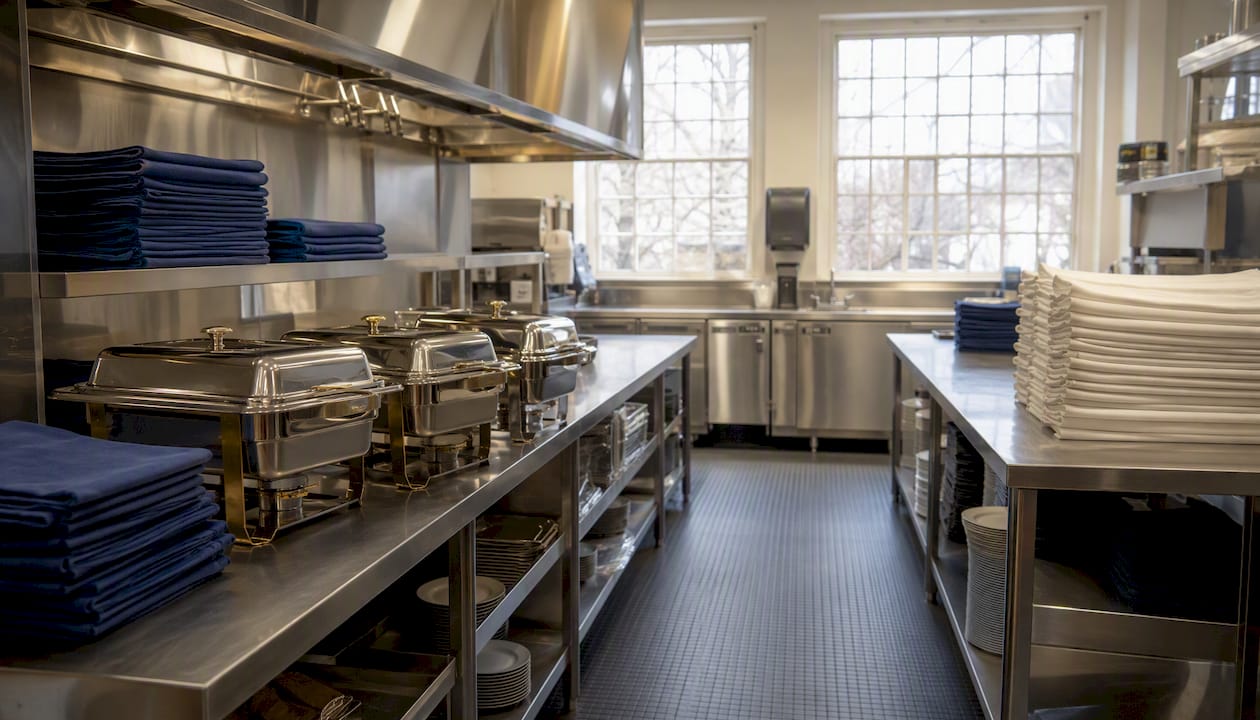
Pro Tip: Build a simple timeline checklist the moment you book the venue: note the tasting window (typically 4–8 weeks before the event), the final-count deadline, the deposit due date, and the day-of setup window. Missing the tasting window is the single most common reason planners end up with a menu they haven't actually approved.
How do you choose the right service format?
Getting this decision right early prevents expensive mid-planning pivots.
According to a complete catering format guide, drop-off catering typically runs in a reasonable per-person range and scales well for corporate accounts, while full-service formats require substantially more staffing and coordination. Here's how each format breaks down:
Format selection heuristics:
- Choose drop-off when the host wants zero staffing overhead and the event is informal or under 50 people.
- Choose buffet when guest count exceeds 75 and you want variety without per-plate cost.
- Choose stations when guest experience and interaction matter more than efficiency. Interactive chef stations drive engagement and often justify the higher per-person rate because guests remember them.
- Choose full-service plated when formality is non-negotiable, such as a seated wedding dinner or a black-tie corporate event.
- Choose a food truck for outdoor or festival-style events where a casual, social atmosphere is the point.
Food delivered in insulated carriers typically holds safe temperature for 30–90 minutes, which matters for drop-off and station formats where setup and service overlap. Build that window into your day-of timeline.
How do you price a custom package without getting blindsided?
The per-person food cost is only the starting line. A buffet quoted at $38 per person can land at $58 per person after labor, rentals, bar, tax, and gratuity. Planners who don't itemize every line before signing a contract routinely discover this gap on the final invoice.
The full itemized cost structure:
A detailed pricing breakdown for 100-guest events shows that the line items planners most often miss are labor/service fees, rental equipment, beverage service, delivery, gratuity, and a contingency buffer. Here's a worked example for a 100-person buffet at $38 per person food cost:
That $38 per-person quote becomes roughly $78 all-in. Knowing this math before you present a budget to a client is the difference between a profitable event and an awkward conversation.
Itemized-quote checklist — require vendors to confirm in writing:
- Food cost per person, broken down by course or station
- Labor rate per server/bartender and total staff hours
- Rental itemization (tables, chairs, linens, servingware, chafing equipment)
- Beverage package pricing (non-alcoholic, beer/wine, full bar) as separate line items
- Delivery, setup, and breakdown fees
- Applicable tax rate and what it applies to
- Gratuity policy (included, expected, or discretionary)
- Overtime rate if the event runs long
- Final-count deadline and minimum-guest policy
- Cancellation and substitution terms
Pro Tip: Ask every vendor for a fully itemized quote, not a package total. Vendors who resist itemizing are usually the ones with the largest gap between the headline price and the final invoice. Itemized quotes also make apples-to-apples comparison between three vendors straightforward. For more ways to keep costs in check, the event catering cost-saving checklist covers negotiation tactics and service-level tradeoffs worth reviewing before you sign.
How do you build tiered packages and profitable add-ons?
Tiered packages give clients a clear decision framework and give you a repeatable pricing structure. The goal is three tiers that feel meaningfully different, not three tiers that are the same package with minor garnish changes.
Package tier framework:
| Tier | Menu Depth | Staffing | Rentals | Beverage | Service Hours |
|---|---|---|---|---|---|
| Essential | 1 protein, 2 sides, 1 dessert | Delivery only | Disposable | Water, soft drinks | 2 hours |
| Classic | 2 proteins, 3 sides, salad, 2 desserts | 1–2 servers | Basic linen, chafing | Beer, wine, soft drinks | 3 hours |
| Premium | 3 proteins, 4 sides, salad, 3 desserts, cheese course | Full service staff | Full linen, china, glassware | Full bar or craft cocktail station | 4–5 hours |
High-margin add-ons worth building into every proposal:
- Passed hors d'oeuvres during cocktail hour ($8–$15 per person)
- Plated dessert upgrade or custom cake service
- Craft coffee and espresso station
- Extended bar service (per additional hour)
- Late-night snack station (sliders, fries, mini tacos)
- Branded or custom-printed menus and station cards
- Dedicated event captain or day-of coordinator
The add-on list matters because clients who choose the Essential tier often upgrade one or two items once they see the options laid out. A passed hors d'oeuvres line item on a proposal converts at a high rate because it solves a real problem: guests arrive hungry before the buffet opens. Flexible tiered packages work precisely because they let clients self-select their comfort level without requiring a custom negotiation every time.
Sample short package descriptions for a proposal:
Essential Package: Drop-off buffet with one protein, two sides, and a dessert. Disposable servingware included. Ideal for casual office events and daytime celebrations up to 50 guests.
Classic Package: Staffed buffet with two proteins, a salad, three sides, and two dessert options. Basic linen and chafing equipment included. Beer, wine, and soft drinks available. Best for receptions and milestone celebrations of 50–150 guests.
Premium Package: Full-service plated or station dinner with three proteins, a cheese course, four sides, and a full dessert display. China, glassware, and full linen included. Full bar service and a dedicated event captain. Designed for weddings, galas, and formal corporate events of 75–200 guests.
How do you design a menu that works for everyone?
A menu that ignores dietary diversity isn't just a guest-experience problem. It's a liability. One unlabeled allergen at a buffet station can end an event badly. The goal is a menu that's genuinely inclusive without becoming a logistical nightmare.
Menu categories to cover in every package:
- Protein/entrée options (at least two, including one non-meat option)
- Plant-forward or vegetarian main (not just a side salad)
- Starch or grain (rice, pasta, roasted potatoes)
- Two to three vegetable sides
- Salad (dressed separately to extend holding time)
- Dessert (at least one option that is gluten-free or nut-free)
- Beverage selections (non-alcoholic always, alcoholic as add-on)
- Kids' options for family events (simpler proteins, plain starches)
Building menus around categories rather than fixed dish lists makes it easier for caterers to scale portions and swap items without reworking the price model. Write menu descriptions that include portion cues and presentation notes: "Herb-roasted chicken thigh, 6 oz, served with pan jus" tells a caterer exactly what to prepare and price, while "roasted chicken" does not.
Dietary accommodation workflow:
- Send a dietary survey to guests at RSVP (ask for vegetarian, vegan, gluten-free, nut allergy, shellfish allergy, dairy-free, and other).
- Compile counts and share them with your caterer at least 7 days before the event.
- Require written vendor sign-off on allergen handling procedures (separate prep surfaces, dedicated utensils, no cross-contact).
- Label every buffet station card with dietary icons: V (vegetarian), VE (vegan), GF (gluten-free), N (contains nuts).
- Place allergen-safe items at the beginning of the buffet line, before shared serving utensils can cause cross-contact.
The Healthy Eating Plate from Harvard Health offers practical plate-balance guidance that can inform how you proportion vegetables, proteins, and grains across a menu, particularly useful when designing nutrition-forward corporate or wellness event menus.
Pro Tip: For large events with multiple allergen flags, ask your caterer to prepare allergen-sensitive meals as individually plated portions, even at a buffet event. A labeled, covered plate handed directly to the guest eliminates cross-contact risk and takes the guesswork out of buffet navigation. For family-focused events, the family celebration menu planning guide has additional category ideas worth borrowing.
How do you calculate portions and avoid running short?
Running out of food at an event is the one failure guests remember for years. Running out of the vegetarian option at minute 20 of a 90-minute buffet is worse, because it signals the host didn't plan for their guests.
Portion formulas by format:
- Plated service: Plan one entrée portion per guest, 5–6 oz protein, 3–4 oz starch, 3–4 oz vegetable. Add a 5–8% buffer for plating errors and late arrivals.
- Buffet: Plan 1.25–1.5 portions per guest for the first two hours. Guests return for seconds. Add an 8–12% buffer on proteins and a 10–15% buffer on popular sides.
- Stations: Plan 3–5 bites per station per guest for cocktail-hour stations. For meal-replacement stations, use buffet math.
- Desserts: Plan 1.2 dessert portions per guest at buffet events; 1.0 for plated.
- Beverages: Plan 2 drinks per guest for the first hour, then 1 drink per guest per hour after that. For a 3-hour event, that's roughly 4–5 drinks per person total.
Conversion quick-list:
- 100 guests, buffet dinner: order for 120–130 portions of protein, 140–150 portions of sides
- 100 guests, plated: order for 105–108 portions of each course
- 100 guests, cocktail stations (4 stations): plan 400–500 total bites across all stations
Waste-control tactics:
- Stage replenishment in 30-minute intervals rather than filling all chafing dishes at once.
- Group guests by meal choice (for plated events) using place cards or pre-event meal selection.
- Use 10-inch plates instead of 12-inch at buffets; guests take more appropriate portions.
- Brief servers to offer seconds proactively rather than leaving guests to return to the line, which reduces waste from guests taking large initial portions "just in case."
Events with open bars tend to see lower food consumption; events with children or athletes tend to run higher.
What should you confirm with your caterer before signing?
A vendor who gives you a great tasting and a vague contract is a risk. The contract is where the event either holds together or falls apart at 7 PM on a Saturday.
Vendor-question checklist for consistent proposals:
- What is your minimum guest count and delivery radius?
- How many staff members are included, and what are their roles?
- What servingware and rental equipment is included vs. extra?
- Do you carry general liability insurance, and can you provide a certificate?
- What is your final-count deadline, and what is the minimum you'll hold us to?
- What is your overtime rate if the event runs past the contracted end time?
- What happens if a menu item becomes unavailable? What is your substitution policy?
- How do you handle allergen separation in prep and at service?
A thorough caterer checklist prioritizes transparency on pricing and package inclusions, flexibility for customization, and clear statements on staffing and rentals. Vendors who can answer all eight questions above without hesitation are the ones worth shortlisting.
Tasting checklist:
- Sample every protein option at the portion size you've specified.
- Test a cold item after 45 minutes at room temperature to simulate buffet conditions.
- Ask how allergen-sensitive items are prepared and request a demonstration if the event has significant allergy flags.
- Evaluate presentation: does it match what you'd put in front of 150 guests?
- Confirm that the tasting menu matches the contracted menu exactly.
Contract clauses to require:
- Cancellation policy with specific refund tiers (30 days out, 14 days out, 7 days out)
- Overtime rate, stated per hour per staff member
- Late delivery remedy (discount, partial refund, or service credit)
- Substitution rules: vendor must notify you at least 48 hours before the event
- Final-count deadline and the minimum-billing threshold
Negotiation tips: Ask for a package discount when you bundle rentals with catering from the same vendor. Always request itemized quotes from at least three vendors before negotiating, because knowing the market rate is the only real leverage you have.
Pro Tip: Standard catering orders typically need 24–48 hours of lead time; custom or large-scale events usually require 3–7 days. Building that window into your booking timeline from day one prevents the scramble that happens when a planner tries to finalize a menu five days before a 200-person wedding.
What templates and tools do you need to build a vendor brief?
Templates turn this guide into something you can send to a caterer by end of day. The four documents every planner needs are a one-page vendor brief, an itemized-quote worksheet, a dietary survey, and a vendor-question checklist.
Template overview:
| Template | What It Solves | Key Fields |
|---|---|---|
| One-page vendor brief | Gives caterers everything they need to quote accurately | Event date, guest count, format, menu categories, dietary counts, rental needs, budget range, timeline |
| Itemized-quote worksheet | Forces line-item transparency and enables apples-to-apples comparison | Food cost, labor, rentals, bar, delivery, tax, gratuity, contingency |
| Dietary survey | Captures guest dietary needs before the menu is finalized | Vegetarian, vegan, GF, nut allergy, shellfish allergy, dairy-free, other |
| Vendor-question checklist | Standardizes vendor evaluation across multiple quotes | Lead time, minimums, staffing, insurance, substitution policy, overtime rate |
One-page vendor brief structure:
Event basics: Date, start/end time, venue name and address, guest count (confirmed/estimated), event type, formality level.
Service format: Chosen format (buffet, plated, stations), service hours, setup window, breakdown deadline.
Menu categories: List by category (proteins, plant-forward mains, sides, salads, desserts, beverages). Note portion cues where known.
Dietary counts: Number of vegetarian, vegan, gluten-free, and allergen-flagged guests. Note any severe allergies requiring separate preparation.
Rental needs: Linens, servingware, chafing equipment, tables, chairs (note what the venue already provides).
Timeline: Tasting date, final-count deadline, deposit due date, setup arrival time.
Budget range: Per-person target and total budget ceiling.
Simple cost-calculator structure (build in a spreadsheet):
Inputs: guest count, per-person food cost, labor rate per server, number of servers, rental cost, beverage budget, delivery fee, tax rate, gratuity rate, contingency percentage.
Outputs: total food cost, total labor, total rentals, total beverage, subtotal, tax amount, gratuity amount, contingency amount, grand total, and per-person all-in cost.
Once you have this calculator, you can run three vendor quotes through it in 10 minutes and see the true cost of each side by side. For menu inspiration across event types, the festive meal offerings guide covers scalable category ideas for weddings, conferences, and corporate functions.
How The Ambassador Club makes package customization work in practice
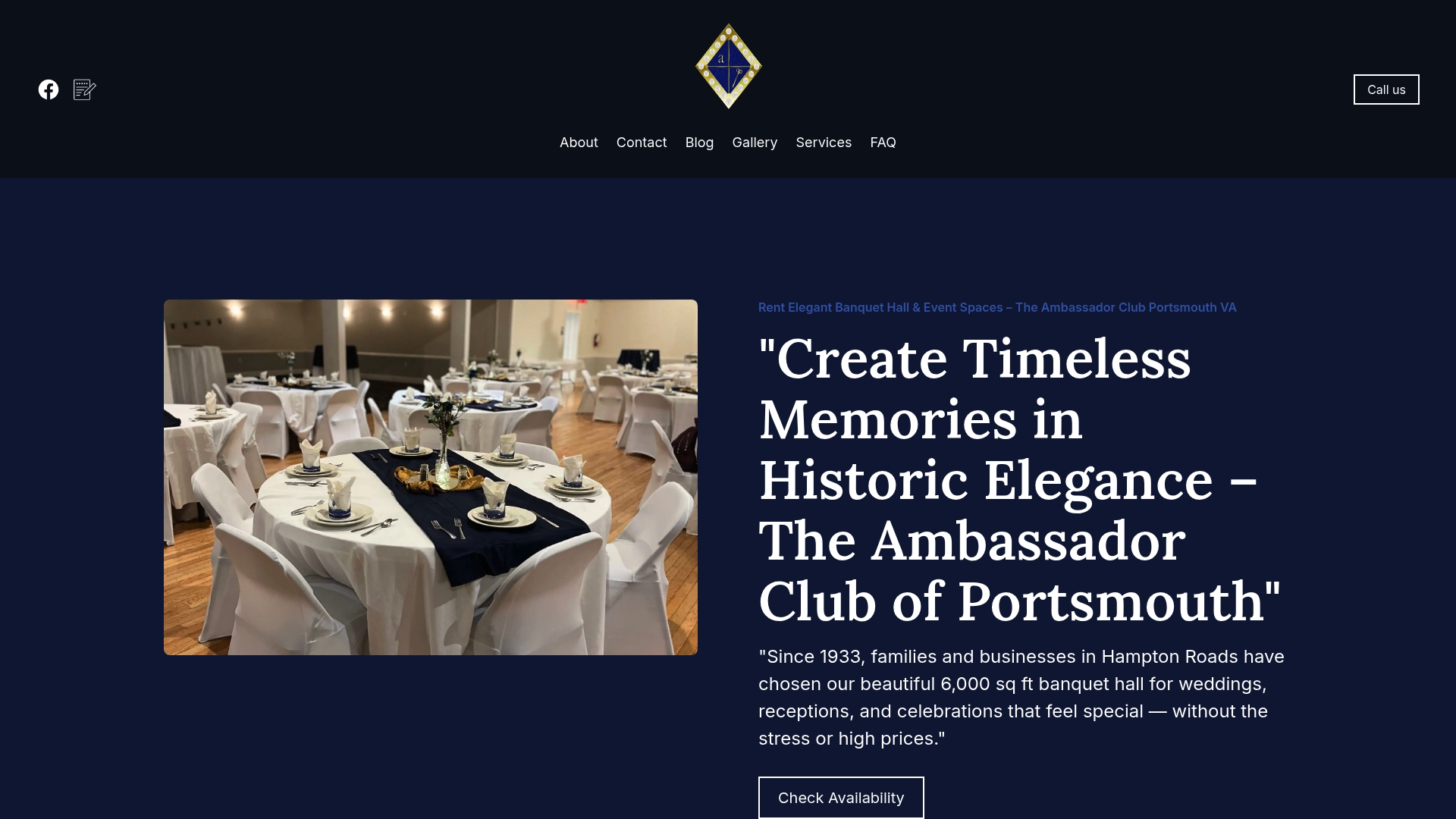
The Ambassador Club in Portsmouth, VA, has been hosting events since 1933. Its 6,000 sq ft hall accommodates up to 200 guests, and the on-site full commercial kitchen is the detail that changes everything about package design.
When a venue has a full commercial kitchen, plated service becomes viable without a catering truck kitchen. Caterers can prep, hold, and plate on-site rather than transporting finished dishes, which improves food quality and reduces the logistical complexity of hot-holding. At the Ambassador Club, that kitchen access means a planner can offer a full-service plated dinner as a realistic option, not just a buffet or drop-off.
The venue's included amenities (tables, chairs, dry bar, dance floor, large projection wall, and built-in projector) reduce the rental line items in a catering brief. A planner building a package for an Ambassador Club event can remove linen tables, chairs, and A/V rental from the itemized quote and redirect that budget toward food quality or staffing upgrades.
Venue coordination checklist for package planning:
- Confirm kitchen access hours and whether the caterer needs to bring additional equipment.
- Identify loading/unloading windows and whether the venue has a dedicated service entrance.
- Establish staging areas for hot and cold holding separate from the guest-facing buffet or service area.
- Assign a venue staff liaison who handles A/V, lighting, and room transitions so the catering team can focus on service.
- Note projection and sound needs that affect station placement (a chef station near the projection wall may block sightlines).
The venue's flexible outside-catering policy means planners can bring in a preferred caterer or use the kitchen for in-house preparation, a hybrid approach that works well for corporate clients with recurring events. Catering coordination responsibilities between venue, caterer, and host are cleaner when the venue has a designated point of contact for each function, which the Ambassador Club provides as part of its standard booking.
Pro Tip: When the venue includes tables and chairs in the rental, remove those line items from your caterer's quote before comparing bids. A caterer who quotes $72 per person including rentals may actually be more expensive than one quoting $68 per person when the venue already covers the same rentals.
Explore the Ambassador Club's venue amenities and rental packages to see how the included amenities translate directly into a leaner catering brief and a more predictable total event cost.
What I do first on event day to keep catering on track
The hour before guests arrive is where most catering problems either get caught or become disasters. Here's what I do every time.
My event-day quick wins:
First, I walk the service area 90 minutes before doors open. I check that hot items are holding at temperature, cold items are on ice, and every station card is labeled correctly, including dietary icons. A mislabeled gluten-free item discovered after guests have served themselves is a much bigger problem than one caught during setup.
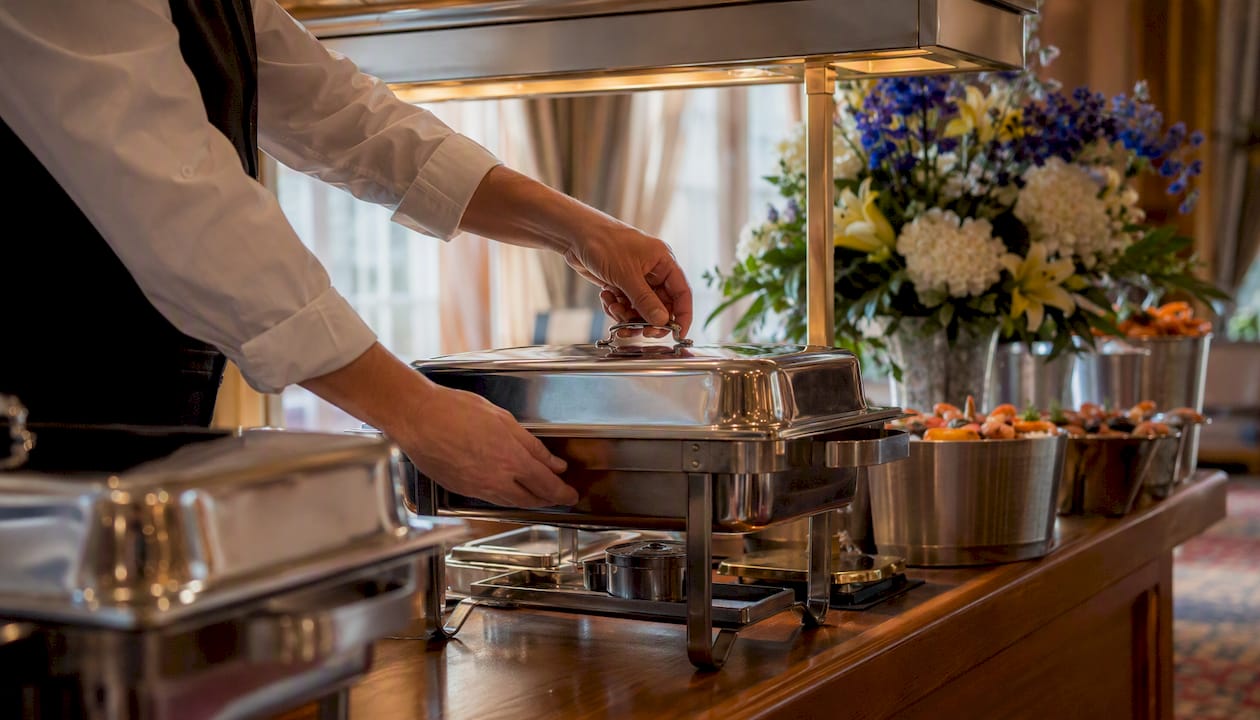
Second, I do a staff check-in 60 minutes out. I confirm every server and bartender is on-site, knows their station assignment, and has reviewed the allergen protocol. If a staff member is missing, I know early enough to call the vendor for a replacement or adjust the service plan.
Third, I verify the final guest count against the caterer's prep count. A 10-person spike at a 100-person event is manageable if the caterer knows at 5 PM, not at 7 PM when the buffet line is already moving.
Event-day quick checklist:
- Arrival window confirmed with caterer (typically 2–3 hours before service)
- Hot items verified at 140°F or above; cold items at 40°F or below
- All station cards in place with dietary labels
- Staff roster confirmed and roles assigned
- Final guest count shared with catering captain
- Backup plan for dietary requests confirmed (individually plated allergen meals ready)
Handling last-minute changes: When a guest shows up with a dietary need that wasn't on the survey, the best answer is a directly plated portion from the kitchen, not a guess at the buffet line. If the caterer prepared allergen-safe items as individual plates (as recommended in the menu design section), this is a 30-second fix. If they didn't, it's a 20-minute scramble. That's the real argument for building individual allergen plates into every contract.
Sources
- Types of Catering: A Complete Guide to Choosing the Right One
- Eventory
- How to create a catering menu your business customers will love
- Effortless Events: Choosing the Best Food Caterers for Your Needs - Zerocater
- The Ultimate Checklist for Choosing Your Next Caterer
- Health
FAQ
What does a catering package typically include?
A standard catering package includes food by course or station, basic service staff, and disposable or rental servingware.
How far in advance should you book a caterer?
Standard orders typically need 24–48 hours of lead time; custom or large-scale events usually require 3–7 days of planning time. For weddings and formal galas, booking 4–8 weeks out is standard to allow time for tastings and contract finalization.
What is the difference between buffet and full-service plated catering?
Buffet catering lets guests serve themselves from shared stations, typically costs $25–$55 per person, and requires fewer servers. Full-service plated catering involves servers delivering individual courses to seated guests, typically costs $65–$150+ per person, and is suited to formal events where presentation and pacing matter.
How do you handle dietary restrictions in a catering package?
Send a dietary survey at RSVP, compile counts, and share them with your caterer at least 7 days before the event. Require written allergen-handling procedures and label every buffet station card with dietary icons. For severe allergies, request individually plated portions prepared separately from shared buffet items.
How do you compare catering quotes fairly?
Request fully itemized quotes from at least three vendors covering food cost, labor, rentals, bar, delivery, tax, gratuity, and contingency. Run each quote through the same cost-calculator structure to get a true per-person all-in figure, then compare on that number rather than the headline price.