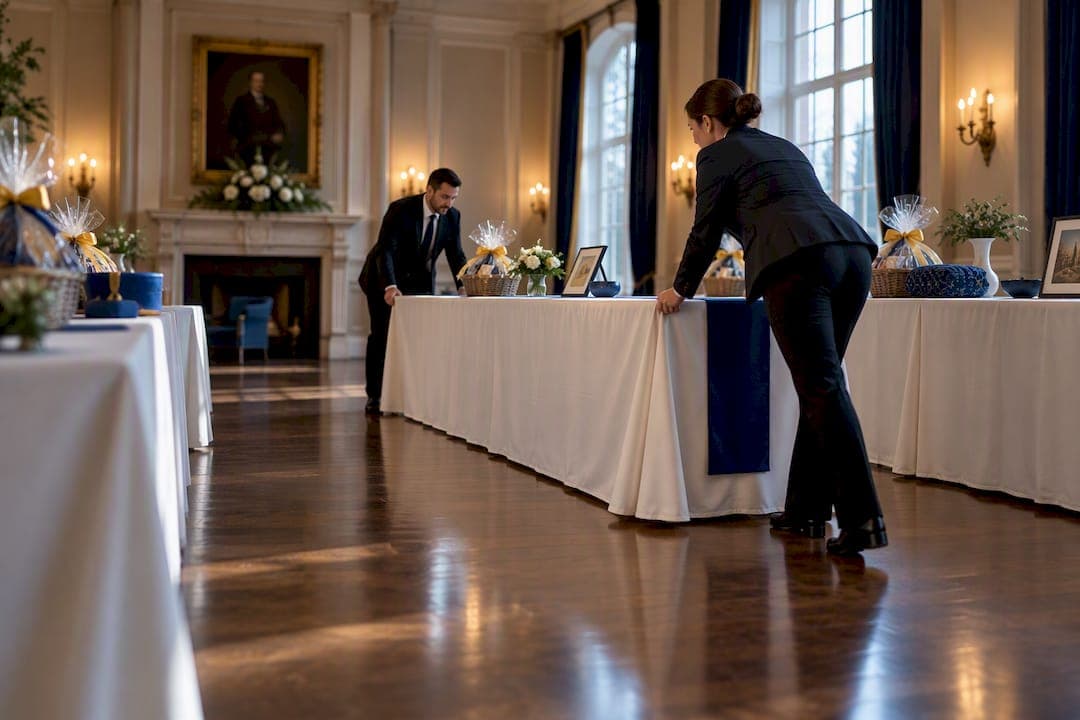
Put your auction area on the busiest walking path in the room, feature your top three items where every guest passes twice, and make bidding so obvious a stranger could join without asking a question. Everything else, from bid sheets to lighting, exists to support that one flow. Work through the checklist below and you'll have a reproducible setup that lifts bids and keeps volunteers off their feet fixing problems.
TL;DR:
- Position the auction area along the main guest route, such as near the bar or restrooms, to maximize browsing and bidding activity.
- Curate fewer top-dollar items and anchor them at high-traffic points to draw attention and encourage multiple passes through the auction zone.
- Set starting bids at 30 to 40% of the item's fair market value with incremental increases scaled to price, ensuring competitive bidding without discouraging early participation.
- Use mobile bidding features like notifications and proxy bidding early in the event to maintain momentum, with paper sheets as a backup for spotty Wi-Fi or older guests.
- Assign specific volunteer roles and follow a strict timeline for setup, promotion, and routines to prevent last-minute chaos and streamline checkout processes.
Table of Contents
- Silent Auction Setup Checklist for Setup Day
- How Should You Lay Out the Room for Best Flow?
- What Makes an Item Card Actually Sell the Item?
- How Do You Set Starting Bids and Increments?
- Should You Use Mobile Bidding or Paper Bid Sheets?
- Who Runs the Room? Volunteer Roles and Checkout
- What's the Right Timeline From Planning to Event Day?
- How Does a Venue Reduce Your Setup Workload?
- What One Change Reliably Moves the Needle?
- Let a Venue Handle the Logistics While You Run the Auction
- Sources
- FAQ
Silent Auction Setup Checklist for Setup Day
A silent auction setup comes together in three phases: what happens before the event, what happens the morning of, and what happens once doors open. Missing a step in any phase is usually what causes the 9 PM scramble.
- Pre-event: Photograph and catalog every item, confirm fair market value (FMV) for tax receipts, finalize your bidding platform or print bid sheets, and order signage and table linens.
- Day-of setup: Place tables along the walking route, add risers and linens, tape down QR codes at eye level, test Wi-Fi in the actual auction corner, and do a lighting walkthrough before guests arrive.
- Event night: Open bidding with a clear announcement, rotate volunteers every 45 to 60 minutes so tables never sit unattended, check bid sheets or the mobile dashboard hourly, and run a 10/5/1 minute countdown before close.
- Checkout: Confirm the payment flow (auto-charge, staffed desk, or both) is tested before the first bid is placed, not after the last one.
Treat this as your master reference; the sections below dig into the reasoning behind each step.
How Should You Lay Out the Room for Best Flow?
Pick one concentrated auction zone, not several scattered clusters. The best spot sits on a route guests already walk: between the entrance and the bar, or along the path to the restrooms. A well-organized silent auction setup increases browsing time and bidding, largely because grouped, visible tables give people a reason to slow down instead of walking past.
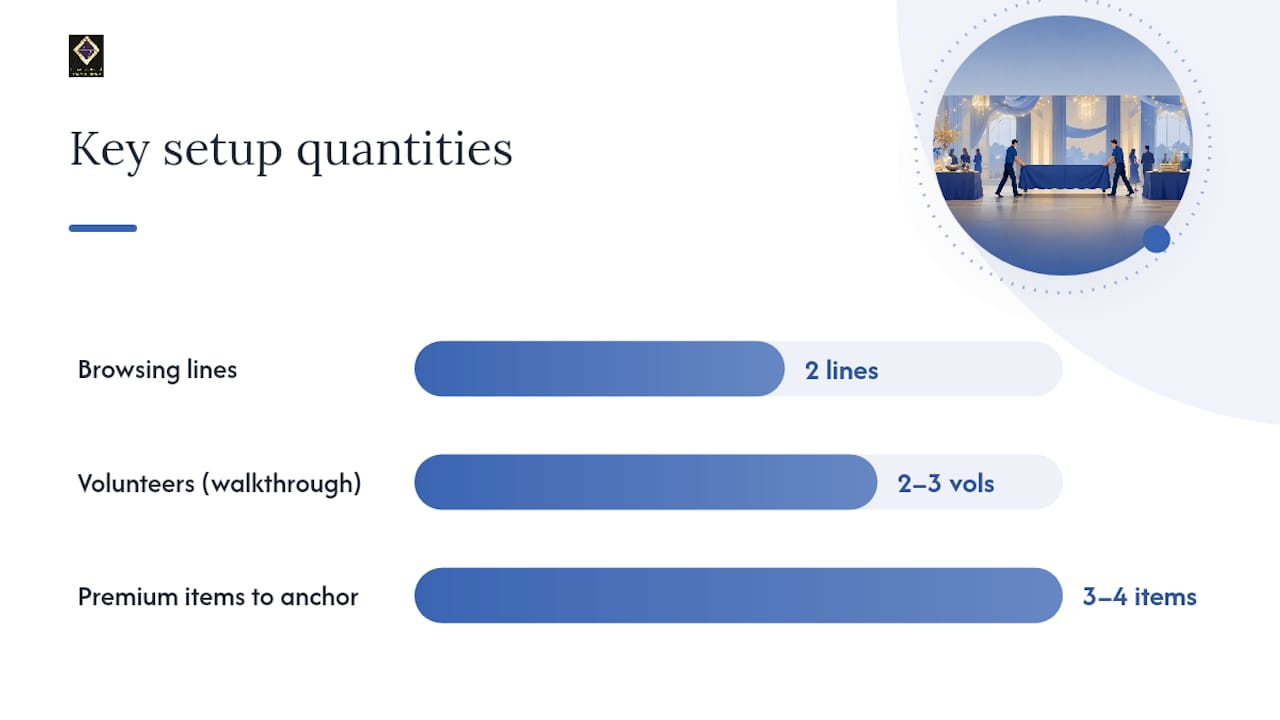
Fewer tables, better curated, beats a wall of items nobody has time to read. Leave 4 to 6 feet between table faces so two lines of guests can browse in opposite directions without colliding. That spacing also gives your top-dollar items room to breathe instead of getting lost next to a gift basket.
- Anchor your three or four premium items near high-traffic nodes, like the entrance to the main hall or the bar line.
- Group items by theme (travel, wine, family fun) rather than by donor, since themed tables encourage longer browsing and cross-category bidding.
- Keep a walking lane at least 3 feet wide down the center of the auction area at all times.
- Run a 20-minute walkthrough with two or three volunteers acting as guests before doors open, and watch where they bunch up.
Pro Tip: Have a volunteer stand at the narrowest point in your layout during the practice walkthrough. If two people can't pass comfortably there, that's your bottleneck, and it will be worse with a drink in every hand.
What Makes an Item Card Actually Sell the Item?
Every item card needs the same six pieces of information, in the same order, every time: a short title, a one or two sentence description that sells the experience rather than lists the object, the FMV, the starting bid, the bid increment, and the donor's name. Add a QR code and lot number so mobile bidders and paper bidders both know exactly what they're looking at.
Consistency does more work than decoration. Matching linens, uniform card sizes, and height variation using risers or crates create a visual hierarchy that tells guests where to look first, and display-focused strategies confirm that consistent signage and height variation improve perceived value.
- Photograph experience packages (dinners, trips, lessons) with people actually using them, not empty rooms or blank gift certificates.
- Give intangible items, like a private chef dinner, a physical stand-in on the table (a chef's hat, a wine glass) so they don't disappear next to wrapped goods.
- Keep decoration minimal around the QR code and bid line. That's the part guests need to read fastest.
- Skip elaborate props that compete with the price and lot number for attention.
Clear signage does double duty: it makes items look more valuable and it cuts down the time volunteers spend answering "wait, what is this?" questions all night.
How Do You Set Starting Bids and Increments?
Set your starting bid around 30 to 40% of FMV. Price it higher and you scare off the first bidder; price it lower and you leave money sitting on the table with nobody to blame but the setup. This range comes straight from how silent auction rules and setup guides recommend pricing donated items, and it holds whether the item is a $50 gift basket or a $2,000 vacation package.
Bid increments should scale with price, not stay flat across the whole room:
- Items under $100: increments of $5
- Items from $100 to $500: increments of $10 to $25
- Items over $500: increments of $25 or more
Buy-it-now pricing works only when used sparingly, typically 150 to 200% of FMV, so an eager bidder can lock in a high-value item without accidentally killing off competitive bidding earlier in the night. On paper sheets, print the next valid bid line for line, so nobody has to do math standing up with a pen. Mobile platforms should enforce this automatically. Getting the increment wrong is one of the most common, most fixable, silent auction planning mistakes.
Should You Use Mobile Bidding or Paper Bid Sheets?
Mobile bidding earns its keep once you're running more than 50 guests, mainly because outbid notifications and remote bidding keep momentum going through the whole night instead of dying off after the first hour. Keep paper bid sheets as a backup regardless of platform. Older guests and spotty venue Wi-Fi will find you eventually.
Prioritize features that actually change behavior at the table, not just ones that look good in a sales demo:
- Outbid text or push notifications
- Proxy bidding, so a guest can set a max and walk away
- Auto-charge checkout tied to a card on file
- Simple, fast registration at the door
- Reporting that breaks down totals by item and by volunteer table check
Test the Wi-Fi and every QR code inside the actual room, not from the parking lot, and do it at the time of night bidding will actually happen. One platform review confirms that testing the mobile-bidding flow with a volunteer acting as a bidder catches dead zones and bad QR placement that a desk test never reveals. Post a one-page how-to at the entrance and near each table, and staff a short demo table in the first 30 minutes so nobody spends the whole night confused about how to place a bid. Comparing platform options ahead of time also helps you shortlist the right event software before you commit to one for the season.
Who Runs the Room? Volunteer Roles and Checkout
A silent auction runs on six roles: setup lead, item check-in, table monitors, tech support, checkout or cashier, and a runner who handles transport and last-minute fixes. Assign these by name before the event, not by whoever's standing around at 5 PM.
- Arrival and check-in window: Items arrive, get tagged, photographed if not already done, and placed on their assigned table.
- Opening: A short announcement tells guests bidding is live and points them toward instructions.
- Closing countdown: Announce at 10, 5, and 1 minute before close so nobody misses a final bid.
- Checkout: Auto-charge through the mobile platform, a staffed card desk, or both, always paired with a receipt and clear item pickup instructions.
For disputes, document the lot number, the time, and the bidder's contact information immediately, then route it to a designated checkout manager rather than debating it at the table. Clear checkout procedures minimize unpaid items and speed up departure, which matters more than it sounds once 150 guests want their coats at the same time.
What's the Right Timeline From Planning to Event Day?
Silent auction planning tips almost always come down to timing. Rushed catalogs and untested platforms are what create event-night chaos, not bad luck.
- 8 to 12 weeks out: Set your fundraising goal, form your committee, build the item wish list, and start sponsor outreach.
- 4 to 6 weeks out: Finalize the item catalog and photos, lock in your bidding platform, design signage templates, and map the venue layout.
- 1 to 3 weeks out: Promote featured items to your guest list, run a full platform test, confirm volunteer shifts, and print all signage.
- Event day: Check items in against your catalog, build the physical display, test mobile bidding and power at every table, and walk the full room before doors open.
This structure mirrors what most experienced auction organizers recommend as a compact prep timeline, and the event-day walkthrough is the step people skip most often, right before they regret it. For the broader fundraising calendar around your auction, a charity fundraiser planning guide can help you sequence the auction against your program, dinner, and appeal.
How Does a Venue Reduce Your Setup Workload?
A venue that handles storage, staging, and furniture setup takes real weight off your volunteer list. Secure item drop-off windows and an in-house staging area mean donated items aren't sitting in someone's car trunk the morning of the event, and coordinated vendor arrivals mean your check-in volunteer isn't also directing catering trucks.
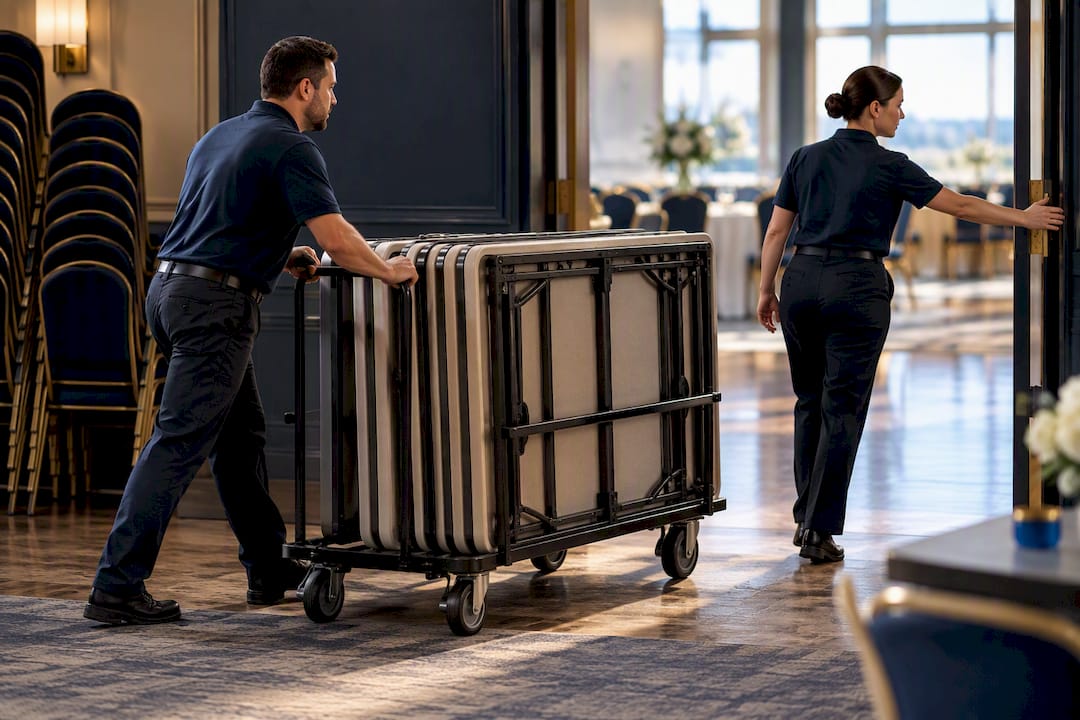
A venue operating out of a 6,000 sq ft hall handles logistics such as kitchen coordination for catering, A/V and lighting access for signage and presentations, and furniture set up before your team arrives. Built-in supports like a secure drop-off window and a dedicated pickup desk routinely save volunteer teams four to eight hours of event-night labor, hours better spent working the room than hauling tables.
What One Change Reliably Moves the Needle?
Most silent auctions don't fail because of bad items. They fail because guests never slow down long enough to read what's on the table. The single most reliable fix I've seen argued across auction guides isn't a fancier platform or a bigger sponsor ask. It's moving the auction tables ten feet closer to the bar line.
One layout tweak, pulling the display out of a side room and into the main walking path, can turn a quiet auction into one where guests circle back twice before the closing bell. Test your floor plan with real bodies before the real guests show up. It costs nothing and it's the fix people skip most.
— MARTIN
Let a Venue Handle the Logistics While You Run the Auction
This venue is a good option for nonprofits who'd rather spend planning hours on procurement and outreach than on tracking down folding tables and figuring out where the caterer parks. The hall includes a full commercial kitchen for flexible catering, tables and chairs on-site, a dry bar, a large projection wall for donor recognition or a live scoreboard, and sufficient floor space across several thousand square feet to lay out a display area without cramming guests together.

Booking includes setup, cleaning, and security as part of the package, with a $250 security deposit, a $350 cleaning fee, and security staffing at $65 per hour listed on the venue's FAQ page. If you're weighing a full-service space against renting furniture and hauling tables yourself, take a look at the Standard Event Package or browse the full list of event services, from corporate events to charity hosting, and reach out to check dates for your next auction night.
Sources
For deeper display tactics, see the table setup ideas guide, pricing and rules breakdown, mobile bidding overview, and step-by-step planning timeline. For catering coordination near your auction tables, the catering cost-saving checklist and this festive catering offerings list are worth a look too.
- Silent auction table setup ideas that improve bidding
- How to run a silent auction: rules and setup
- Silent auctions (RallyUp)
- How to run a silent auction: 7 steps (32auctions)
FAQ
Are Silent Auctions Profitable?
Yes, when the setup supports browsing and bidding rather than getting in its way. A well-organized layout with clear signage and grouped items increases engagement, which directly translates into more bids per item and higher final totals.
How Do You Set Pricing for a Silent Auction?
Start bids around 30 to 40% of an item's fair market value, then scale increments by price band: roughly $5 under $100, $10 to $25 between $100 and $500, and $25 or more above that. Buy-it-now pricing, if used, should sit around 150 to 200% of FMV so it doesn't shut down bidding early.
What Sells Well at Silent Auctions?
Experience packages, like private dinners, travel, and sports tickets, tend to outperform physical goods because they photograph well and feel personal. Themed bundles grouped together also perform better than single random items scattered across the room.
What Do You Start Silent Auction Items at?
Most guides land on 30 to 40% of the item's fair market value as the starting bid range. That's low enough to invite the first bid, but high enough to protect the donor's contribution from being undervalued.