
Set a net revenue goal, then build your calendar backward from it: 6 to 12 months out for a gala-scale event, 8 to 12 weeks for a smaller one. Your three immediate moves are locking a working budget, securing a venue deposit, and starting sponsorship outreach. Everything else in charity fundraiser planning, from seating charts to auction lots, exists to serve that number and that date.
TL;DR:
- Securing your venue and sponsorships at least six months in advance is crucial to meet large gala timelines and ensure priority based on your revenue goals.
- Aim for a 3:1 return on your costs by carefully balancing your budget, with contingency funds of 10 to 15 percent, and exclude low-return events if costs outweigh expected revenue.
- Lock auction procurement at least three weeks before the event and design sponsorship tiers with visible benefits to maximize revenue through structured selling.
- Assign clear volunteer roles with detailed contingency plans and keep the run-of-show locked two weeks early to maintain schedule control and avoid last-minute chaos.
- Focus your marketing efforts starting three months out with targeted outreach, emphasizing your mission and impact to increase attendance and engagement.
Table of Contents
- What Should a Charity Fundraiser Planning Checklist Include?
- When Should You Start Planning a Charity Gala?
- How Much Should a Charity Fundraiser Cost to Run?
- How Do You Structure Sponsorships and Auction Items?
- How Do You Choose a Venue and Plan the Seating?
- Which Technology Actually Moves the Needle on Event Night?
- How Do You Market a Charity Event to Fill Seats?
- Who Runs the Room? Volunteer Roles and Run-of-Show
- What Should You Check Right Before Doors Open?
- What Happens After the Event Ends?
- Practical Cost-Saving Tips From a Working Venue Host
- One Night, One Fix: A Planner's Note on What Actually Works
- Templates and Guides Worth Bookmarking
- Sources
- FAQ
What Should a Charity Fundraiser Planning Checklist Include?
A usable template does one job: it ties your revenue goal to every logistical decision that follows. Skip the generic checklist floating around online, and build one that opens with an executive summary covering your net revenue target, gross ticket pricing, and program impact story. Everything below that summary should map directly back to those numbers.
A working template needs to cover these areas without gaps:
- Budget with line items and a contingency line
- Venue contract status and deposit deadline
- Sponsorship tiers with dollar targets per tier
- Ticketing platform and pricing tiers
- Volunteer roster with named owners per role
- Run-of-show with timed cues
- Post-event reconciliation and donor follow-up steps
Assign an owner to each line, set a hard deadline next to it, and export a weekly progress view for your committee meeting. A complete planning template that links your goal to budget, timeline, and committee roles saves you from rebuilding the wheel every event cycle, and it makes the event repeatable next year instead of a one-off scramble.
When Should You Start Planning a Charity Gala?
Timing drives almost every decision quality issue organizers run into. Wait too long to lock a venue and you lose your preferred date or pay a rush fee. Wait too long on sponsorship and the good tiers are gone before you ask.
Here's how the milestones break down for a mid-size to large gala:
- 6 to 12 months out: Set the net revenue goal, pick the event format, and start venue tours. Large fundraising events need this much runway to secure a strong venue and build a real sponsorship pipeline; smaller events can compress this into a few months.
- 3 to 6 months out: Sign the venue contract, launch sponsorship sales, open ticket registration, and start auction procurement calls.
- 1 to 3 months out: Confirm entertainment and catering offerings, finalize the run-of-show draft, and push your first marketing wave.
- 1 to 2 weeks out: Close ticket sales or set a walk-in policy, print signage and auction catalogs, and confirm your final headcount with the venue.
- Week-of: Deliver load-in instructions to volunteers, confirm AV and Wi-Fi with the venue, and print name tags and table assignments.
- Day-of: Run setup by 10:00 AM for a 6:00 PM event, brief volunteers 90 minutes before doors, and lock the run-of-show timing with your emcee or auctioneer.
Two deadlines matter more than the rest. Lock your venue by the 6-month mark for a gala-scale event, and close procurement on auction items at least three weeks before the event so your team has time to catalog, photograph, and print bid sheets or load items into your mobile bidding app.
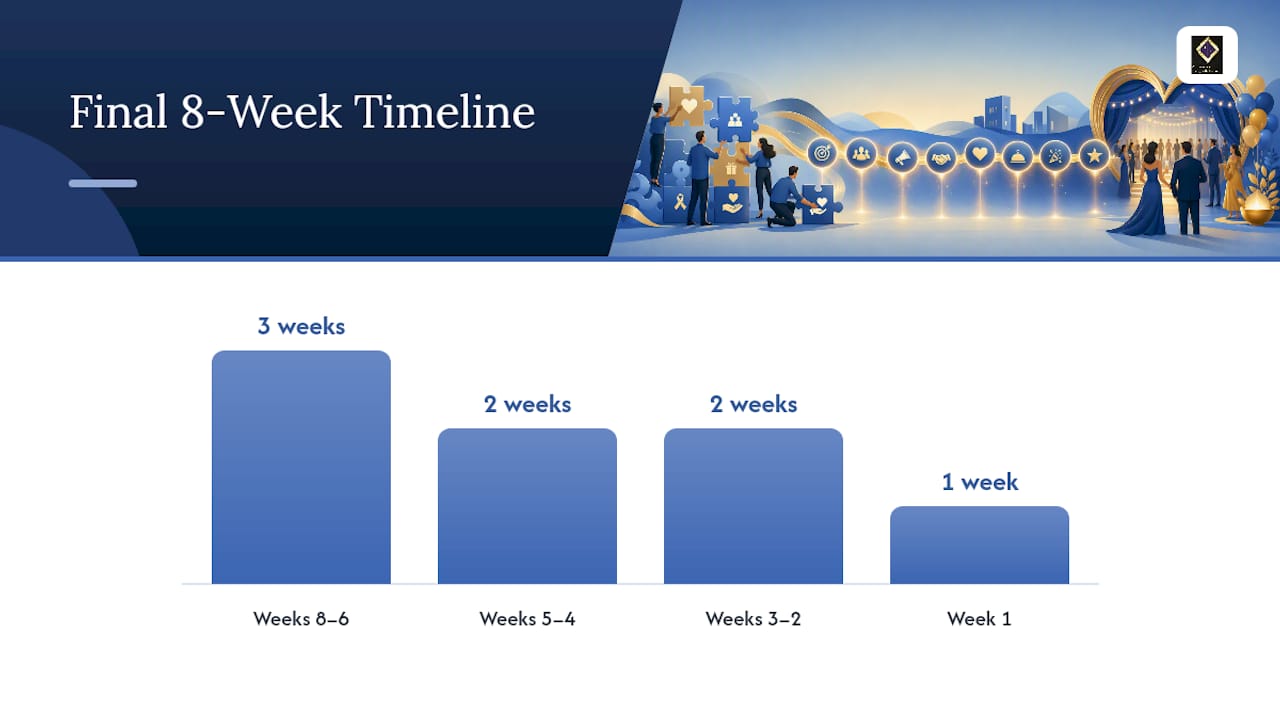
For the final 8 weeks, a week-by-week rhythm keeps momentum: weeks 8 to 6 finalize sponsors and open ticket sales, weeks 5 to 4 lock the auction catalog and send save-the-dates to major donors, weeks 3 to 2 confirm all vendors and print materials, and the final week is entirely logistics: seating charts, volunteer briefings, and a final walkthrough.
How Much Should a Charity Fundraiser Cost to Run?
Set two numbers before you set anything else: your gross revenue target and your net target after expenses. Split the gross goal across three streams, typically ticket sales, sponsorships, and auction or fund-a-need revenue, so no single stream carries the whole event.
Budget by category, and build in room for the unexpected:
- Venue and catering (usually the largest line item)
- AV, entertainment, and decor
- Marketing and printing
- Auction platform and mobile bidding fees
- Staffing, security, and insurance
- Contingency: 10 to 15% of total budget
A quick sanity check on event size and format: a common industry benchmark aims for a 3:1 return, meaning $3 raised for every $1 spent. That ratio varies a lot by market and cause, so treat it as a planning guardrail, not a guarantee. If your projected costs put you below a 2:1 return, scale the format down before you scale the ask up.
Pro Tip: Run your ROI check before you sign any venue contract, not after. If the math doesn't clear a reasonable return, a smaller cocktail reception often outperforms an overbuilt gala on a per-dollar basis.
How Do You Structure Sponsorships and Auction Items?
Sponsorship revenue should be sold, not just listed on a sponsorship deck. Build three to four tiers with clear dollar values and visible benefits, then start your sell cycle at the 5 to 6 month mark so decision-makers have budget cycle time to say yes.
Get these procurement and structure decisions right:
- Price sponsorship tiers with specific, visible perks (table signage, program ad, stage mention)
- Start sponsorship outreach 5 to 6 months before the event, not 2
- Lock auction procurement cutoffs three weeks before the event to allow time for cataloging and staging
- Bundle mid-value items into themed lots to generate more excitement and higher bids than single low-value items alone
- Set your fund-a-need giving levels in advance ($100, $250, $500, $1,000) and script the ask around a specific program outcome
A skilled benefit auctioneer improves the sequencing between the live auction and the paddle-raise, and that transition point is often where events either build or lose momentum heading into the ask.
Pro Tip: Put your fund-a-need immediately after your highest-energy live auction item, not at the end of the night when half the room has already left.
How Do You Choose a Venue and Plan the Seating?
Venue selection sets the ceiling on everything from catering flexibility to how well your sponsors get seen. Walk every finalist with your checklist in hand rather than trusting a sales pitch.
Confirm these before signing anything:
- Guest capacity against your projected headcount, with room to spare
- AV capability, reliable Wi-Fi, and kitchen access if you're bringing outside catering
- Insurance requirements and cancellation terms in the contract
- Load-in windows, storage space for auction items, security staffing, and parking capacity
Seating strategy is where a lot of organizers leave money on the table. Put sponsors at tables with clear sightlines to the stage and auction display, not tucked in a back corner because they booked late. Mix major-donor prospects with board members at the same tables instead of clustering by familiarity, since a well-placed seatmate can double as a stewardship conversation. Reserve a small VIP block near the front for top-tier sponsors and your honorary chair, and keep that list locked at least a week out so your floor plan doesn't shift the day of.
Which Technology Actually Moves the Needle on Event Night?
Your ticketing and auction platform choice affects revenue more than most organizers expect. Look for mobile bidding support, CRM integration, real-time reporting, and transparent fee structures before you commit.
Set these workflows before doors open:
- Choose a platform with mobile bidding built in, not bolted on
- Set up express check-in with pre-loaded credit cards to cut lines
- Decide your auto-charge policy for winning bids in advance, and communicate it on every bid sheet
- Export donor and purchase data into your CRM within 48 hours, not weeks later
Integrated mobile bidding and payment tools typically boost paddle-raise totals by double digits when they're set up correctly, largely because remote bidders and slower movers in the room can still participate without a paper bid sheet.
How Do You Market a Charity Event to Fill Seats?
Filling the room is a marketing problem with a deadline. Start your promotional push at the 3-month mark with email, then layer in social and direct outreach as the date closes in.
Build your promotional calendar around these mechanics:
- Email cadence: save-the-date at 3 months, invitation at 6 to 8 weeks, reminder series in the final 2 weeks
- Social push timed to coincide with sponsor and partner amplification, not run in isolation
- Direct phone or personal outreach to major donors and past top bidders, which outperforms email for that segment every time
- Early-bird pricing to drive early commitment, plus a limited VIP table release to create urgency
Your copy should lead with the mission, not the party. A hero message about the specific program your event funds converts better than generic "join us for an evening" language, especially when paired with one concrete impact number.
Who Runs the Room? Volunteer Roles and Run-of-Show
Every successful event night comes down to a handful of people knowing exactly what they're doing and when. Assign these roles by name, not by department, at least two weeks before the event:
- Check-in lead: manages registration table and credit card capture
- Auction monitor: watches bid sheets or the mobile platform for closing times
- Fund-a-need coordinator: manages paddle distribution and giving-level tally
- Payments lead: handles auto-charge issues and manual payment overrides
- Floor manager: runs the master run-of-show timeline and cues the emcee
Give each volunteer a one-page role brief with their shift window, their backup contact, and three likely problems they'll face. Your run-of-show should list exact cue times (doors at 6:00, welcome remarks at 6:45, live auction at 7:30, fund-a-need at 8:15) along with a contingency trigger, like what happens if the program runs 15 minutes behind.
Pro Tip: Print two copies of the run-of-show for every key volunteer, one in their pocket and one taped inside their folder. Phones die and screens get hard to read in dim rooms.
What Should You Check Right Before Doors Open?
The last 90 minutes before guests arrive is when small oversights turn into night-long headaches. Run through these checks in order:
- Confirm Wi-Fi and payment processing are live and tested with a dummy transaction
- Verify auction display tables match the printed or digital catalog
- Walk the seating chart against the actual name tags
- Brief every volunteer on their role and their backup contact
If a card declines at check-in, have a second payment method ready and a volunteer trained to handle it quietly, away from the line. If the mobile bidding platform drops connectivity, fall back to paper bid sheets for that specific item rather than pausing the whole auction. If a bidder disputes a winning bid, pull the digital or paper record immediately and settle it away from the crowd. At night's end, run checkout in shifts, hand off physical items only against a signed receipt, and reconcile the cash box before anyone leaves the building.
What Happens After the Event Ends?
The 48 hours after your event matter almost as much as the event itself for long-term donor relationships. Send a thank-you text or email within 48 hours, follow with tax receipts and a program impact update within two weeks, and use that update to set up next year's ask.
Reconciliation should happen fast:
- Break down revenue by stream: tickets, sponsorships, auction, fund-a-need
- Compare actual costs against your budgeted contingency line
- Report net ROI to your board or stakeholders within two weeks
- Hold a debrief within a week and capture what worked, what didn't, and specific numbers for next year's plan
A 3:1 raise-to-spend benchmark is a useful yardstick when you're reporting results, but pair it with your actual net figure since board members care more about dollars raised than ratios.
Practical Cost-Saving Tips From a Working Venue Host
Running events at a working venue teaches you where the real savings hide. A full commercial kitchen on-site, like the one at The Ambassador Club, lets planners bring in outside catering or use bundled catering packages instead of paying a flat per-plate markup. Confirm your load-in window, staffing needs, and final menu at least three weeks out, not three days out. For deeper menu-planning steps, see this guide to family celebration menu planning, and this breakdown of event catering cost-saving strategies.

One Night, One Fix: A Planner's Note on What Actually Works
The best events aren't the ones with the biggest budget. They're the ones where someone locked the run-of-show two weeks early and stuck to it. A gala once ran 40 minutes ahead of schedule purely because the floor manager had a printed contingency plan for a shortened program, and moved the fund-a-need up rather than letting the room lose energy waiting on a stalled auction close. The fix that saved the night wasn't more money. It was one person with a backup timeline in their pocket.
If you take one thing from this guide, make it that: write your contingency triggers into the run-of-show itself, not into a separate document nobody opens at 8:00 PM.
— MARTIN
Templates and Guides Worth Bookmarking
For deeper planning tools beyond this checklist, start with Funraise's fundraising event planning template for budget and role-mapping, Givebutter's nonprofit event planning checklist for timeline sequencing, and Soapbox Engage's nonprofit gala checklist for auction procurement specifics. For catering-side planning, customizing catering packages helps control per-guest costs.
Sources
- The Ultimate Nonprofit Event Planning Template | Givebutter
- How to Plan a Nonprofit Gala: A Complete Checklist for 2026 | Soapbox Engage
- Fundraising event planning template | Funraise
FAQ
What Is the 30/70 Rule for Charities?
The 30/70 rule is a common guideline suggesting nonprofits keep overhead and fundraising costs around 30% or less of total spending, directing the remainder toward program impact. It's a rough benchmark, not a legal requirement, and actual ratios vary by cause and organization size.
What Is the 80/20 Rule in Fundraising?
The 80/20 rule holds that roughly 80% of donations typically come from about 20% of donors, usually your major donors and top sponsors. That's why direct outreach to that smaller group matters more than broad email blasts when you're planning a charity fundraiser.
What Is the 33% Rule for Nonprofits?
Definitions of the "33% rule" vary depending on the source, and there's no single universally accepted standard. Some organizers use it informally to describe keeping any one revenue stream, like ticket sales, from exceeding a third of total revenue, which protects the event if that stream underperforms.
How Do I Organize a Charity Fundraiser?
Set your net revenue goal first, then build a timeline backward from event day, budgeting 6 to 12 months for a gala-scale event or 8 to 12 weeks for a smaller one. From there, lock your venue, launch sponsorship outreach, open ticket sales, and build a run-of-show that assigns every volunteer a specific role and cue time.
How Far in Advance Should I Book Auction Item Procurement?
Lock your procurement cutoff at least three weeks before the event so your team has time to catalog items, confirm fair-market values, and print or upload materials to your bidding platform. Waiting past that window creates last-minute scrambling that shows up in a rushed catalog on event night.