
Offsite meetings reliably produce clearer decisions, stronger cross-team collaboration, and measurably higher creative output when they're planned against a specific objective. Leaders, cross-functional teams, and event planners see the biggest gains: faster alignment, new working relationships that outlast the trip, and a noticeable morale lift. The catch is that none of it happens by accident.
TL;DR:
- An offsite should have a clear measurable objective and a designed agenda aligned with that goal to ensure meaningful decision-making and outcomes.
- The choice of venue, including layout, AV equipment, and accessibility, significantly impacts engagement, with dedicated spaces supporting workshop formats and informal interactions.
- Proper planning involves confirming AV and connectivity testing in advance, avoiding over-scheduling and underestimating travel time to maximize productive hours.
- Offsites in hybrid or remote environments tend to produce a 24% increase in collaboration requests and foster relationships that persist over two years.
- Regularly scheduled offsites, ideally once or twice a year, are most effective when they focus on knowledge exchange, relationship building, and strategic alignment.
Table of Contents
- What Are the Real Benefits of Offsite Meetings?
- Do Offsites Actually Deliver ROI?
- How Do You Plan an Effective Offsite?
- What Should You Avoid During an Offsite?
- Offsite Checklist and Sample Agendas
- A Venue Host's Take on What Actually Makes Offsites Work
- Book an Offsite Venue That Removes the Planning Friction
- Sources
- FAQ
What Are the Real Benefits of Offsite Meetings?
The productivity gain shows up first. Pull a team out of their normal building and the interruptions that eat a typical Tuesday, pinging Slack, walk-by questions, back-to-back internal meetings, mostly disappear. Decisions that would take three follow-up emails at the office get made in the room, on the spot, because the people who need to weigh in are already sitting there.
Collaboration works the same way but compounds over time. A cross-functional offsite forces engineering, sales, and finance to hash out a roadmap face-to-face instead of trading comments in a shared doc for two weeks. Harvard Business Review's research on offsites points out that this kind of deep work and relationship building is exactly what hybrid and remote setups struggle to replicate.
Creativity gets a boost from something less obvious: distance. New scenery interrupts the mental scripts people run in their usual workspace. Convene's research on offsite planning notes that a non-traditional setting acts as a catalyst for creative thinking and raises psychological safety, which is why people speak up more freely in an unfamiliar room than in the same conference room they've argued in for years. Neutral, low-distraction venues also support better information retention, according to organizational psychology research on offsite collaboration, so what gets discussed actually sticks.
Morale and venue quality matter more than most agendas account for.
- Recognition moments land harder outside the office, where they feel intentional rather than routine.
- Retention improves when employees associate the company with investment in their growth, not just deadlines.
- A dedicated AV setup and a layout built for workshops (round tables, breakout nooks, a dance floor doubling as open floor space) remove the friction that kills momentum in a repurposed hotel ballroom.
- Accessible venues widen who can actually attend and contribute.
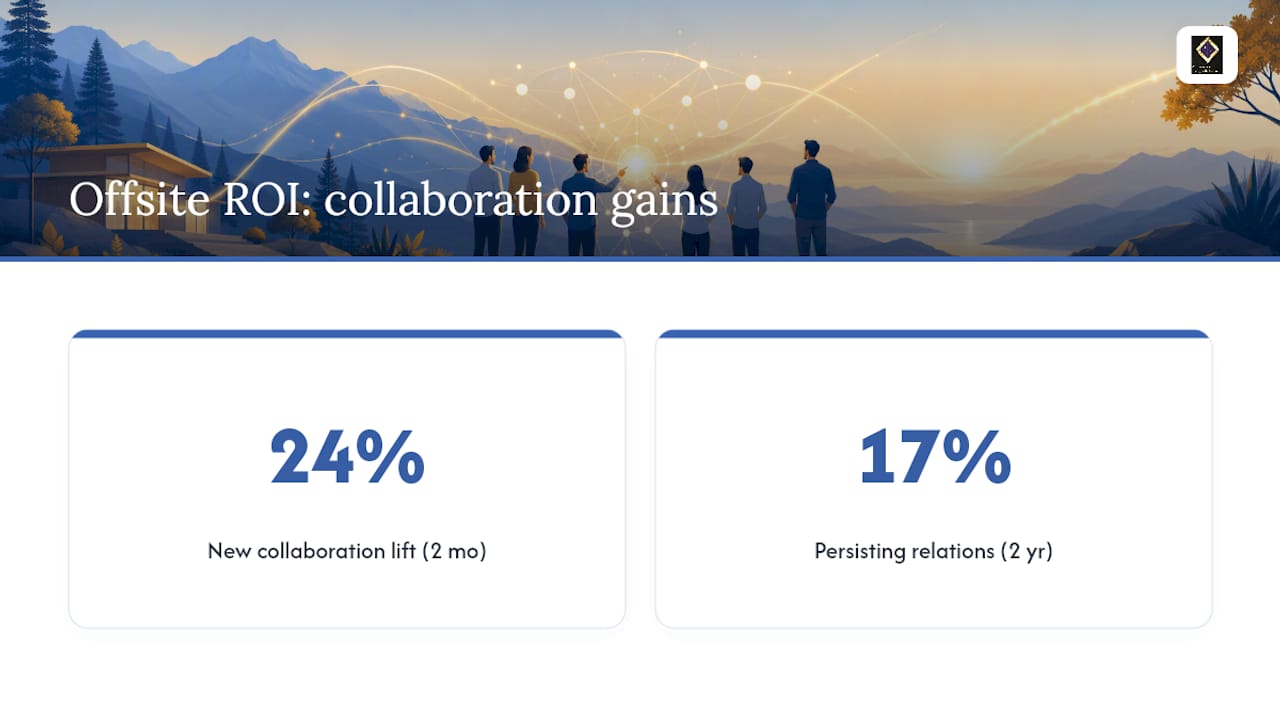
Statistic to remember: attendees of offsite retreats saw roughly a 24% increase in new collaboration requests in the two months following the event.
Do Offsites Actually Deliver ROI?
The research backs up what most leaders sense intuitively but rarely quantify. HBR frames offsites as most valuable for knowledge-intensive organizations, precisely because deep work and relationship building are hard to replicate in a hybrid schedule fragmented across time zones and calendars.
The numbers get more specific from there.
Attendees of offsite retreats experienced about a 24% increase in new collaboration requests in the two months after the event, and roughly 17% of those new relationships persisted over two years.
That's not a one-week sugar high. The caveat: context matters. A remote-first company running its first offsite in three years will see a bigger jump than a team that already meets in person weekly. Frequency and baseline collaboration levels shape how much lift you should expect.
How Do You Plan an Effective Offsite?
Start with the objective, not the venue. Are you aligning on strategy, training new managers, or rebuilding trust after a rough quarter? The answer determines everything downstream.
- Write down the measurable output. A decision made, a roadmap finalized, three cross-team pairings formed, something concrete you can check against 30 days later.
- Pick the format to match. A half-day works for a single decision; a full day suits training; multi-day trips fit strategic resets or annual leadership alignment, which practitioner guides recommend over routine execution meetings.
- Run the venue checklist. Room layout, AV specs, catering, breakout spaces, accessibility, and transport all affect whether the offsite hits its stated goal.
- Set the budget by category. Venue, catering, and travel add cost, but targeting decision-making or culture-building sessions tends to justify the spend better than a loosely themed "team day."
- Design the agenda in short blocks. Assign an owner to every segment and protect real social time, not just a coffee break wedged between two presentations.
Pro Tip: Confirm AV and connectivity in writing with the venue, then schedule a test run before attendees arrive. Poor tech is one of the most common reasons an otherwise well-planned offsite falls flat.
What Should You Avoid During an Offsite?
Most offsite failures trace back to a handful of repeat mistakes, and each one is easy to catch before you book anything.
- No stated objective, so the day feels productive but nothing measurable actually happened.
- No follow-up plan, meaning the energy from the room evaporates by Monday.
- An agenda packed end to end with zero informal time, which kills exactly the relationship-building that makes offsites worth the cost.
- A venue missing the AV or accessibility features the day actually requires.
- Underestimating travel time, which quietly shrinks a "full day" into four usable hours.
- No assigned facilitator, so sessions drift and decisions never get made.
Offsite Checklist and Sample Agendas
Venue booking checklist: confirm AV specs in the contract, cancellation policy, accessibility features, and catering details in writing.
Logistics checklist: arrival windows, an AV test slot, dietary forms collected in advance, and one named point of contact on-site.
- Half-day agenda: welcome and objective (15 min, facilitator), working session (90 min, team lead), lunch and informal time (60 min), decisions recap (30 min, owner assigned).
- Full-day agenda: morning strategy block, working lunch, afternoon breakout sessions, closing session with a decisions log and assigned owners.
- Follow-up sequence: publish the decisions log within 48 hours, assign owners immediately, then check progress at 30, 60, and 90 days.
A Venue Host's Take on What Actually Makes Offsites Work
Running events inside a working commercial kitchen and a 6,000 sq ft hall for years teaches you something academic research can't: most offsite failures are logistical, not strategic. A built-in projection wall and dry bar cut setup time dramatically compared to renting in outside AV. Layout matters more than teams expect. Round tables for breakouts beat classroom rows for anything requiring real discussion, and a menu of simpler shared plates keeps lunch from eating 90 minutes out of the working agenda. For planners weighing capacity against group size, our guide on venue capacity is worth a look before you book.
— MARTIN
Book an Offsite Venue That Removes the Planning Friction
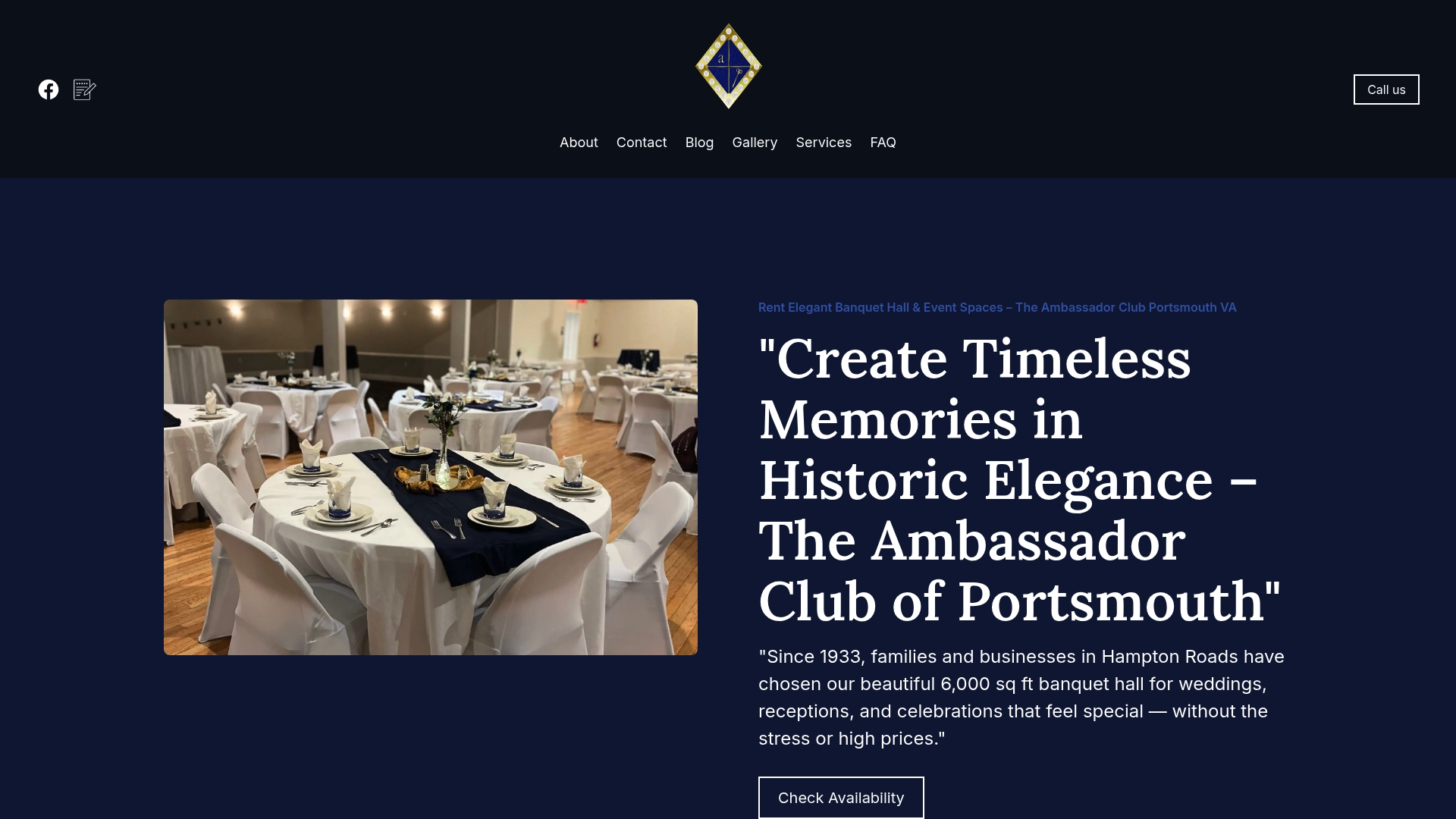
Ambassador Club of Portsmouth gives corporate teams a historic 6,000 sq ft hall with a full commercial kitchen, built-in projection wall, dance floor, and dry bar already in place, so you're not coordinating five vendors to run one working session. Packages cover setup, cleaning, and security, and flexible outside catering policies mean you can bring in a caterer that fits your team's preferences instead of being locked into a single kitchen. Compared to renting a generic hotel conference room and layering on separate AV and catering contracts, this cuts real planning hours out of your week.
If you're weighing venue options for a leadership offsite or a full-day training session, our guide to choosing venue size for corporate events walks through capacity and layout tradeoffs in more detail. For business travel and timing considerations that affect attendance, Wild Foodz's piece on convenience in business travel is a useful companion read. When you're ready to move forward, request a site visit or a sample agenda through the Ambassador Club of Portsmouth landing page and check availability for your target dates.
Sources
- Why offsites work — Harvard Business Review
- Management professors: think twice about skipping offsites — Fortune
- What is an offsite meeting and why should you plan one? — Convene
FAQ
What Should Be Avoided During Offsite Meetings?
Avoid agendas with no stated objective, back-to-back sessions with zero informal time, and venues missing the AV or accessibility features the day requires, all of which quietly cancel out the benefits an offsite is supposed to deliver.
What Are the 5 P's of Meetings?
Definitions vary across sources, but a common version covers purpose, participants, plan, place, and process, essentially confirming why you're meeting, who needs to be there, what happens, where, and how.
What Are the Benefits of Online Meetings?
Online meetings cut travel cost and time and work well for routine updates, but they struggle to replicate the deep focus and relationship building that in-person offsites generate, which is why HBR argues offsites remain valuable for knowledge-intensive teams specifically.
How Often Should a Company Run an Offsite?
Once or twice a year is a common cadence for leadership alignment offsites, with allocated social time built into the schedule; many organizations book between December and March, which can affect venue availability.