
Stress-free event planning means the outcome, not the mood: a system that catches problems before guests notice them, so the host spends the actual event present instead of firefighting. It's not about eliminating every hiccup. It's about building enough buffer, delegation, and structure that hiccups stay invisible.
You can start acting on this before finishing the article. Here's the short version:
- Set the vision first. Decide what "success" looks like before booking anything.
- Lock the date and budget together. These two decisions drive every other one.
- Assign a single timeline keeper. One person, one authority, no conflicting instructions.
- Protect the final hour before the event. Nothing new gets scheduled there.
- Build one shared plan document. Contacts, contracts, and timeline in a single place everyone can see.
Each of those gets its own playbook below, along with the checklist, the vendor math, and the backup plans that keep a rough patch from turning into a visible mess.
Key Takeaways
Stress-free event planning works because it replaces last-minute decisions with a checklist built weeks in advance, protected by time cushions and a single point of accountability.
| Point | Details |
|---|---|
| Lock date and budget first | These two decisions drive every other choice and prevent decision paralysis later. |
| Assign one timeline keeper | Give a single person authority to change the run-of-show to avoid conflicting instructions. |
| Build in 10 to 15% transition buffers | Add extra time to transitions so small delays never become visible to guests, typically a modest buffer built into the schedule. |
| Centralize vendor and plan details | Keep contacts, contracts, and the timeline in one shared document everyone can access. |
| Choose a venue with built-in services | Ambassadorclubportsmouth's package includes kitchen access, setup, and cleaning to cut coordination tasks. |
Table of Contents
- What Is Stress-Free Event Planning and How Do You Build a Timeline?
- How Do You Delegate Without Creating More Work?
- How Should You Budget and Book Vendors Without Missing Deadlines?
- How Do You Build a Day-Of Timeline With Buffer Time?
- What Are the Most Common Event Planning Failures and How Do You Back Them Up?
- What Tools Keep an Event Team Aligned Without Extra Meetings?
- How Do Venue Packages Reduce Day-Of Stress?
- How Do You Manage Client and Stakeholder Expectations?
- How Do You Communicate With Vendors and Team Members to Avoid Misunderstandings?
- How Do You Run a Post-Event Review That Actually Improves Future Planning?
- How Do Event Planners Take Care of Themselves During the Process?
- How Do You Manage a Budget to Reduce Financial Stress?
- Why Systems Beat Panic on Event Day
- Book a Venue That Removes the Coordination Work Entirely
- Sources
- FAQ
What Is Stress-Free Event Planning and How Do You Build a Timeline?
Front-loading two decisions, your date and your budget, stops the decision paralysis that cascades into everything else. Once those are locked, the rest of the timeline falls into a predictable rhythm rather than a scramble.
Here's roughly how the weeks break down for a mid-sized event, adapted from the kind of week-by-week planning that hospitality guides recommend:
- 8+ weeks out: Confirm date, budget, guest list, and venue. Book vendors with the longest lead times.
- 4 to 6 weeks out: Finalize menu, send invitations, confirm rental orders, assign roles to your team.
- 2 weeks out: Lock the final headcount, confirm vendor arrival windows, build the run-of-show.
- The final week: Prep make-ahead food, pack a day-of kit, confirm every vendor by phone or text.
- Day of: Execute the run-of-show. Nothing new gets added after setup begins.
A party planning checklist that spreads tasks across this kind of window, rather than cramming them into the final 72 hours, is one of the biggest predictors of a calm host. The "one-hour-before" rule matters here too: everything that can be finished early should be finished early, so the final hour before guests arrive belongs to the host, not the to-do list.
Pro Tip: Make-ahead dishes and a "guests bring the sides" request cut day-of cooking time dramatically without making the event feel any less hosted.
How Do You Delegate Without Creating More Work?
Delegation only reduces stress when the handoff is specific. "Can you help with the DJ?" creates more questions than it answers. A deliverable, a deadline, and a point of contact does not.
Four roles cover most events of any size:
- Vendor lead: Confirms arrival times, handles day-of vendor questions, and is the single point of contact for outside companies.
- Guest coordinator: Manages RSVPs, seating, and any last-minute guest issues.
- Timeline keeper: The only person authorized to adjust the run-of-show once it's set, a tactic that keeps teams from working off conflicting instructions.
- Site lead: Oversees setup, signage, and breakdown at the venue itself.
When you hand off a task, write it as: task, deadline, who to contact if something goes wrong. That's the whole template.
If a volunteer role starts requiring specialized skill (AV setup, professional bartending, security), that's the signal to convert it to paid help rather than stretch a favor past its limits.
How Should You Budget and Book Vendors Without Missing Deadlines?
A workable event budget has three lines: fixed costs (venue, rentals), variable costs (catering per head, favors), and a contingency line worth 10% of the total. Skip that contingency line and any surprise becomes a crisis instead of a rounding error.

Vendor booking order matters more than most hosts expect. A practical rule from event-planning guides is to book vendors with the longest lead times first, meaning venue and caterer before florist or DJ, then layer in shorter-lead items as the date approaches.
Once vendors are booked, centralize their information in one place:
- Contact name, phone, and email for every vendor.
- Contract terms and payment due dates.
- Arrival and load-in windows for the day of the event.
- Any special requirements (power access, kitchen use, parking).
Catering usually eats the largest share of a personal or nonprofit event budget, and menu planning steps built around your vendor's lead time keep this line from becoming the one that blows the budget late.
How Do You Build a Day-Of Timeline With Buffer Time?
A run-of-show is just a script for the day, minute by minute, but the script only works if it assumes things will run a little late.
A basic outline looks like this:
- Vendor and staff arrival, setup begins.
- Final walkthrough and troubleshooting window.
- Guest arrival buffer.
- Main event moments (ceremony, speeches, dinner service).
- Transitions between moments.
- Breakdown and vendor departure.
Professional planners routinely add 10 to 15% extra time to every transition in a run-of-show, which absorbs the small delays that happen at almost every event without letting guests notice anything went off schedule. A 30-minute cocktail hour becomes 34 to 35 minutes on paper. That's the whole trick.
Write a call sheet for vendors and team that lists arrival time, task, and contact number for each person. Distribute it 48 hours ahead, not the morning of.
Pro Tip: If you only build cushion into one part of the day, put it right before the biggest visible moment, like the ceremony or the keynote. That's where a delay is most noticeable to guests.
What Are the Most Common Event Planning Failures and How Do You Back Them Up?
Most event problems fall into a short, predictable list: weather, a delayed caterer, a tech failure, or missing rentals. Event planning consistently ranks among the more stressful jobs precisely because these issues tend to surface at the worst possible moment, right before or during the event itself.
Cheap, low-effort backups cover most of these:
- Weather: Have an indoor alternative identified in advance, even if it's a smaller footprint.
- Caterer delay: Keep a pre-packed snack kit or a backup appetizer platter on standby.
- Tech failure: Pack spare chargers, an extra HDMI cable, and a backup speaker.
- Missing rentals: Confirm your rental order 72 hours out, not just at booking.
The decision rule is simple: if a problem will be visible to guests within 15 minutes, activate the backup immediately. If it's fixable behind the scenes, give it one attempt before switching plans.
What Tools Keep an Event Team Aligned Without Extra Meetings?
One shared document does more for stress reduction than any app subscription. It should hold vendor contacts, the full timeline, contract terms, and payment milestones, all in one place that every team member can see without asking.
Keep the toolset simple:
- A shared spreadsheet or document for the master event plan.
- One calendar invite per major deadline, not a flood of separate reminders.
- A single messaging channel for day-of updates, so nothing important gets buried in someone's texts.
Starting early and keeping a shared central plan rather than scattering information across emails and phone calls is one of the most consistent tactics across event-planning guidance. Use quick status checks (a one-line text: "caterer confirmed for 4pm") for routine updates, and reserve full calls for anything that changes the timeline or budget.
How Do Venue Packages Reduce Day-Of Stress?
A short list of built-in services can quietly remove half of a host's coordination workload before the event even starts. A venue package that includes setup, a working kitchen, and cleaning eliminates several logistics items that otherwise land on the host or the timeline keeper.
At the Ambassador Club in Portsmouth, Virginia, that typically looks like:
- Full commercial kitchen access, so caterers or a host-managed spread don't need outside equipment rentals.
- Tables, chairs, and a dance floor included, removing an entire rental category from the vendor list.
- Setup and cleaning built into the package, so the site lead isn't managing breakdown crews on top of everything else.
- A dry bar and built-in projection wall, which simplifies both hospitality and presentation logistics for corporate events.
A venue like this can genuinely lower coordination load simply because fewer moving pieces need separate vendors, separate contracts, and separate confirmation calls.
How Do You Manage Client and Stakeholder Expectations?
Most expectation problems start the same way: someone assumed something the plan never actually promised. The fix is writing decisions down and confirming them, not just discussing them out loud.
Set expectations early by putting the budget, guest count, and event vision in writing before vendors are booked. If a stakeholder wants changes later, that document becomes the reference point instead of a memory argument.
Give stakeholders a small number of real decision points, not an open-ended say in everything. For a corporate event, that might mean the executive sponsor approves the guest list and budget tier, while the planner controls vendor selection and run-of-show details. For a wedding or family event, it's usually the couple or host approving the big-ticket items (venue, catering, date) while delegating smaller choices like centerpieces or favors.
Update stakeholders on a schedule, not whenever they ask. A short weekly recap (what's confirmed, what's pending, what needs a decision) prevents the constant "just checking in" messages that eat planning time.
When a request comes in that would blow the budget or timeline, respond with the tradeoff instead of a flat no. "We can add that, but it means cutting the floral budget by 15%" gives the stakeholder a real choice instead of a wall.
Finally, build in one buffer decision point about two weeks before the event where no further major changes are accepted. Communicate that date early, and stakeholders tend to respect it because they saw it coming.
How Do You Communicate With Vendors and Team Members to Avoid Misunderstandings?
Most vendor misunderstandings trace back to information that lived in one person's head instead of on paper. The fix isn't more communication. It's more specific communication.
Every vendor conversation should end with a written confirmation: date, time, deliverable, and cost, sent by email even if the conversation happened by phone. This isn't about distrust. It's about making sure both sides remember the same agreement three weeks later.
Give each vendor a single point of contact on your team, the vendor lead role mentioned earlier, rather than letting multiple team members reach out with overlapping or conflicting requests. Vendors juggling five events a week don't have the bandwidth to reconcile mixed messages from your side.
Confirm arrival times and logistics 48 to 72 hours before the event, not just at booking. Plans change. A caterer who confirmed six weeks ago might have a different truck or a different lead cook by event day, and a quick check catches that early.
For internal team communication, the timeline keeper role solves most of the confusion. When only one person can approve changes to the run-of-show, team members stop getting conflicting instructions from different directions. Route every schedule question through that person, even if it feels like an extra step.
Keep a single channel, whether that's a group text or a shared app, for day-of updates. Splitting communication across email, text, and phone calls guarantees someone misses something important.
How Do You Run a Post-Event Review That Actually Improves Future Planning?
Skipping the post-event review is one of the easiest ways to repeat the same avoidable problems next time. A short debrief, done within a week while memory is fresh, is worth more than a long one done a month later.
Ask three questions of your core team: what worked, what caused stress, and what would you change if you did this again. Keep it specific. "Vendor coordination was rough" isn't useful. "The caterer arrived 40 minutes late because the load-in time wasn't confirmed" is something you can fix next time.
Gather feedback from stakeholders and guests too, if the event type calls for it. A short survey after a corporate event or nonprofit fundraiser, three or four questions, catches issues the planning team never saw from the inside.
Write the findings into next year's version of the shared plan document, not a separate file that gets lost. If the caterer confirmation issue keeps showing up, that becomes a permanent line item: "confirm load-in time 72 hours out," built into the checklist itself.
The goal of a post-event review isn't blame. It's converting a one-time frustration into a permanent fix, so the same stress point doesn't resurface at the next event.
How Do Event Planners Take Care of Themselves During the Process?
Event planning stress compounds when the planner treats their own well-being as the last priority on the list. That's backward. A burned-out planner makes worse decisions under pressure, which creates more problems to manage.
Protect actual sleep and meals during the final week before an event, not just during the event itself. The week leading up to an event is often more draining than the day itself, and skipping meals or sleep to squeeze in one more task rarely pays off.
Build a hard stop into your own schedule, a time each evening when you close the laptop and stop responding to vendor emails until morning. Vendors used to reasonable business hours will respect this. The ones who don't are a signal worth noting for future bookings.
Delegate not just tasks but decisions. If a team member can make a reasonable call on seating chart questions or vendor timing without checking with you first, let them. Every decision routed through one person is a decision that person has to hold in their head.
On the day of the event, build fifteen minutes into your own schedule with no task attached, even if it's just standing somewhere quiet before guests arrive. That's the practical version of the "protect the final hour" rule mentioned earlier, applied to the planner instead of just the timeline.
How Do You Manage a Budget to Reduce Financial Stress?
Financial stress during event planning usually comes from surprises, not from the total cost itself. A host who knows the number going in, even a large one, handles it better than a host who gets hit with unplanned add-ons three weeks before the date.
Build the budget with three categories: fixed costs that won't change (venue rental, base catering), variable costs that scale with guest count (per-head meal pricing, favors), and a contingency line set at roughly 10% of the total. That contingency line is what absorbs the inevitable extra rental chair or last-minute floral change without derailing the rest of the plan.
Review the budget against actual spending every two weeks, not just once at the start. Catching a category running over by 10% at week four is manageable. Catching it three days before the event is a crisis.
Ask vendors for payment schedules broken into milestones (deposit, midpoint, final balance) rather than one lump sum. This spreads the financial pressure across the planning window instead of concentrating it right before the event, when cash flow is often tightest.
If the budget starts to strain, cut from categories guests won't notice, like specialty linens or premium favors, before cutting from categories they will notice, like food quality or guest count. A cost-saving approach to catering specifically is often the highest-leverage place to trim, since it's usually the largest line item and has the most flexible options within it.
Why Systems Beat Panic on Event Day
The single most reliable stress reducer isn't more effort. It's a system that runs without you needing to hold every detail in your head. Hosting events at a venue built for exactly this kind of turnover has shown, again and again, that the calm hosts are the ones who wrote the plan down weeks earlier, not the ones scrambling hardest on the day.
Book a Venue That Removes the Coordination Work Entirely
Every checklist, buffer, and delegation trick above still leaves the host managing rentals, kitchen access, and cleanup crews across multiple vendors. Ambassadorclubportsmouth removes that layer by folding it into one booking: a full commercial kitchen, tables and chairs, a dance floor, and setup and cleaning built into the package, all inside a 6,000 square foot hall that's hosted Hampton Roads families and businesses since 1933.

That means fewer contracts to track, fewer vendor confirmations to chase, and one point of contact instead of five. Whether you're planning a wedding, a corporate event, or a nonprofit fundraiser for up to 200 guests, the venue side of your checklist gets a lot shorter the moment the room itself handles setup, kitchen access, and breakdown. Check available dates and get a quote through the Ambassador Club landing page before locking in your event date.
Sources
- A 21-step event planning checklist that covers every detail
- Party Planning Checklist: The Ultimate Hosting Guide for a Stress-Free Party
FAQ
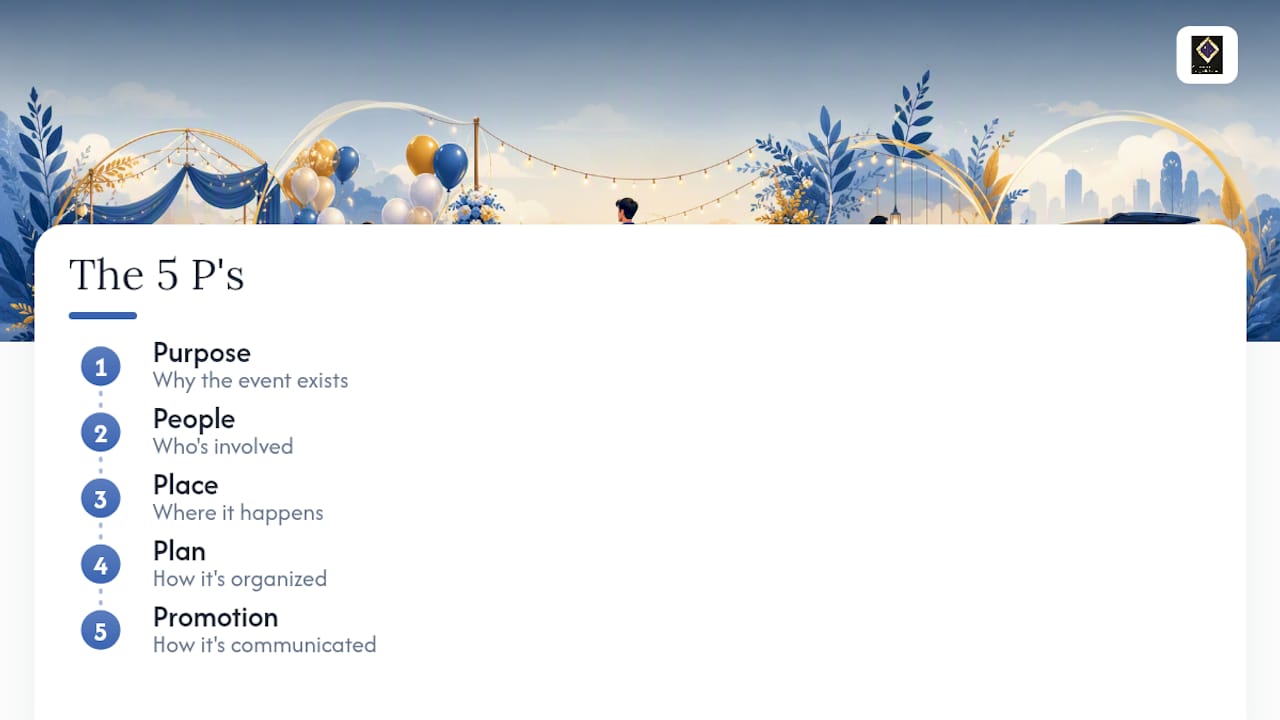
What Are the 5 P's of Event Planning?
The 5 P's commonly cited in event management are Purpose, People, Place, Plan, and Promotion, covering why the event exists, who's involved, where it happens, how it's organized, and how it's communicated.
What Does It Mean to Be Stress-Free?
Being stress-free during event planning doesn't mean nothing goes wrong. It means you've built enough buffer, delegation, and backup plans that problems get absorbed before guests or stakeholders notice them.
How Do You Plan a Stress-Free Wedding?
Lock your date and budget early, delegate roles like vendor lead and timeline keeper, build a run-of-show with transition buffers, and choose a venue that handles setup and cleanup, like Ambassadorclubportsmouth's included packages, so fewer vendors need separate coordination.
What Type of Event Planners Make the Most Money?
Corporate and association event planners, along with those managing large conferences or destination weddings, tend to command higher fees due to bigger budgets and more complex logistics, though earnings vary widely by region and experience.
How Far Out Should You Start Planning an Event?
Most checklists recommend starting at least 8 weeks out for a mid-sized event, booking vendors with the longest lead times, like the venue and caterer, first and layering in smaller details as the date approaches.