
For most family events, an all-inclusive bundled package is the lowest-stress path forward. It locks in catering, setup, cleanup, and basic staffing under one contract, so you are not chasing six separate vendors the week before the party. The one exception: if your family has strong catering preferences or an existing caterer relationship, a venue-only booking often makes more financial sense.
Before you call a single venue, request these three things in writing:
- An itemized package sheet listing every line item (catering, AV, security, cleaning, gratuity, overtime)
- An availability and deposit summary showing hold periods, deposit amounts, and cancellation windows
- A site visit slot so you can verify capacity, layout, and accessibility before signing anything
Venue operators who share clear line-item pricing and sample contract terms reduce negotiation friction and post-booking disputes. If a venue resists providing any of these three, that resistance tells you something.
Table of Contents
- How do you compare family event venue packages?
- Side-by-side look at the four package archetypes
- What do family event packages usually include and exclude?
- How do venues price packages, and what should you expect to pay?
- How do you choose the right package and what should you ask?
- Booking timeline, capacity planning, and family logistics
- How does The Ambassador Club's offering map to these archetypes?
- What should you do after comparing venue quotes?
- Key Takeaways
- What most families get wrong when picking a venue
- The Ambassador Club is ready to walk you through your options
- Useful sources
- FAQ
How do you compare family event venue packages?
Understanding what you are actually buying is the first step. The industry uses four package archetypes, and venues often mix the language freely, which creates confusion when you try to compare venue services across quotes.
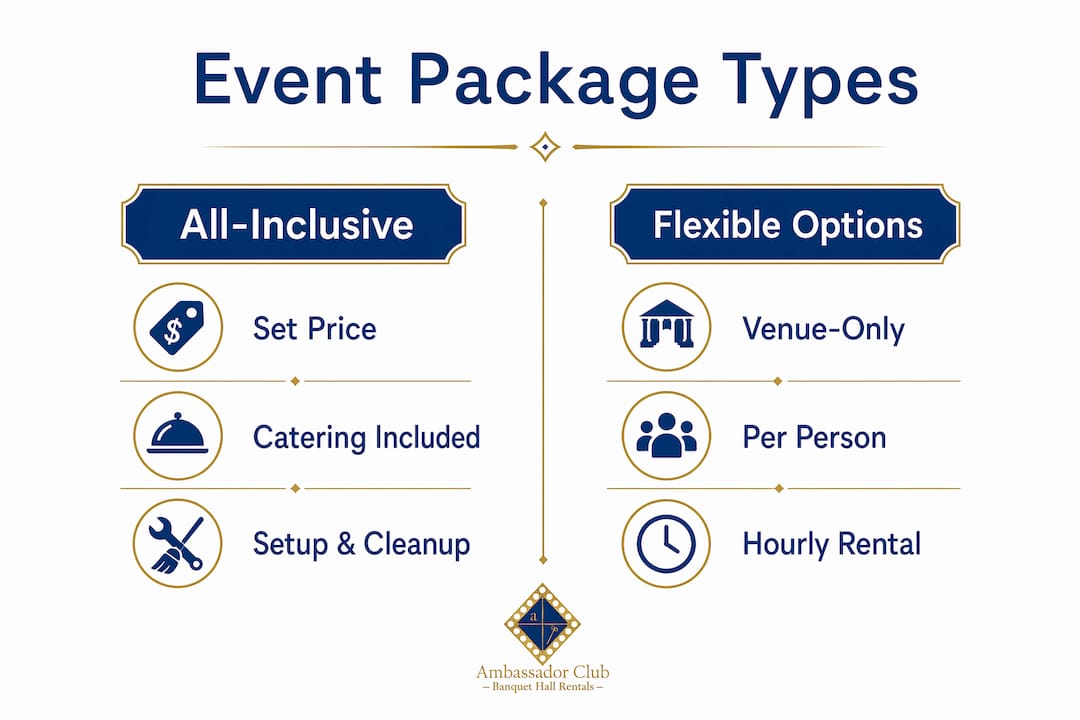
- All-inclusive/bundled: Venue rental, catering, basic décor, staffing, setup, and cleanup rolled into one price. Best for families who want a single point of contact and a predictable total bill. Works well for milestone birthdays, reunions, and receptions with a moderate number of guests.
- Venue-only/dry hire: You rent the physical space and source everything else yourself. Lower headline rental cost, but external costs for catering, lighting, and sound can easily exceed the base fee if you are not careful. Right fit when you have a preferred caterer or want full creative control.
- Per-person/catering-led: Pricing is built around a food-and-beverage minimum per head. The venue and basic staffing are bundled into that per-person rate. Common at hotel ballrooms and banquet halls. Works well for formal sit-down dinners or events where catering is the centerpiece.
- Hourly/tiered: You pay by the hour or by a time block, sometimes with pricing that shifts based on peak demand or event size. Common for shorter events, daytime parties, or venues that serve multiple bookings per day.
- Hybrid/partial packages: A growing middle ground. Many venues now offer venue-plus-catering bundles without décor, or venue-plus-AV without staffing. Worth asking about if the all-inclusive price feels padded with services you do not need.
Matching the archetype to your family's makeup matters more than chasing a feature checklist. A compact venue with a bundled package suits toddler birthday parties; a large multi-amenity hall with a per-person catering option fits a multi-generational reunion far better.
Side-by-side look at the four package archetypes

| All-Inclusive Bundle | Venue-Only / Dry Hire | Per-Person / Catering-Led | Hourly / Tiered | |
|---|---|---|---|---|
| What's included | Venue, catering, basic décor, staffing, setup/cleanup | Facility only | Venue + catering + basic staff | Facility for set time block |
| Pricing model | Flat package fee or per-person | Flat rental | Per-person minimum | Hourly or block rate |
| Typical price range | Varies by market; mid-to-high range | Lower upfront; add-ons raise total | Varies by menu tier | Lower entry; overtime fees apply |
| Best for | Families wanting one contract, 200 guests | Families with own caterer/vendors | Formal dinners, receptions | Shorter events, daytime parties |
| Capacity & layout | Usually fixed room configurations | Flexible; you arrange vendors | Ballroom/banquet style typical | Depends on venue |
| Outside vendors allowed | Often restricted or subject to fees | Yes, by design | Caterer usually exclusive | Varies |
| Deposit & cancellation | Typically 25–50% deposit; 30–90 day cancel window | Similar; varies by venue | Often non-refundable deposit | Often shorter windows |
| Common hidden costs | Gratuity, service charges, overtime, premium AV | Catering, AV, furniture, insurance | Gratuity, bar upgrades, overtime | Overtime, cleaning, setup fees |
What do family event packages usually include and exclude?
Headline prices are almost never the full story. Knowing what is typically bundled versus what gets added at billing time protects you from sticker shock.
Typical inclusions in a base package:
- Venue rental for a defined time window (often 4–6 hours)
- Standard tables and chairs
- Basic AV (microphone, speaker, projector if available)
- Standard linens in house colors
- Setup and cleanup windows (sometimes included in rental time, sometimes not)
- On-site coordinator or event staff contact
Frequent exclusions that inflate the final bill:
- Gratuity and service charges (often 18–22% added at billing)
- Additional hours beyond the base rental window
- Premium AV, specialty lighting, or uplighting
- Third-party vendor fees (florists, photographers, entertainment)
- Event insurance or liability coverage
- Security personnel (sometimes mandatory for events over a certain headcount)
- Cake-cutting fees, corkage fees, or outside-vendor handling fees
Always ask for an itemized breakdown of every package component. A per-person price of $45 can look competitive until you add a mandatory 20% service charge, a $300 security fee, and a $150 cleaning surcharge.
Pro Tip: Ask the venue to send you a sample invoice from a comparable past event, not just the package menu. That document will show you every line item that actually appears at billing, including the ones missing from the brochure.
How do venues price packages, and what should you expect to pay?
Event venue pricing generally falls into four structures: flat rental fees for a set period, hourly rates, per-person pricing tied to catering, and tiered pricing that shifts with event size or peak demand. Each model has a different risk profile for families.
Flat rental gives you the most predictable total. You know the number before you sign. The risk is that add-ons (AV upgrades, extra hours, security) can still surprise you.
Per-person pricing feels transparent but hides the most variability. Menu upgrades, bar packages, and mandatory gratuity all multiply by headcount, so a 100-person event at $55 per person can land at $7,500 or more once service charges and gratuity are added.
Hourly and tiered rates suit shorter events but carry overtime exposure. If your family runs late, you pay. Venues with tiered pricing often charge significantly more for Friday and Saturday evenings than for weekday or Sunday morning slots.
Seasonality and day of week move prices substantially. Mid-week and off-season bookings frequently cost meaningfully less than a prime Saturday date, sometimes enough to fund a catering upgrade. If your family has flexibility on the date, that flexibility is worth real money.
Statistic to know: According to event venue pricing research, the four standard pricing models (flat, hourly, per-person, tiered) are the industry norm across U.S. venues, and the model you choose determines which hidden costs carry the most risk. Per-person packages expose you to gratuity multiplication; flat-rental packages expose you to add-on creep.
For a practical U.S. cost shape: smaller community halls and historic venues in mid-size markets often run flat rentals in the low-to-mid four figures for a half-day or evening block. Hotel ballrooms and resort venues in the same markets typically start higher on a per-person basis. Neither figure is universal; local market, day of week, and season all shift the number.
How do you choose the right package and what should you ask?

Start with three family-specific inputs before you look at a single brochure: your headcount, your age mix, and your formality level. A toddler birthday needs a compact, easy-to-supervise space with a flat rental. A larger multi-generational reunion needs a large hall, flexible catering, and ADA-accessible restrooms. Getting the archetype right first saves hours of comparison work.
Evaluation checklist, in order of importance:
- Capacity and usable layout (dance floor, seating for elders, kid zones)
- True total cost (base price plus all mandatory fees, gratuity, and overtime)
- Inclusion list versus exclusion list (line by line)
- Flexibility on outside vendors (caterer, entertainment, décor)
- Deposit amount and cancellation/refund window (in writing)
- Event insurance requirements and who carries the policy
- Accessibility: ADA compliance, parking, stroller access
- Overnight accommodation options nearby for out-of-town guests
Questions to put on your itemized sheet request:
- What is the cleaning fee, and is it included or billed separately?
- Is security required, and what is the cost per officer per hour?
- What is the gratuity or service charge percentage, and what does it apply to?
- What are the overtime fees if the event runs past the contracted end time?
- Are outside caterers allowed, and is there a handling or corkage fee?
- What AV equipment is included, and what is the upgrade cost?
- Can you provide a sample contract with the cancellation and deposit clauses?
Red flags to watch for:
- Vague line items like "event services" with no dollar amount attached
- No written cancellation window or a verbal-only refund promise
- Capacity claims that do not specify seated versus standing versus dance floor
- A required vendor list with no pricing disclosed upfront
For families planning a family reunion booking, getting the contract terms in writing before paying any deposit is non-negotiable.
Booking timeline, capacity planning, and family logistics
When to move on a date:
- For Saturday evening events in peak season (May through October), start inquiring 9–12 months out
- For weekday or off-season events, 4–6 months is usually sufficient
- Ask about hold periods: many venues will hold a date for 7–14 days without a deposit while you finalize your decision
- Vendor confirmations (caterer, entertainment, photographer) are typically due 30–60 days before the event
Sizing the room for a mixed-age family:
- Usable capacity is always less than the posted maximum. A hall that holds 200 standing holds roughly 120–140 at round tables with a dance floor.
- Reserve space for a kid zone or supervised activity corner if you have guests under 10
- Seat elderly guests near restrooms and away from speaker stacks
- Check the venue size guide for your specific headcount before committing to a room
Family-specific logistics to compare across venues:
- Restroom count and proximity to the main hall
- Stroller and wheelchair access (ramps, elevator, wide doorways)
- Parking: on-site, free, and sufficient for your headcount
- Noise restrictions and curfew times (critical for evening events with a DJ or live band)
- Nearby lodging options for out-of-town family members
Event flow and layout matter as much as the amenities list. A hall with intentional pockets of pause, a quieter seating area away from the dance floor, and clear sightlines from the adult tables to the kids' area makes the event genuinely easier to manage. Ask the venue coordinator to walk you through the floor plan with your specific family scenario in mind.
How does The Ambassador Club's offering map to these archetypes?
Ambassadorclubportsmouth has operated in Portsmouth, VA, since 1933, and the 6,000 sq ft banquet hall is built for exactly the kind of multi-generational family event this comparison framework is designed to evaluate.
Facility features at a glance:
- 6,000 sq ft banquet hall accommodating up to 200 guests
- Full commercial kitchen (supports outside caterers or in-house catering arrangements)
- Tables and chairs included
- Dry bar
- Dance floor
- Large projection wall with built-in projector
- Setup and cleanup included in packages
- Security available as an add-on
- Optional transportation services
How the packages map to the four archetypes:
- All-inclusive style: Ambassadorclubportsmouth packages that bundle the hall, setup, cleanup, security, and AV under one agreement. You can bring your caterer or arrange catering through the venue's kitchen access.
- Venue-only/dry hire style: The hall can be rented as a base facility, giving families with existing vendor relationships full flexibility to bring in outside catering, entertainment, and décor.
- Per-person add-ons: Catering arrangements can be structured on a per-person basis depending on the caterer you select, with the commercial kitchen available to support that setup.
- Hourly/tiered: Shorter daytime events or community functions can be structured around block-time arrangements.
Sample line items to request when you inquire:
- Base hall rental fee for your date and time block
- Cleaning fee (included or separate)
- Security fee per officer
- AV package (projection wall, microphone, speaker)
- Setup and breakdown window timing
- Deposit amount and cancellation policy in writing
The historic character of the building, the full commercial kitchen, and the flexibility on outside vendors make Ambassadorclubportsmouth a strong fit for families who want the convenience of an all-inclusive feel without being locked into a single in-house caterer. Why event halls matter for family gatherings comes down to exactly this kind of flexibility.
What should you do after comparing venue quotes?
Match your family scenario to the right archetype first, then compare true totals, not headline prices.
- Large multi-generational reunion (80–200 guests): All-inclusive or per-person catering package at a hall with a commercial kitchen and ADA access. Ambassadorclubportsmouth fits this profile directly.
- Smaller milestone birthday or anniversary (30–60 guests): Venue-only or hybrid package where you control catering and décor.
- Formal dinner or reception (any size): Per-person catering-led package at a venue with a full kitchen and staffing.
Three immediate next steps:
- Request itemized package sheets from every venue on your shortlist (use the question list above)
- Schedule a site visit at each finalist to verify layout, accessibility, and AV before signing
- Compare true totals: base price plus all mandatory fees, gratuity, overtime, and security
For Portsmouth-area families, Ambassadorclubportsmouth is a recommended starting point given its capacity, kitchen access, flexible vendor policy, and historic hall character.
Key Takeaways
The most reliable way to compare family event venue packages is to request itemized pricing, a sample contract, and a site visit from every venue before paying any deposit.
| Point | Details |
|---|---|
| Start with the archetype | Match all-inclusive, venue-only, per-person, or hourly to your headcount and formality before comparing prices. |
| Request itemized sheets | Ask for every line item including gratuity, security, cleaning, and overtime before evaluating any headline price. |
| Seasonality moves prices | Mid-week and off-season bookings often cost meaningfully less than prime Saturday dates at the same venue. |
| Insist on written cancellation terms | A verbal refund promise is not a policy; get the deposit amount and cancellation window in the signed contract. |
| Ambassadorclubportsmouth | The 6,000 sq ft Portsmouth hall accommodates up to 200 guests with a commercial kitchen, flexible vendor policy, and packages covering setup, cleanup, and AV. |
What most families get wrong when picking a venue
The conventional wisdom says to start with your budget and work backward to a venue. That logic sounds practical, but it produces bad comparisons. When you lead with a budget number, you end up comparing headline prices across venues that are structured completely differently. A $3,500 flat rental at one venue and a $28-per-person rate at another look like they belong in the same conversation. They often do not, once you add gratuity, security, and overtime to the per-person quote.
The smarter move is to start with your family's specific scenario: headcount, age mix, formality, and whether catering flexibility matters. Those four inputs narrow you to one or two archetypes before you look at a single price. Then you request itemized sheets from venues that fit those archetypes, and you compare true totals, not brochure prices.
There is also a tendency to underweight logistics. Parents focus on the room's aesthetics and the catering menu, then discover on the day that parking is inadequate, the restrooms are on a different floor, or the noise curfew cuts the event short at 9 PM. A 20-minute site visit with a specific list of logistics questions prevents all of that. The layout questions matter as much as the amenity list, and the event flow and supervised pause zones in a hall determine how manageable the event actually feels for the adults running it.
One more thing families consistently overlook: the value of a venue with a full commercial kitchen and a flexible outside-vendor policy. That combination gives you the convenience of an all-inclusive setup without the markup of a single in-house caterer. It is the reason Ambassadorclubportsmouth works for such a wide range of family event types.
The Ambassador Club is ready to walk you through your options
Families planning events in the Hampton Roads area get a straightforward path at Ambassadorclubportsmouth: a 6,000 sq ft historic hall, a full commercial kitchen, and packages that cover setup, cleanup, AV, and security without forcing you into a single caterer.

The hall holds up to 200 guests, includes a dance floor, dry bar, and large projection wall, and has been hosting family milestones in Portsmouth, VA, since 1933. You can bring your own caterer, use the commercial kitchen, or arrange catering through the venue. The deposit schedule, cancellation window, and every line item are available in writing before you commit.
Schedule a tour or request an itemized package sheet at The Ambassador Club. You will leave with a sample contract, availability for your date, and a clear total cost so you can compare it against any other quote on your list. If you are also thinking about adding a group activity to your event weekend, family boat tours in the area are a popular complement for out-of-town guests.
Useful sources
The pricing and package guidance in this article draws on the following sources. Readers who want to go deeper on any topic can consult them directly, and anyone inquiring at Ambassadorclubportsmouth can request the venue's internal sample contract and itemized package wording during a scheduled tour.
- Event Venue Pricing Guide — Bonnie Hawthorne: definitions of pricing models and the case for itemized comparisons
- NHM Venue Hire Charges — Natural History Museum: dry hire budgeting and external cost guidance
- Questions to Ask Before Booking a Kids Party Venue — Jungle Fiesta: itemized breakdown checklist and mandatory fee awareness
- Walnut Creek Venue Pricing — Walnut Creek Venue: seasonality and day-of-week pricing effects
- Reunion Resort vs. Encore Resort — Exclusive Private Villas: matching venue type to family age mix
- Great Wolf Lodge Charlotte vs. LaGrange — Family Critic: event flow and layout considerations for family events
- The Ambassador Club — Venue Overview — Ambassadorclubportsmouth: facility details, capacity, and package structure
FAQ
What is the best package type for a family event?
For most families, an all-inclusive bundled package is the lowest-stress option because it covers catering, setup, cleanup, and staffing under one contract. If you have a preferred caterer or want full creative control, a venue-only arrangement often delivers better value.
What is a realistic budget for a 100-person family event?
Budget varies significantly by market, day of week, and package type. A flat-rental community hall in a mid-size U.S. market can run in the low-to-mid four figures; a per-person catering package at a hotel ballroom for 100 guests typically lands higher once gratuity and service charges are added. Always compare true totals, not headline prices.
What is the difference between a venue and an event package?
The venue is the physical space; the event package is the bundle of services and operational support layered on top of it. These are distinct purchase decisions, and comparing them separately helps you identify where a quote is padded and where it is lean.
How far in advance should you book a family event venue?
For Saturday evening events during peak season (May through October), inquire 9–12 months out. For weekday or off-season events, 4–6 months is usually sufficient. Many venues will hold a date for 7–14 days without a deposit while you finalize your decision.
Does The Ambassador Club allow outside caterers?
Ambassadorclubportsmouth offers a full commercial kitchen and a flexible outside-vendor policy, so families can bring their own caterer or arrange catering independently. Contact the venue directly to request an itemized package sheet and confirm the current terms for your event date.