The core venue security requirement is a written, site-specific security plan built on a formal risk assessment, commonly called a THIRA. Start that assessment before anything else. It determines your staffing ratios, your screening setup, and your budget. CISA's guidance frames this as a layered approach, and most permit offices expect the finished plan 30 to 90 days before doors open. The venue operator or event organizer owns this responsibility, and the first move is simple: assign a safety officer or hire an assessor this week.
TL;DR:
- Security plans must be detailed, include multiple annexes, and be submitted 30 to 90 days before the event, with strong emphasis on risk assessment and permit compliance.
- Staffing ratios vary significantly by event risk profile, ranging from one guard per 100–150 attendees at low-risk events to one per 25–50 at high-density concerts, with supervision and shift minimums crucial for effective coverage.
- Physical security measures should prioritize trained personnel, communication redundancy, and natural CPTED principles over expensive hardware, tailored to the venue's threat level.
- Screening procedures must be consistent, include clear signage, and account for ADA accommodations, with explicit escalation processes for illegal items or policy violations.
- Permits require comprehensive documentation, stakeholder coordination, and early engagement with law enforcement, fire, and EMS, especially for events exceeding 200–500 guests or involving alcohol, street closures, or late hours.
Table of Contents
- Venue Security Requirements: What a Complete Plan Must Include
- How Many Security Guards Do You Need? Ratios and Roles Explained
- Physical Security Measures: Perimeter, Access Control, and Surveillance
- Screening Procedures and Prohibited Items: What to Check and Who to Check
- Permits, Legal Requirements, and Coordinating With First Responders
- What Does Event Security Actually Cost? Realistic Budget Scenarios
- How Do You Perform a Site-Specific Risk Assessment (THIRA)?
- Your Pre-Event Security Checklist and Templates
- Venue Operator Perspective: Applying These Requirements at a Real Venue
- Sources
- FAQ
Venue Security Requirements: What a Complete Plan Must Include
A security plan that survives a permit reviewer's scrutiny isn't a one-page memo. It's a document with distinct chapters, each answering a specific operational question, backed by named contacts and clear ownership.
The core chapters permitting offices and event security providers (ESPs) expect include:
- Emergency Action Plan (EAP): evacuation routes, shelter-in-place triggers, and who calls the "stop the show" decision.
- Crowd management annex: capacity limits, flow diagrams, and choke-point mitigation.
- Entry and egress plan: gate counts, screening lanes, and post-event dispersal timing.
- Credentialing plan: badge tiers for staff, vendors, media, and VIPs, plus who issues and revokes them.
- Traffic and parking plan: vehicle staging, drop-off zones, and rideshare holding areas.
- Communications plan: radio channels, escalation chain, and backup methods if primary systems fail.
- Medical and EMS annex: staffing levels, ambulance staging, and AED locations.
- VIP protection protocol: if applicable, separate routing and close protection detail.
- Drone policy: no-fly zones and reporting procedure for unauthorized aircraft.
- Photography and media protocol: press credentialing and restricted-area boundaries.
Ownership of these pieces splits three ways in practice. The venue typically provides the physical layout, existing camera infrastructure, and building egress diagrams. The organizer owns the event concept: guest count, alcohol service, VIP list, and vendor roster. The contracted ESP builds the operational muscle: guard deployment, screening protocols, and the communications plan that ties it together. KBHCCD's requirements illustrate this division well. Their venue mandates a written plan 45 days before any event involving alcohol, sporting activity, or more than 500 attendees, and it specifies exactly who submits what.
A realistic submission checklist looks like this:
- Site-specific risk assessment summary (THIRA-style)
- Written security plan with all annexes listed above
- Certificate of insurance naming the venue and municipality
- Staffing roster with names, license numbers, and shift assignments
- Traffic management plan if road closures are involved
- EMS staffing confirmation and ambulance staging location
- Signed vendor and caterer access agreements
Miss even one of these, and permit reviewers routinely bounce the whole packet back, causing delays. Planners coordinating staffing alongside security should also read our breakdown of what event staffing includes, since guard counts and general event staff often get confused during budget planning.
How Many Security Guards Do You Need? Ratios and Roles Explained
Staffing math isn't guesswork, but it does shift dramatically based on risk profile. A quiet corporate luncheon and a beer-soaked outdoor concert need entirely different formulas, and treating them the same is how venues end up either overpaying or under-protected.
Industry guidance from HireSecurityNow's staffing guide puts low-risk seated events at roughly one guard per 100 to 150 attendees. Add alcohol service, and that ratio tightens to about one guard per 50 guests. Concerts and festivals, with their higher crowd density and lower predictability, often need one guard per 25 to 50 people.
| Event type | Typical guard ratio | Notes |
|---|---|---|
| Seated corporate event, no alcohol | 1:100–150 | Lower risk, predictable crowd flow |
| Wedding or reception with bar service | 1:50 | Alcohol service raises intervention needs |
| Concert or general-admission festival | 1:25–50 | Dense crowds, higher unpredictability |
| High-profile or VIP event | Custom | Driven by threat assessment, not ratio alone |
These numbers describe licensed security guards, not crowd managers. The two roles are legally distinct. A crowd manager is trained in life-safety functions, such as directing evacuation and monitoring capacity, but typically doesn't carry law enforcement authority or handle physical intervention. A licensed security guard does both crowd oversight and enforcement of venue policy, and many jurisdictions require separate certification for each function. For events with elevated risk profiles, some organizers add off-duty law enforcement officers, who bring arrest powers a private guard doesn't have.
Supervision matters as much as headcount. A common rule of thumb assigns one lead supervisor for every eight to ten officers, splitting posts between static positions (entrances, stages, backstage) and roving patrols that cover blind spots and respond to incidents. Sample post assignments for a mid-size event might include two officers at the main entrance conducting bag checks, one roving the perimeter, one stationed at the bar, and a supervisor floating between zones with a radio.
Shift minimums typically run four to six hours regardless of your event's actual length, and setup and teardown windows need their own coverage, since that's often when theft and unauthorized access happen. Book your ESP two to four weeks out for standard events; anything involving alcohol permits or over 500 guests should be locked in 45 days ahead to match typical permit deadlines.
Pro Tip: Ask your ESP for their supervisor-to-guard ratio in writing before signing a contract. A provider that won't specify supervision levels is usually cutting corners on quality control, not just price.
Physical Security Measures: Perimeter, Access Control, and Surveillance
Physical security scales with your venue's actual threat profile, not with how much budget you have left over. CISA's layered security approach treats no single measure as sufficient on its own. Fencing without lighting is a false sense of security. Cameras without monitoring staff are just recordings of what already went wrong.
Perimeter control starts with defining your boundary clearly. Temporary fencing works for outdoor events and festivals; permanent venues rely more on controlled entry points and staffed doors. Vehicle mitigation, bollards, planters, or parked heavy vehicles blocking approach routes, matters most anywhere crowds gather near street access, and it's cheap compared to the alternative.
Access control is where credentialing earns its keep. A credentialing board should track:
- Badge color or tier by access level (staff, vendor, VIP, media)
- Photo ID verification process at issuance
- Expiration and same-day revocation procedure
- A master list cross-checked against the roster submitted for permits
Magnetometers and clear-bag policies reduce prohibited-item risk substantially, and CISA's screening guide treats them as standard for higher-attendance events.
Surveillance and communications round out the technical layer. Camera placement should cover entrances, cash handling areas, and any choke points identified during your risk assessment, not just wherever wiring happens to reach. Communications redundancy, often called PACE (primary, alternate, contingency, emergency), means your team has a backup if radios fail: a second radio channel, then cell phones, then a runner system if all else drops.
Some of the highest-impact measures cost almost nothing. CPTED principles (Crime Prevention Through Environmental Design) rely on lighting, sightlines, and furniture placement to naturally discourage problems before they need enforcement. A historic hall with strong lighting at every exit and unobstructed sightlines from the bar to the dance floor often needs fewer roving guards than a poorly lit space with blind corners.
Screening Procedures and Prohibited Items: What to Check and Who to Check
Screening isn't just for stadium-scale events. Even a 200-guest reception with alcohol service benefits from a documented, consistent screening approach, because inconsistency is what triggers complaints and liability.
- Decide who gets screened. Attendees are the obvious group, but staff, vendors, and media credentials should also pass through a checkpoint, since insider risk is a real category CISA's screening guide addresses directly.
- Choose your screening method. Walk-through metal detectors (WTMD) handle high volume efficiently but need calibration and a dedicated lane. Hand-held metal detectors (HHMD) work well for smaller guest counts or secondary screening. X-ray belts add cost and staffing but catch items a magnetometer misses, like liquids or blades in bags.
- Build secondary screening SOPs. When a detector alarms, staff need a clear, respectful process: private pat-down area, same-gender screener option where possible, and a supervisor available for disputes.
- Post clear signage before the checkpoint. Guests who know what's prohibited before they arrive cause far fewer conflicts at the gate.
- Plan ADA accommodations. Alternate screening paths for guests with mobility devices or medical equipment need to exist before event day, not improvised in the moment.
- Know your escalation path for illegal items. If screening turns up something beyond a policy violation, a weapon, drugs, and so on, staff need a documented process: isolate the item and person, notify law enforcement immediately, and preserve the area until officers arrive.
Pro Tip: Publish your prohibited items list on the ticketing page and in pre-event email reminders, not just at the gate. Guests who learn about a bag-size restriction after driving to your venue get angry fast, and that anger becomes your security team's problem.
Permits, Legal Requirements, and Coordinating With First Responders
Permit rejections almost always trace back to one thing: the organizer treated security paperwork as an afterthought instead of a parallel track that starts on day one of planning.
Common triggers that require a formal permit and security plan include attendance crossing 200 to 500 guests, alcohol service of any kind, street closures, fireworks, or events running past midnight. Municipal guidelines commonly set these thresholds, and lead times for submission often run 30 to 90 days depending on complexity.
Documentation permitting offices typically expect includes:
- Certificate of insurance naming the municipality and venue
- Full staffing roster with license numbers for security personnel
- The written security plan, including all annexes
- Confirmed EMS staffing level, appropriate for expected attendance
- Traffic management plan for any road or lane closures
One detail organizers underestimate: an attendance threshold of roughly 500 guests is enough to trigger mandatory security staffing at major convention facilities, regardless of how low-risk the event feels on paper. A quiet 500-person gala still needs a documented plan under many venue policies.
Joint planning meetings with police, fire, and EMS aren't a courtesy, they're often a requirement, and skipping them is the single fastest way to get a permit application flagged. Police typically weigh in on crowd flow and traffic control, fire departments review egress capacity and occupancy limits, and EMS confirms staging locations and response time estimates. Schedule this meeting at least 30 days out, and always get any verbal permit conditions confirmed in writing afterward. A city official's spoken approval means nothing if the person who gave it changes jobs before your event date.
What Does Event Security Actually Cost? Realistic Budget Scenarios
Security pricing runs on guard-hours, and the rate itself is only the starting number. Modifiers stack fast, and organizers who don't budget for them get blindsided by a final invoice that's 30% higher than the quote.
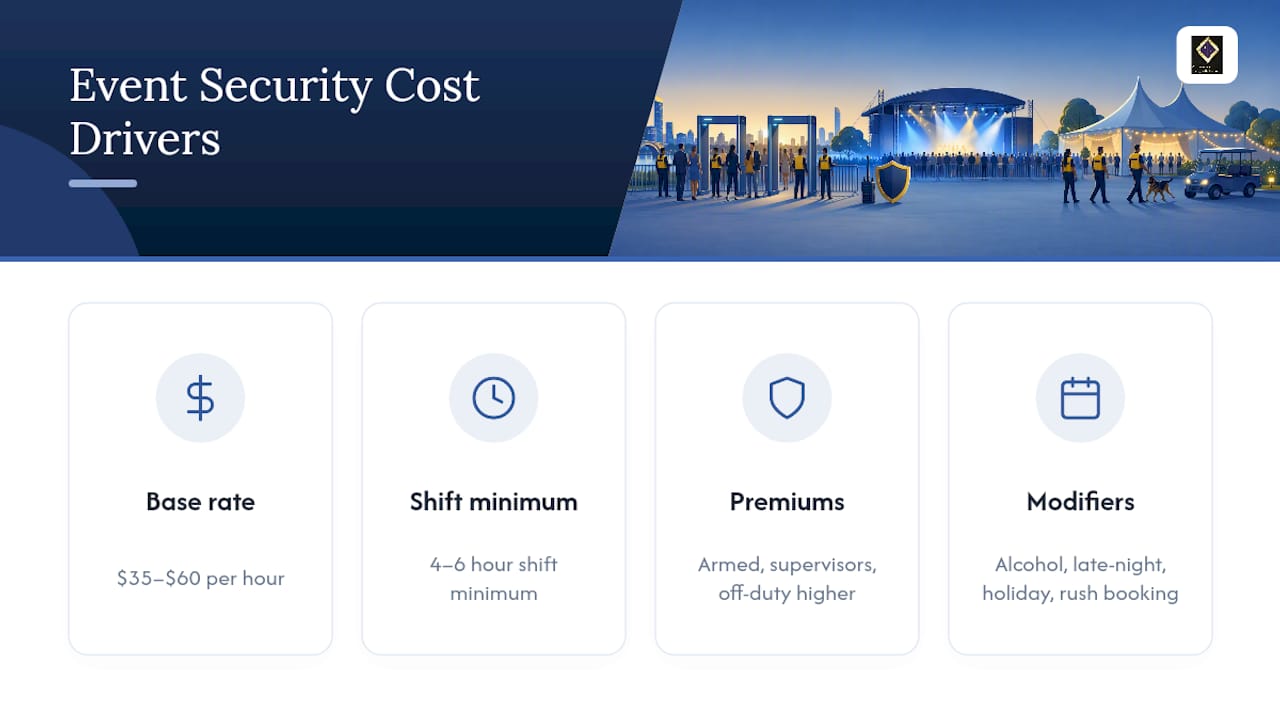
Calvis's cost breakdown puts standard unarmed guard rates between $35 and $60 per hour, with most contracts carrying a four to six hour shift minimum even for shorter events. Armed guards, supervisors, and off-duty law enforcement all command a premium above that base rate. Alcohol service, late-night hours, and holiday dates typically add an uplift, and booking within a week or two of your event date often triggers a rush surcharge on top of everything else.
Typical staffing and cost will vary depending on event specifics. For example, a 200-guest reception with alcohol might require several guards, a 500-guest event more, and a large concert many more. Costs reflect guard hourly rates, shift minimums, supervisory needs, and booking lead times.
Buy-versus-lease decisions matter for equipment like magnetometers and radios: renting through your ESP usually beats purchasing unless you're running events monthly. Ask any contractor for an itemized quote breaking out base rate, minimums, and modifiers separately, so hidden add-ons can't hide inside a lump-sum number.
Pro Tip: Get your security quote itemized by guard-hour, supervisor premium, and equipment rental separately. A single lump-sum number is the easiest place for a contractor to bury a markup you'd otherwise catch.
How Do You Perform a Site-Specific Risk Assessment (THIRA)?
A THIRA, short for Threat and Hazard Identification and Risk Assessment, is the professional standard CISA recommends before finalizing any security plan. It's not a formality. It's the document that determines every staffing and budget number that follows.
- Identify your assets. This includes people, cash, high-value equipment, and reputation exposure, anything a bad outcome would damage.
- List credible threats and hazards. Weather, crowd crush, alcohol-related altercations, theft, and unauthorized access all belong on this list, scaled to your actual event type.
- Estimate likelihood for each item. Not everything deserves equal weight, a coastal outdoor venue weighs weather differently than an indoor hall does.
- Assess consequence severity. What happens if the threat materializes: minor disruption, injury, or something worse?
- Match mitigation options to each risk, using CISA's cost-tiered framework of low, moderate, and high-cost measures to prioritize what fits your budget.
The output should be decision-grade: a risk matrix, a list of recommended mitigations, and a rough cost estimate permitting offices can review alongside your written plan. This is what sets your guard ratio, tells you whether magnetometers are warranted, and flags which EAP annexes need the most detail.
Anyone with event risk-assessment training can perform a basic THIRA for a small private event. Larger or higher-profile events benefit from a licensed security consultant, and refresh the assessment annually or whenever your venue layout changes significantly. For anything involving elevated threat indicators, bomb threats, high-profile attendees, past incidents, escalate to specialist resources like canine explosives detection teams or providers certified under the SAFETY Act.
Your Pre-Event Security Checklist and Templates
Turning all of this into action means working backward from event day on a fixed timeline. Miss a step at the 90-day mark, and you're scrambling by week three.
- 90 days out: commission the THIRA, identify permit requirements, and confirm insurance needs.
- 30 days out: finalize the written security plan, submit permit paperwork, and schedule the joint meeting with police, fire, and EMS.
- 14 days out: confirm your ESP staffing roster, lock in equipment rentals, and finalize credentialing lists.
- 3 days out: distribute post orders, confirm shift schedules, and brief supervisors on the communications plan.
Post orders should specify each guard's exact post, hours, and radio channel, along with escalation contacts. Credentialing checklists need badge tiers, issuance logs, and a same-day revocation process. Entry, egress, and end-of-night sweep checklists round out the operational side, covering everything from bag-check protocol at the door to a final walkthrough confirming no unauthorized persons remain after closing.
| Checklist item | When to complete |
|---|---|
| Risk assessment (THIRA) | 90 days out |
| Security plan and permit submission | 30 days out |
| ESP roster and equipment confirmed | 14 days out |
| Post orders and briefings distributed | 3 days out |
CISA's Venue Guide and Public Venue Security Screening Guide both include sample forms worth adapting directly into your own permit file.
Venue Operator Perspective: Applying These Requirements at a Real Venue
Running security at a 6,000 square foot historic hall looks nothing like managing a stadium, but the underlying logic doesn't change. A THIRA still comes first, even if it takes an afternoon instead of a week.
What surprises most first-time planners is how much guest experience rides on decisions that look like pure security trade-offs. Adding a second crowd manager at the entrance often does more for the evening than a third camera pointed at a hallway nobody uses. Cameras record what happened. A trained person at the door prevents the awkward moment from happening at all.
Off-site vehicle staging is another quiet win for smaller venues. Keeping rideshare pickups a block away instead of stacking cars at the front door reduces congestion and gives staff a cleaner sightline on who's approaching. It costs nothing but a little signage and a conversation with guests ahead of time.
The lesson that holds up across venue sizes: spend on trained people and communication redundancy before spending on hardware. A well-briefed crowd manager with a working radio outperforms an expensive camera system every time an actual incident happens. For planners weighing where their next dollar goes, our guide on accessible venue design covers how entry and egress choices affect both safety and guest comfort at the same time.
— MARTIN
Sources
Every figure and requirement in this guide traces back to a small set of primary resources worth bookmarking directly.
- Venue Guide for Security Enhancements (CISA)
- KBHCCD Event Safety and Security Requirements (Dallas Convention Center)
- Event Security Guide for Organizers: Costs, Staffing & Permits (2026) | HireSecurityNow
- Event Security Cost: What You'll Pay in 2026 | Calvis
These are the documents permit reviewers themselves reference, which makes them worth citing directly in your own submission packets.
FAQ
How many security guards do you need for an event?
It depends on risk level: roughly one guard per 100 to 150 guests for a low-risk seated event, one per 50 if alcohol is served, and one per 25 to 50 for concerts or festivals, according to industry staffing guidance.
How much does security cost for a venue?
Unarmed guards typically run $35 to $60 per hour with a four to six hour shift minimum, and costs rise with armed staffing, alcohol service, holiday dates, or last-minute booking, per Calvis's cost breakdown.
What disqualifies you from being a security guard?
Disqualifications vary by state licensing board, but they commonly include a felony conviction, certain violent misdemeanors, and failure to pass the required background check or training certification; check your specific state's licensing authority for the exact list.
Do you need security for an event?
Most venues require it once attendance crosses roughly 200 to 500 guests, alcohol is served, or the event involves road closures or late-night hours, and a written, site-specific security plan is the standard expectation across municipal permitting offices.