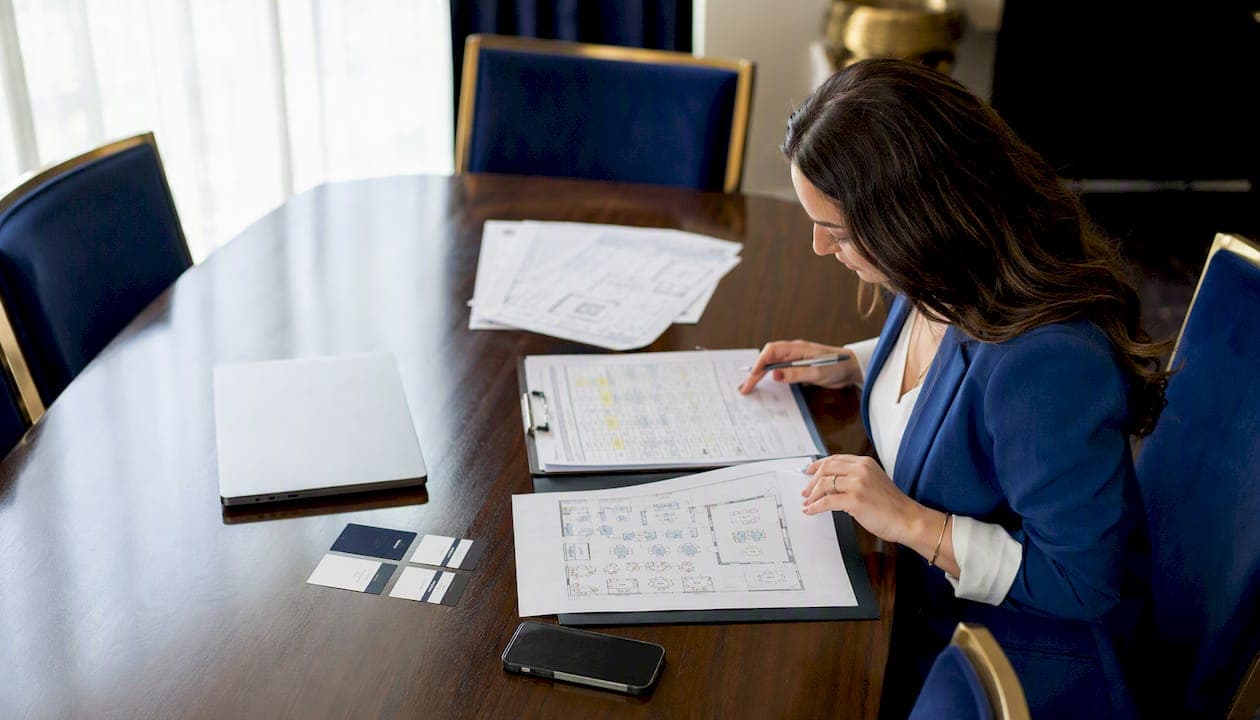
Venue access time is the contract window when you and your vendors are allowed to enter the space to set up — not when guests arrive, and not when the ceremony starts. It covers everything from unloading the florist's van to testing the AV system and arranging centerpieces. Your first move: ask your venue for the written load-in and load-out hours and confirm what each of your vendors needs before you sign anything.
Table of Contents
- Why access time can make or break your wedding day
- What the contract terms actually mean
- How access time maps to your wedding-day timeline
- What to confirm in your venue contract
- What to do when the access window is too short
- Why the end time matters as much as the start
- What planners know that most couples don't
- Key Takeaways
- The venue side of the access-time conversation
- Ambassadorclubportsmouth makes access time straightforward
- Useful sources
- FAQ
Why access time can make or break your wedding day
Underestimating access time is, according to expert planners, the single most common cause of rushed setups and quality problems with décor and AV. When the window is tight, something always gets cut — and it's usually the thing you spent the most money on.
Here's which vendor services feel the squeeze hardest:
- Florals and draping: Fresh arrangements need time to be placed, adjusted, and watered. A rushed florist skips the finishing touches.
- AV and lighting: Sound checks and lighting cues require the room to be quiet and clear of other vendors. AV always goes first.
- Catering staging: Caterers need kitchen access, chafing dish setup, and a clear path from the kitchen to the tables.
- Photography: Your photographer needs 20–30 minutes to shoot the empty, styled room before guests walk in. No access time, no detail shots.
- Event safety: Venues need time to confirm fire exits are clear, run insurance checks, and complete any required inspections before the first guest enters.
If a prior event ran late, your load-in window can shrink to 60 minutes — which makes a complex AV or floral setup nearly impossible without additional access negotiated in advance.
Pro Tip: Add a 30–60 minute buffer specifically for shared infrastructure like freight elevators and loading docks. These are the most common bottlenecks, and they're almost never factored into the vendor's quoted setup time.
What the contract terms actually mean
Venue contracts use specific language that's easy to misread. Here's what each term means in practice, along with typical hour ranges you'll see in the United States.

| Term | What it means | Typical example |
|---|---|---|
| Load-in / vendor access | When vendors may enter to unload and set up | 8:00 a.m. for a 6:00 p.m. event |
| Rental period | The full block of time you're paying for | 8:00 a.m.–11:00 p.m. (full-day) |
| Event start time | When guests are invited to arrive | 6:00 p.m. |
| Hard stop | The contractual end time; all vendors must be out | 11:00 p.m. or midnight |
| Early access fee | Charge for entering before the standard window | $200–$600 per hour |
| Day-before access | Setup the evening before the event | Negotiated separately |
| Load-out / breakdown | When vendors must remove all equipment | 30–60 min after event end |
A full-day rental typically has a long rental period covering much of the day, while a half-day rental often starts a few hours before the event, allowing a setup window that may be shorter than expected when multiple vendors share loading facilities.
One term couples often confuse: "doors open" does not mean vendors can start unloading. As venue guidance makes clear, door time is when guests may enter; operational unloading requires a separate confirmed start-to-unload time from venue staff.
The 30-5 minute rule you'll hear planners mention refers to scheduling vendor arrivals 30 minutes before the next task is needed, and giving a 5-minute warning before each transition. It keeps the day moving without anyone waiting on someone else.
Venue setup rules also vary significantly by venue type: hotels restrict access because of banquet staff schedules and service elevators; conference centers run dock reservation systems; museums add security and preservation protocols. There's no universal law that sets supplier access time — it's entirely governed by your booking contract.
How access time maps to your wedding-day timeline
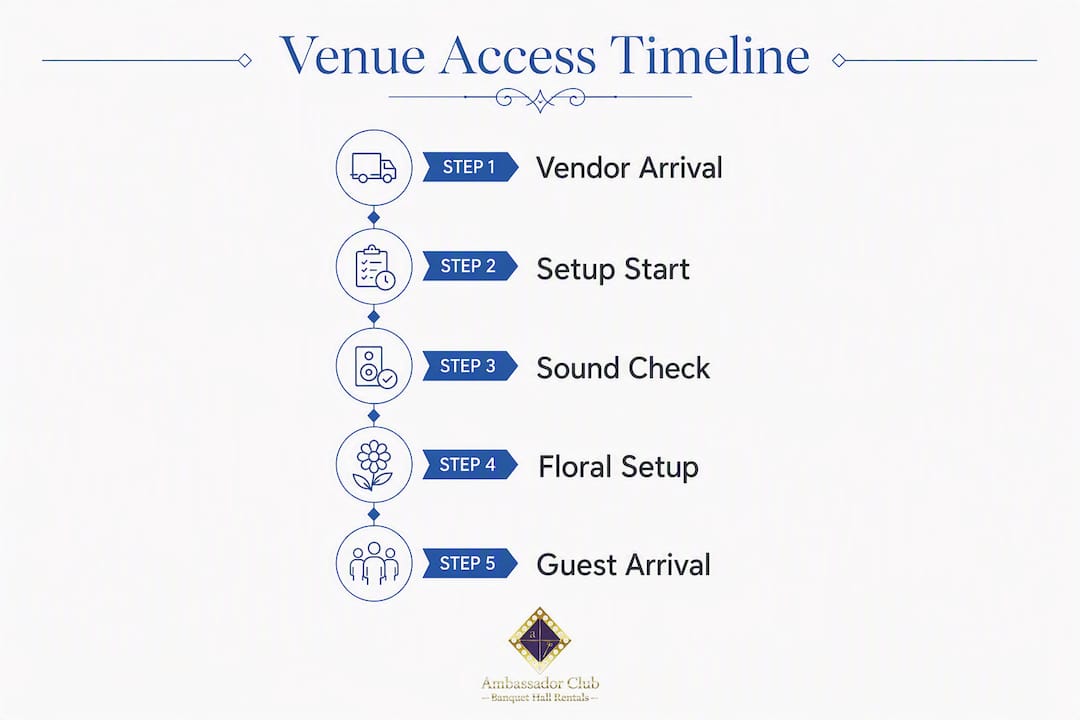
The table below shows a realistic sequencing for three event sizes. These are starting points — adjust based on your specific vendor list and venue layout.
| Time | Small wedding (under 200 guests) | Medium wedding (150 guests) | Large wedding (200 guests) |
|---|---|---|---|
| 8:00 a.m. | Venue opens; AV team arrives | Venue opens; AV and lighting crew | Venue opens; AV, lighting, staging |
| 8:30 a.m. | AV test complete | AV test begins | AV test and lighting cues |
| 9:00 a.m. | Florist arrives | Florist and linen crew arrive | Florist, linen, backdrop crew |
| 10:00 a.m. | Décor complete; caterer stages | Décor partially complete | Décor in progress; caterer stages |
| 11:00 a.m. | Caterer setup done | Décor complete; caterer stages | Décor complete |
| 12:00 p.m. | Photographer detail shots | Caterer setup done | Caterer setup done |
| 1:00 p.m. | Bridal party prep begins | Photographer detail shots | Photographer detail shots |
| — | Final walk-through | Bridal party prep | Bridal party prep |
| 5:00 p.m. | Guests arrive | Final walk-through | Final walk-through |
| 6:00 p.m. | Ceremony | Guests arrive; ceremony | Guests arrive; ceremony |
AV always goes first because sound and lighting checks require an empty, quiet room. Florals and draping follow because they're sensitive to foot traffic. Catering stages last because food safety rules limit how early dishes can be set out.
To convert your venue's access hours into vendor call times: work backward from guest arrival. Give photographers 30 minutes before guests enter for empty-room shots. Give caterers at least 90 minutes for full staging. Give AV crews the first slot, always.
What to confirm in your venue contract
Access to the venue is a formal contract clause that defines who enters, when, and under what conditions. Before you sign, confirm every item below in writing.
- Exact load-in start time — not just "morning access," but a specific hour and whether it's the door-unlock time or the start-to-unload time (these can differ by 30+ minutes)
- Whether setup time is included in the rental fee or billed separately
- Hard-stop time and overtime penalties — ask for the dollar amount per 30-minute overage
- Load-out deadline — when all vendors and equipment must be fully removed
- Loading dock rules — reservation requirements, truck size limits, and whether dock time is shared with other events
- Freight elevator access — scheduled windows, weight limits, and whether a venue staff member must operate it
- Parking permits for vendor vehicles — especially for large trucks or refrigerated vans
- Vendor insurance requirements — most venues require each vendor to carry liability insurance and provide a certificate of insurance before load-in
- Staff check-in procedure — who vendors report to on arrival and whether a venue coordinator is present during setup
- Staggered arrival policy — whether vendors can be scheduled at different times to avoid dock congestion
Setup time is often separate from event start time and can be affected by prior bookings, labor rules, and building access policies — so never assume the rental period automatically includes full setup access from the first minute.
What to do when the access window is too short
Short windows are negotiable more often than couples realize. Here's how to approach it.
Negotiation levers to use first:
Ask for early access in writing before the contract is finalized — it's much harder to add after signing. Request a guaranteed dock appointment time, not just general access. If the venue has hosted your event type before, ask for their standard load-in schedule as a reference.
Early access fees are commonly charged by venues, typically ranging from $200 to $600 per hour. For a complex setup, paying for two extra hours is almost always cheaper than the cost of incomplete décor or a failed AV check.
Sample email language:
"We'd like to confirm a load-in start time of [X] a.m. for our [date] event. Could you confirm whether this is the door-unlock time or the start-to-unload time, and whether a dock reservation is required? We'd also like to discuss day-before access for AV and staging."
Practical workarounds when the venue won't budge:
- Stage linens and centerpieces in a nearby holding space and carry them in quickly once doors open (a textile staging checklist helps here)
- Pre-build floral arrangements off-site and deliver them finished
- Hire additional crew so AV, florals, and catering can run in parallel rather than sequentially
- Prioritize: AV and structural elements first, decorative finishing last
Pro Tip: Pay for extended access when your setup involves rigging, custom lighting, or a live band. Reshuffling vendor sequencing saves time on simple setups; for complex ones, the extra hours are worth every dollar.
Why the end time matters as much as the start
Load-out is often as critical as load-in. Venues enforce hard stops because of cleaning crews, next-day events, and staff shift rules. Overruns typically trigger per-30-minute penalties, and some venues will begin charging immediately at the contracted end time regardless of whether the party has wound down.
Plan your vendors' breakdown schedule the same way you planned load-in: work backward from the hard stop. Build in a 30–60 minute buffer before the contract end time so no vendor is scrambling.
Before the event, confirm these load-out details with each vendor:
- How long does their breakdown take, and do they need dock access?
- Do they require venue staff to operate the freight elevator for removal?
- Who is responsible for disposing of floral waste and catering materials?
- Does the venue provide any breakdown assistance, or is it entirely the vendor's responsibility?
- What happens to items left behind after the hard stop?
Distribute a written load-out schedule to every vendor at least two weeks before the event. On the day, assign one person — a coordinator or a trusted family member — to track the clock and give vendors a 60-minute and 30-minute warning before the hard stop.
What planners know that most couples don't
The most common mistake planners see: couples assume "access at 8:00 a.m." means unloading starts at 8:00 a.m. It often doesn't. Operational access differs from physical access — the contract may say 8:00 a.m., but unloading begins only after security or janitorial staff release the space, which can push the real start to 8:30 or 9:00 a.m.
The second mistake: not accounting for freight elevator time. A single elevator serving multiple vendors adds 20–30 minutes per vendor trip. On a busy load-in morning, that compounds fast.
Here's a sample minute-by-minute run for a medium-size wedding with a 6:00 p.m. ceremony:
8:00 a.m. — Venue coordinator releases space; AV crew begins cable runs and speaker placement. 9:00 a.m. — Lighting crew starts rig; AV sound check complete by 9:45 a.m. 10:00 a.m. — Florist arrives; linen crew stages tables. 11:30 a.m. — Backdrop and arch installation complete. 12:00 p.m. — Caterer arrives; kitchen staging begins. 1:30 p.m. — Décor complete; photographer shoots empty room. 2:00 p.m. — Final walk-through with venue coordinator. 4:30 p.m. — Bridal party arrives for pre-ceremony photos. 5:45 p.m. — Doors open for guests. 6:00 p.m. — Ceremony begins.
Get this schedule in writing from your venue and distribute it to every vendor. Verbal agreements about timing are the fastest way to create confusion on the day.
Key Takeaways
Venue access time is a contractual detail that directly controls setup quality, vendor coordination, and your event-day stress level — confirm it in writing before you sign.
| Point | Details |
|---|---|
| Access time vs. event time | Access time is the vendor setup window; event time is when guests arrive — never assume they overlap. |
| Confirm start-to-unload time | "Doors open at 8:00 a.m." may not mean unloading starts then; verify the operational release time. |
| Buffer for shared infrastructure | Add 30–60 minutes for freight elevators and loading docks — these are the most common bottlenecks. |
| Hard stop has real penalties | Overtime fees apply immediately at the contract end time; plan vendor breakdown to finish 30–60 minutes early. |
| Ambassadorclubportsmouth | The Ambassador Club in Portsmouth, VA, provides clear written load-in and load-out windows and coordinates directly with your vendors. |
The venue side of the access-time conversation
Access windows exist because venues are running a business with multiple bookings, cleaning crews, and staff shifts. A 6,000 sq ft hall doesn't reset itself between events — it takes time, labor, and a specific sequence to get a space ready.
What venues wish couples would share earlier: the full vendor list with truck sizes, whether any vendor needs day-before access, and whether the AV setup is simple (a DJ with two speakers) or complex (a live band with a full backline and custom lighting rig). That information changes what the venue can offer and how the dock schedule gets built.
The single most useful thing a couple can do is send a complete vendor contact sheet — name, company, truck size, and estimated arrival time — at least two weeks before the event. It lets the venue coordinator build a real load-in schedule instead of guessing. That one step eliminates most of the day-of confusion.
Ambassadorclubportsmouth makes access time straightforward
Historic venues with clear policies are rare. Ambassadorclubportsmouth, operating since 1933 in Portsmouth, VA, gives couples a written load-in and load-out schedule upfront — no guessing about when your florist can arrive or when the AV crew needs to be out.

The 6,000 sq ft hall accommodates up to 200 guests, includes a full commercial kitchen, built-in AV, tables, chairs, and a dance floor. Comprehensive packages cover setup, cleaning, and security, so your vendors arrive to a space that's already prepped. Flexible catering policies mean your caterer isn't fighting for kitchen access.
Ready to see the load-in schedule and book your wedding date? Contact Ambassadorclubportsmouth directly to request the venue's sample operations timeline and contract checklist.
Useful sources
These resources go deeper on venue access policies, contract language, and scheduling best practices:
- How to check venue setup time before your event — covers operational vs. physical access, freight elevator bottlenecks, and written schedule best practices
- Access to the Venue Sample Clauses — real contract language showing how access terms are written and what to look for
- Site Tours 101: Your Complete Guide to Wedding Venue Visits — recommends booking 60–90 minutes per venue tour and what access questions to ask on-site
FAQ
What does venue access time mean for a wedding?
Venue access time is the contractual window when you and your vendors may enter the space to set up — it's separate from the guest arrival time and the ceremony start. Always confirm the exact start-to-unload time in writing, not just the door-unlock time.
What is the 30-5 minute rule for weddings? Venue access time is the contractual window when you and your vendors may enter the space to set up — it's separate from the guest arrival time and the ceremony start. Always confirm the exact start-to-unload time in writing, not just the door-unlock time.
The 30-5 minute rule is a scheduling practice where vendors are called 30 minutes before their task is needed, with a 5-minute heads-up before each transition. It keeps the load-in sequence moving without gaps or overlaps.
Does venue mean time or place?
"Venue" refers to the physical location, but in event contracts, venue terms like "access time" and "rental period" define both the place and the time window you're authorized to use it. The two are always linked in your booking agreement.
How long does a venue visit take?
Plan 60–90 minutes per venue tour, as site visit guidance recommends. Use that time to ask specifically about load-in start times, dock access, and whether the venue provides a written operations schedule.
Can you negotiate venue access time?
Yes. Early access is negotiable before you sign, and venues may offer extended windows for an early access fee, which typically ranges from $200 to $600 per hour. Day-before access is also available at many venues for complex setups — ask for it in writing.