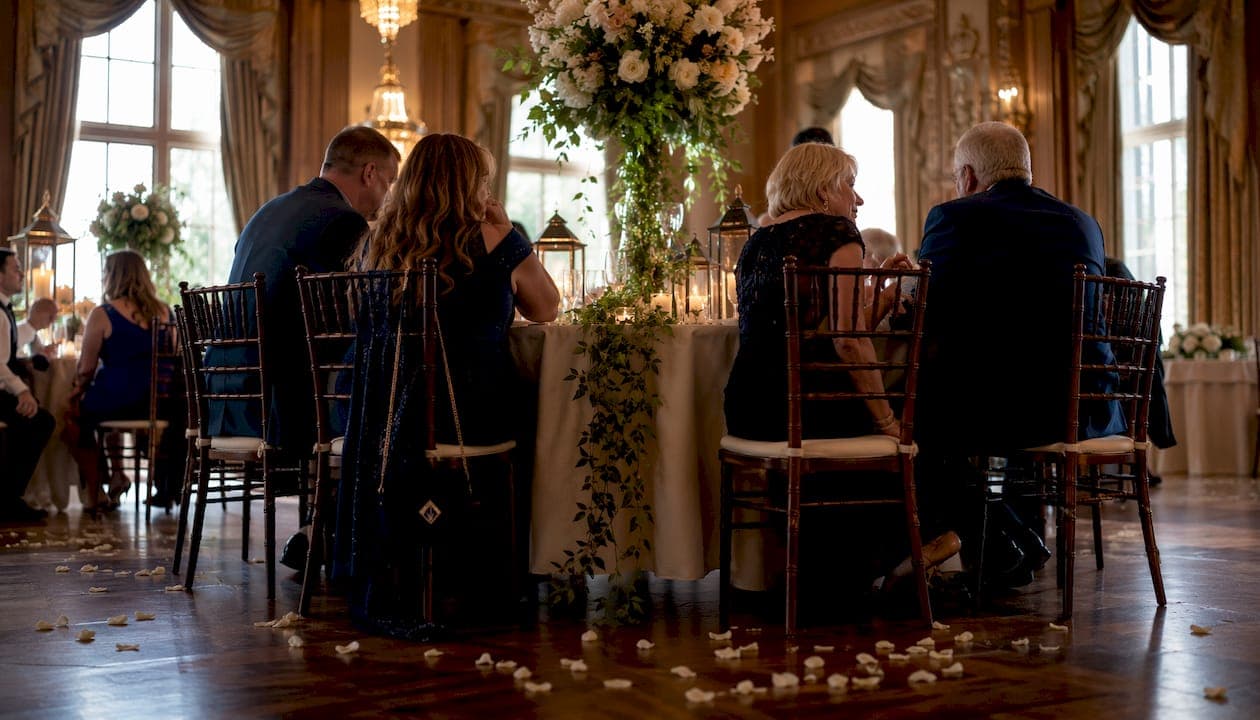
For a small wedding reception, the single highest-impact move is building the entire event around one connected dinner experience. When your guest list sits between 20 and 75 people, you have something most couples never get: everyone in the same room, at the same time, genuinely present. The goal is to protect that.
Here is a quick checklist to anchor your planning:
- Layout: Match table format to guest count (long banquet for 30–60, family-style rounds for 60–75)
- Food format: Choose family-style or plated multi-course over buffet
- Pacing: Slow it down to a dinner-party rhythm with open toasts
- Lighting: Layer candles, dimmers, and one uplighting source
- Budget anchor: Venue and catering will consume roughly 50–60% of your total spend — decide those two first
Most couples who plan small receptions spend between $13,000 and $18,000 for 20–30 guests, with the sweet spot sitting around a half-day photographer, one strong food experience, and a venue with built-in amenities. The payoff: more genuine connection, less wasted budget on crowd logistics.
Table of Contents
- What are the best small wedding reception ideas by experience type?
- How should you arrange seating for different guest counts?
- Which food and drink formats work best for small receptions?
- How do you pace a small reception evening?
- What decor and lighting make a small space feel warm?
- How do you keep a small reception budget under control?
- Why does venue choice define your layout options?
- Key Takeaways
- Small receptions reward intentional planning more than scale does
- Host your small reception at The Ambassador Club
- Useful sources
- FAQ
What are the best small wedding reception ideas by experience type?
The ideas that work best for intimate receptions fall into three buckets. Pick one as your anchor and build everything else around it.
Dining-first ideas
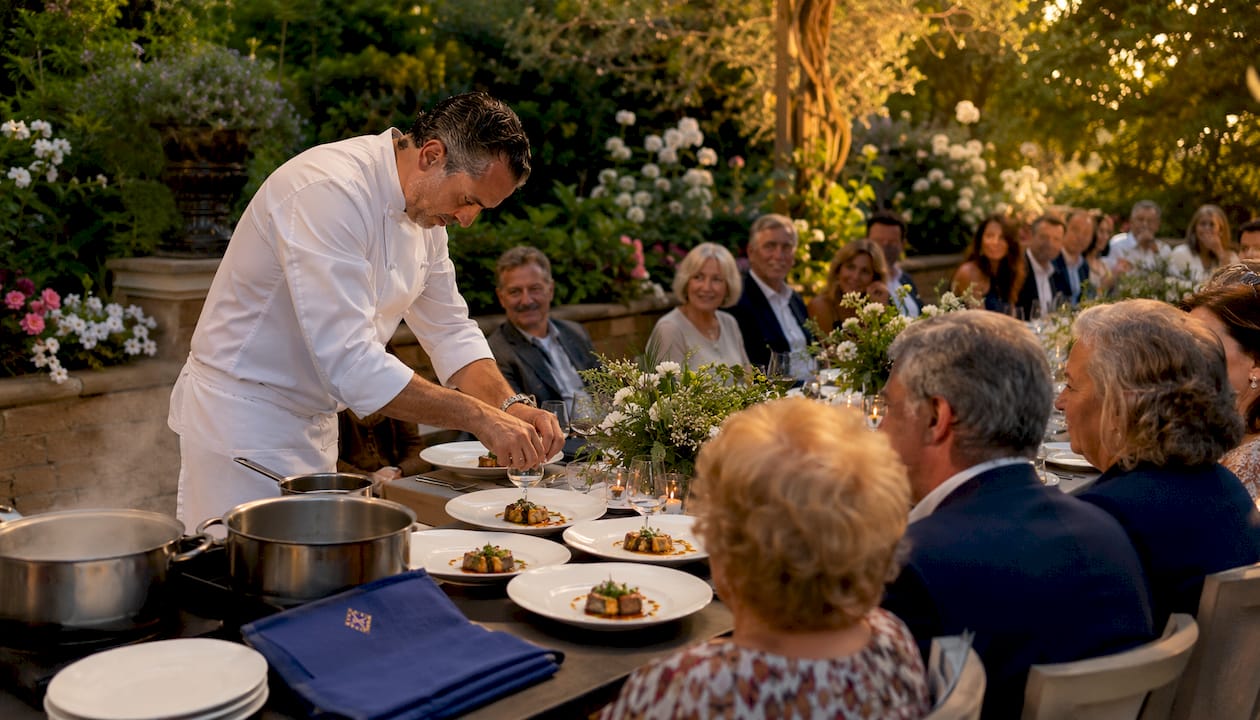
- Long-table chef's dinner: Hire a private chef to cook a 3–4 course meal at your venue. With a small guest list, you can invest in premium dining that would be impractical at 150 guests. Think wine pairings, personalized menus, and a chef who explains each course.
- Restaurant buyout: Book a private dining room at a restaurant meaningful to you. Décor needs are minimal because the space already has character.
- Tasting menu format: Work with a caterer on a 5–6 course tasting menu. Slower pacing means more conversation between courses.
Interactive ideas
- Wine or spirits tasting: A sommelier-led tasting during cocktail hour doubles as entertainment and a conversation starter.
- Live micro-performance: A solo acoustic guitarist, a jazz duo, or a string quartet fills a small room without overpowering it.
- Curated lawn games: Cornhole, bocce, or a trivia round built around your relationship story works especially well for outdoor or backyard settings.
Low-effort, high-impact ideas
- Signature cocktail: One custom drink named after the couple costs almost nothing extra and gives guests something to talk about.
- Candle cluster centerpieces: Groupings of pillar candles and votives at varying heights create warmth and visual depth without a florist's full-day fee.
- Photo slideshow or memory wall: A curated slideshow on a projection screen, or printed photos on a string-light display, personalizes the room in a way that scales perfectly for small groups.
Pro Tip: Match idea complexity to your guest count. A chef's counter experience works beautifully for 20–30 guests; for 60–75, a family-style dinner with a live musician is easier to execute and just as memorable.
How should you arrange seating for different guest counts?
Room layout is where small receptions either feel intentional or fall flat. The right table configuration does more for atmosphere than almost any décor choice.
Guest-count thresholds
- 10–30 guests: A single chef's counter or one small round table keeps everyone in direct conversation. This is the format where a private chef experience shines.
- 30–60 guests: A single long banquet table is the strongest choice. It photographs beautifully, and speakers can make eye contact with every guest during toasts. Conversations travel down the table rather than staying trapped at one round.
- 60–75 guests: Family-style rounds of 8–10 people preserve a communal feel without the logistical strain of one very long table.
- Combined ceremony and dinner: A U-shape arrangement lets everyone face the couple for vows and then transitions naturally into dinner.
Room shape matters
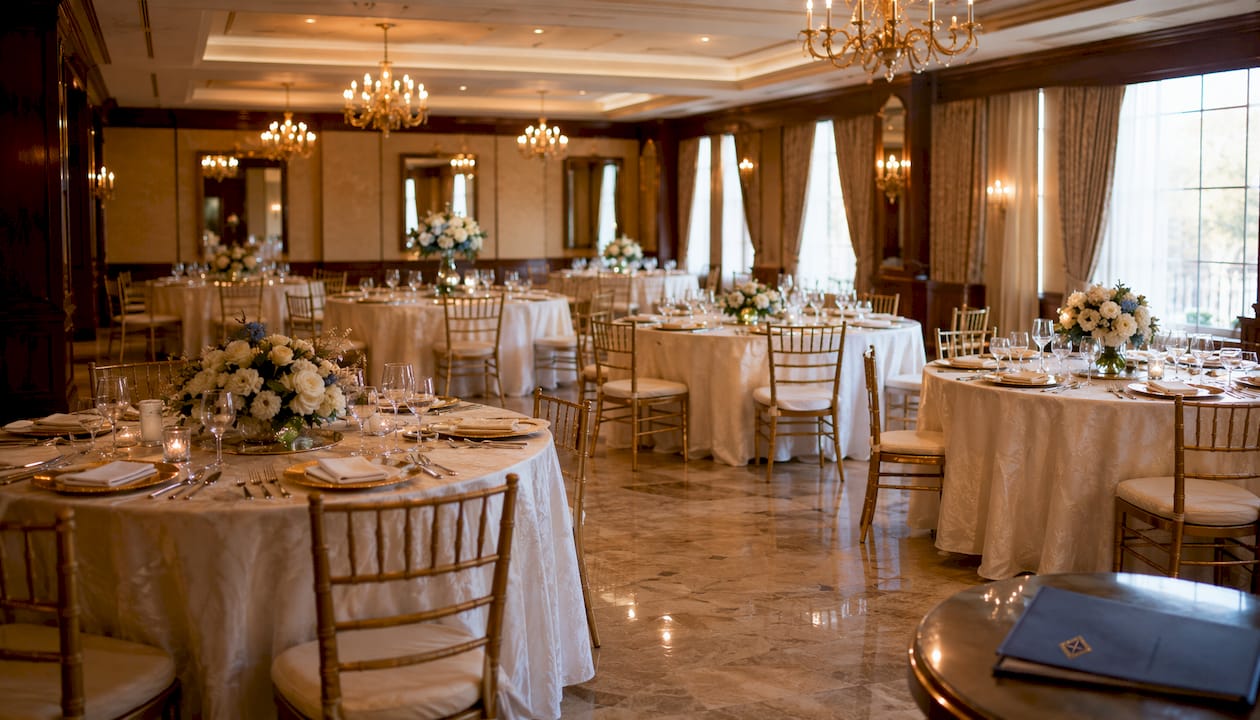
A long, narrow room almost always calls for a single banquet table running its length. A wide, open room gives you more flexibility but risks feeling sparse if you under-fill it. The rule of thumb: aim for a venue whose capacity is roughly 1.3–1.5 times your guest count so the room reads full without feeling cramped.
For toasts and photos, place the couple at the center of a long table or at the head of a U-shape, with parents directly adjacent. That positioning means the camera captures the couple's face during every toast, and guests on both sides maintain natural eye contact.
Pro Tip: Ask your venue coordinator for a scaled floor plan before you commit to a layout. Most venues can provide one, and seeing the actual dimensions prevents the common mistake of planning a long table that leaves awkward empty space at both ends.
Which food and drink formats work best for small receptions?
Food is where a small reception earns its reputation. With fewer guests, you can spend more per head and choose formats that simply do not work at scale.
Catering styles compared
Plated multi-course feels the most formal and gives the evening a clear rhythm. It works well for 20–50 guests when you have a full kitchen on-site and a caterer comfortable with timed service. Expect slower pacing, which is actually an asset for an intimate celebration.
Family-style is the most popular choice for small receptions because it encourages sharing and conversation. Large platters passed around the table feel generous and relaxed. It also tends to cost slightly less per head than plated service.
Chef's counter or tasting menu is the premium option. A private chef cooking 4–6 courses with commentary turns dinner into the entertainment. Intimate celebrations make this realistic in a way that a 200-person wedding never could.
Curated stations or food trucks suit outdoor or casual receptions. They work best when guests are moving around rather than seated for the full evening.
Bar options and cost trade-offs
A full open bar is the single fastest way to inflate per-guest costs. For small receptions, a limited beer and wine selection plus one signature cocktail delivers a satisfying experience at a fraction of the cost. Food and drinks commonly run $80–$130 per guest depending on your market, so bar choices move the needle significantly.
Cost-saving rule of thumb: Book a weekday or off-peak date and cap the bar at beer, wine, and one signature drink. Those two decisions alone can free several hundred dollars per guest for upgrades that matter more, like photography or food quality.
Food service timing
| Service moment | Suggested duration |
|---|---|
| Cocktail hour (arrival, passed hors d'oeuvres) | 60 minutes |
| First course / salad | 20–25 minutes |
| Main course | 30–40 minutes |
| Dessert / cake cutting | 20–30 minutes |
How do you pace a small reception evening?
Small receptions benefit from a dinner-party pace rather than a traditional wedding timeline. Fewer guests means fewer forced transitions, and slowing the timeline down consistently improves guest experience.
Sample 5-hour timeline
| Time | Event |
|---|---|
| — | Guest arrival, cocktail hour begins |
| — | Couple's first look / photos wrap |
| — | Guests seated, welcome remarks |
| — | First course served |
| — | Main course, open toasts begin |
| — | Cake cutting, dessert |
| — | First dance, casual dancing or mingling |
| — | Reception closes |
Entertainment that fits small spaces
- Solo acoustic musician or jazz duo: Fills the room without competing with conversation.
- Curated playlist on a quality speaker: A well-built Spotify playlist with a designated family member managing transitions costs nothing and works surprisingly well.
- Small activity stations: A polaroid guest book, a custom cocktail station, or a short trivia game about the couple.
Toasts for small groups
Open toasts, where any guest can speak briefly, work far better at small receptions than at large ones. With 30 guests, you can invite anyone who wants to share a memory without the evening running off the rails. Set a soft two-minute guideline and ask a family member to gently signal when time is up. Avoid assigning more than two or three formal speeches; the rest of the evening should feel like a conversation, not a program.
For transitions without a full emcee, lighting changes work well. Dimming the room slightly signals a toast is coming. A short music sting cues the first dance. A designated family member can guide guests from cocktail hour to the dining room without a microphone announcement.
Pro Tip: Last-minute scheduling changes are one of the most common sources of evening stress. Share a printed timeline with your venue coordinator, photographer, and caterer at least a week before the event.
What decor and lighting make a small space feel warm?
The biggest decorating mistake at small receptions is spreading too many small accents across the room. Fewer, stronger design moments read far better than a dozen competing elements. Pick one centerpiece style and commit to it.
Lighting tactics
- Layered candlelight: Pillar candles, votives, and tapers at varying heights create warmth that no overhead fixture can replicate.
- Dimmers: If your venue has dimmer-controlled overhead lighting, use it. Dropping the room to 60–70% during dinner changes the entire mood.
- String lights: Overhead Edison bulb strands work for outdoor or barn settings; fairy lights work for indoor tables.
- Uplighting: Two or four uplights in your wedding color placed in corners add depth to a small room without requiring a full lighting package.
Scaled decor choices
One strong centerpiece per table beats five small ones. Quality place settings, printed menus, and textured linens signal intentionality without requiring a florist's full-day rate. Printed place cards double as a personal touch and help guests find their seats without a separate escort display.
For accessibility, keep centerpieces low enough that guests can see across the table. Tall floral arrangements are dramatic in photos but block conversation and sightlines during toasts. The venue aesthetics you choose should support conversation, not compete with it.
These principles translate across themes. A rustic reception uses wooden chargers, greenery runners, and mason jar candles. A modern reception uses geometric vessels, white linens, and a single bold floral color. A garden reception uses loose, organic florals and soft linen napkins. The format is the same; the materials change.
How do you keep a small reception budget under control?
The most powerful budget lever for a small reception is guest count. Every person added to the list increases venue size, catering cost, and rental needs. Decide your guest count before you set a budget, not after.
High-impact budget levers
- Day and time: Weekday and Sunday receptions typically cost less than Saturday evenings at the same venue.
- Venue type: A restaurant private room, a historic hall with included amenities, or a boutique hotel often costs less than a blank-slate venue once you add rentals.
- Bar limits: Capping the bar at beer, wine, and one signature cocktail is the fastest single-line saving.
- Consolidated vendors: A venue with a full commercial kitchen eliminates the need for a separate catering tent, generator, and equipment rental.
Where to spend and where to save
Spend on: Photographer (half-day coverage delivers outsized value at small receptions, where candid moments are easier to capture), food quality, and one experiential element like a private chef or live musician.
Save on: Excessive centerpieces, full-band entertainment, elaborate wedding favors, and multi-tiered cakes (a single-tier cake with beautiful decoration serves 30 guests perfectly).
For a 20–50 guest reception, total budgets typically range from $8,000 to $25,000, with venue and catering consuming the largest share.
Pro Tip: DIY venues look cheap on paper until you add the real line items: portable restrooms, table and chair rentals, a cleanup crew, liability insurance, and sometimes a logistics coordinator. A full-service venue that bundles these items often costs less in total than a low-rent space where you source everything separately.
Why does venue choice define your layout options?
Venue selection is not just a backdrop decision. It determines which layouts are physically possible, which vendors can operate on-site, and whether your hidden costs stay hidden or surface two weeks before the wedding.
The research rule is straightforward: choose a venue whose maximum capacity is roughly 1.3–1.5 times your guest count to avoid a sparse feel. A room built for 200 guests will swallow a party of 40.
"For intimate receptions of 30–60 guests, a single long banquet table maximizes connection and visual impact; for 60–75 guests, family-style rounds of 8–10 people work best to preserve a communal atmosphere." — Paperlust, Small Wedding Ideas 2026
Restaurant private rooms, boutique hotels, vineyards, and small historic halls are consistently the strongest venue types for intimate receptions because they arrive with built-in character, working kitchens, and included amenities.
The Ambassador Club as an illustrative example
The Ambassador Club in Portsmouth, VA, offers a 6,000 sq ft historic hall that has hosted events since 1933. For a small reception of 30–75 guests, the space supports a single long banquet table, a U-shape arrangement, or family-style rounds without the room feeling oversized. The full commercial kitchen means outside caterers can operate without equipment rentals. Included amenities, such as tables, chairs, a dry bar, dance floor, and a large projection wall, eliminate the most common hidden costs that inflate DIY venue budgets. The historic venue benefits extend beyond aesthetics: built-in character reduces the decor budget because the room already has presence.
Venue tour checklist
| Question to ask | Why it matters |
|---|---|
| What is the ceiling height? | Affects lighting options and visual scale |
| Are dimmers included? | Critical for dinner-party atmosphere |
| Is kitchen access included? | Determines catering flexibility and cost |
| What rentals are included? | Tables, chairs, linens save significant money |
| What are the noise and end-time rules? | Affects entertainment choices |
| Are setup, cleaning, and security included? | These add $500–$1,500 at DIY venues |
When a venue bundles setup, cleaning, and included amenities, the comparison with a cheaper bare-bones space shifts quickly. Always build the full cost picture before signing.
Key Takeaways
A small reception succeeds when you prioritize one connected dinner experience, match your venue size to your guest count, and spend on the two things guests remember: food and photography.
| Point | Details |
|---|---|
| Lock guest count first | Every added guest increases venue, catering, and rental costs — decide the list before setting a budget. |
| Match venue to guest count | Choose a venue with capacity roughly 1.3–1.5x your guest count so the room feels full, not empty. |
| Use the right table format | Long banquet for 30–60 guests; family-style rounds of 8–10 for 60–75 guests. |
| Spend where guests notice | Prioritize food quality and a photographer; save on centerpieces, full bands, and elaborate favors. |
| The Ambassador Club option | The Ambassador Club's 6,000 sq ft historic hall in Portsmouth, VA, supports long-table and family-style layouts with included kitchen, AV, and amenities that reduce hidden costs. |
Small receptions reward intentional planning more than scale does
The conventional wisdom about weddings is that more is more: more guests, more décor, more entertainment. Small receptions prove the opposite. When you have 30 people in a room instead of 200, every design decision lands harder, every toast lands louder, and every conversation actually finishes.
What most planning guides miss is that the planning mindset has to shift, not just the guest count. Couples who treat a small reception like a scaled-down large wedding end up with a room that feels thin. Couples who design it from scratch as a dinner party with ceremony elements end up with something genuinely memorable.
The practical side of this is real. A venue with built-in amenities, a working kitchen, and a proportional room size removes the logistics overhead that eats planning time and budget. That is not a minor convenience; it is the difference between spending the week before your wedding coordinating rental deliveries and spending it with the people you are about to marry.
Host your small reception at The Ambassador Club
Historic charm, a full commercial kitchen, and a room that actually fits your guest list: The Ambassador Club in Portsmouth, VA, is a practical choice for couples planning an intimate reception of 30–75 guests.
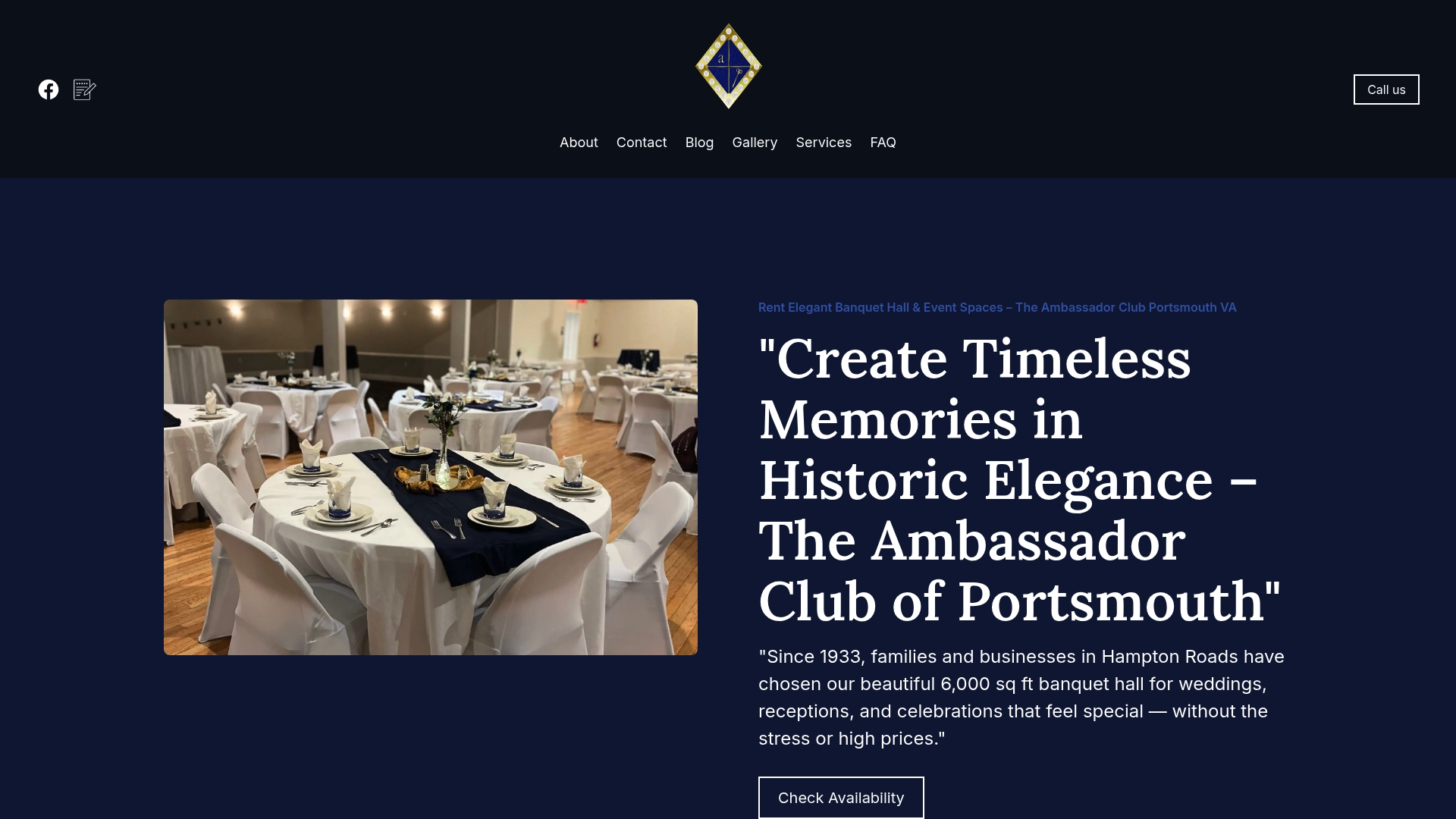
The 6,000 sq ft hall accommodates a single long banquet table, family-style rounds, or a U-shape layout. Tables, chairs, a dry bar, dance floor, and a built-in projection wall are included in the rental. Outside catering is welcome, and comprehensive packages cover setup, cleaning, and security so you are not sourcing those separately.
To check availability or ask about packages for your date, visit The Ambassador Club and submit an inquiry. Dates book in advance, particularly for spring and fall weekends.
Useful sources
- Small Wedding Ideas 2026 — Paperlust: Seating recommendations by guest count and layout guidance for intimate receptions.
- How Much Does a Micro Wedding Cost? — Paperlust: Budget ranges for 10–50 guest weddings, including photography and bar cost breakdowns.
- Small Wedding Cost Breakdown (20–50 Guests) — Honeyfund: Per-guest catering costs and the hidden expenses of DIY venues.
- How to Plan an Intimate Micro-Wedding — I Do Collective: Venue type recommendations and experience-driven splurge ideas for small guest lists.
- How to Design an Intimate Wedding Reception — LoveStruckStyle: Design cohesion principles and lighting strategies for small spaces.
- Intimate Wedding Ideas: 30–75 Guests — Paperlust: Venue sizing rules, timeline pacing, and layout options for mid-size intimate receptions.
FAQ
What do you do at a small wedding reception?
Focus the evening on one connected dinner experience with open toasts, a live musician or curated playlist, and one interactive element like a signature cocktail station or photo slideshow. Small guest lists make activities like group wine tastings or lawn games genuinely engaging rather than logistically complicated.
What is the cheapest way to have a small wedding reception?
Book a weekday or off-peak date, limit the bar to beer, wine, and one signature cocktail, and choose a full-service venue that includes tables, chairs, kitchen access, and cleanup. DIY venues often cost more once you add portable restrooms, rentals, insurance, and a cleanup crew.
What is the 50/20/30 rule for weddings?
The 50/20/30 rule is a budgeting guideline suggesting roughly 50% of the wedding budget goes to venue and catering, 20% to photography and entertainment, and 30% to everything else including florals, attire, and stationery. It aligns closely with the finding that venue and catering consume 50–60% of total spend even at small scale.
How do you run a simple small wedding reception?
Choose one table format that fits your guest count, serve family-style or plated dinner, keep toasts open rather than scripted, and use lighting changes instead of a full emcee to cue transitions. The Ambassador Club's included amenities, from kitchen access to a built-in projection wall, reduce the logistics load so the evening runs without a coordinator managing every detail.