Yes, you can self-cater your wedding if you pick a simple, scalable menu, assemble enough helpers, and follow basic food-safety rules. Guest count and menu complexity determine your workload more than anything else, and access to real refrigeration and heat sources decides whether the food is safe. Even couples who cook everything themselves usually come out ahead by hiring at least a few paid servers for the reception itself.
TL;DR:
- Self-catering is feasible for weddings up to 100 guests, provided the menu is simple, with few dishes, and helpers are reliable and timely.
- Keeping the menu narrow to 2-3 mains and sides, or 6-8 buffet items, reduces prep time, transport, and temperature management efforts.
- Food safety requires strict temperature control, quick transport, and checking food temperatures frequently to avoid spoilage and health risks.
- Hiring dedicated staff for serving and food safety, even if cooking yourself, ensures smoother service and reduces your workload during the event.
- Venues with full commercial kitchens and flexible outside catering policies significantly cut time, stress, and equipment costs for self-catering.
Table of Contents
- Real formats couples use and what they actually take
- Menu templates and portioning that hold up at scale
- Food safety rules you cannot skip
- Deciding who you actually need on the team
- Where the money actually goes and where you can cut it
- A run sheet that keeps the food on schedule
- What a real venue kitchen changes for DIY couples
- When DIY actually makes sense and when it does not
- A venue that makes self-catering easier
- Sources
- FAQ
Real formats couples use and what they actually take
Most self-catered weddings fall into a handful of repeatable formats. A backyard or barn wedding for 40 to 80 guests usually means a small crew of family and friends handling prep the day before, with a few volunteers assigned to serve and clear plates. An appetizer-only reception scales further, and one well-documented example fed 200 guests on a roughly $2,500 food-and-supplies budget by leaning on trays of finger food instead of a full sit-down meal, according to a DIY reception case study. A brunch wedding trims labor further since egg dishes, pastries, and coffee hold up well and need less last-minute cooking.
- Backyard or barn, 40 to 80 guests: one to two days of prep, four to six helpers on the day.
- Appetizer-only, up to 200 guests: heavy prep the week before, larger disposable and staffing budget.
- Brunch format: shortest day-of labor, but a narrower serving window.
One couple who fully self-catered their barn wedding later said they would still hire waiting staff next time, even though the cooking itself worked out fine, based on a first-person account of a self-catered barn wedding.
Menu templates and portioning that hold up at scale
Keep the menu narrow. A reliable structure is 2 to 3 mains plus 2 sides, or an appetizer-heavy spread with 6 to 8 items served buffet style. Both approaches limit the number of dishes you have to cook, transport, and keep at temperature.
For portioning, plan roughly 1 pound of food per adult across mains and sides, half that for children under 10, and add a 10% buffer for seconds and no-shows who still get counted in your order. Community-sourced planning threads consistently point to the same shortcut: fewer dish types, ordered in bulk trays, cuts prep time without cutting variety that guests notice.
- Casual buffet: pulled pork or roast chicken, a vegetarian pasta bake, rice, a green salad, rolls.
- Appetizer spread: meatballs, caprese skewers, a cheese board, mini sandwiches, a fruit platter, deviled eggs.
- Brunch table: a baked egg casserole, a vegetarian frittata, breakfast potatoes, pastries, fresh fruit.
Swap proteins for a plant-based main and mark gluten-free or nut-free dishes clearly on small table cards to cut down on guest questions at the buffet line.
Pro Tip: Label every dish with its name and major allergens before guests arrive, not as they walk through the line.

Food safety rules you cannot skip
Food safety is the one part of self-catering with no room for improvisation. Hot food needs to stay above 140°F and cold food below 40°F; anything sitting between those points at room temperature must be eaten or discarded within 2 hours, or 1 hour if the outdoor temperature is above 90°F, according to FoodSafety.gov's guidance on DIY wedding food.
- Transport hot dishes in insulated carriers and cold dishes in coolers with ice packs, checking temperatures on arrival.
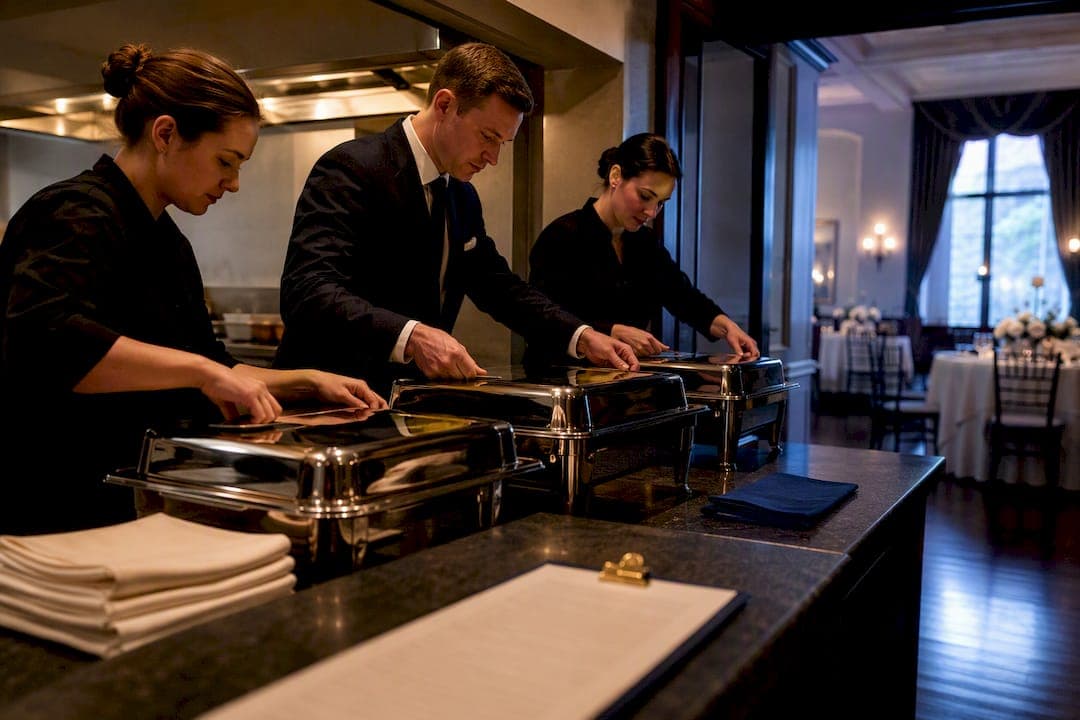
- Use chafing dishes with sternos for the serving line and refill them rather than letting one batch sit out for hours.
- Reheat leftovers to 165°F before serving again, and refrigerate or freeze anything you plan to keep within the same window.
- Ask whoever is cooking where the food was prepared and how raw and ready-to-eat items were kept separate.
Food that sits unrefrigerated for more than 2 hours (or 1 hour above 90°F) should be thrown out, per FoodSafety.gov, which makes a single volunteer assigned to check chafing dish and cooler temperatures every 30 minutes one of the cheapest insurance policies of the day.
Deciding who you actually need on the team
Cooking the food yourselves does not mean serving it yourselves. For around 50 guests, plan on a small team of servers and a bartender; larger receptions require more staff, including at least one dedicated food-safety monitor. Paid servers and bartenders typically work for an hourly rate plus tips, while family volunteers often prefer a small stipend or a thank-you gift over cash.
- Servers: refill buffet trays, bus tables, and flag when a dish is running low.
- Bartender: manages pours and keeps an eye on guests who may need water instead of another drink.
- Setup and cleanup crew: arrives early, breaks down late, and should be a separate group from your servers if possible.
Before the day, walk every helper through a short script: where supplies are, who to ask if something runs out, and what to do if a dish looks like it is sitting too long. If you hire outside staff, confirm in advance whether gratuity is included and whether they carry their own liability coverage, points worth raising with any event support staff you bring on.
Where the money actually goes and where you can cut it
Catering averages a significant chunk of the overall wedding budget on a per-head basis nationally, according to The Knot's wedding cost data, which is exactly why self-catering appeals to so many couples. But hidden costs creep in through rentals, disposables, and last-minute grocery runs.
- Buy proteins and staples in bulk from a warehouse club rather than a regular grocery store.
- Rent chafing dishes and coolers instead of buying them for one use.
- Compare a full buffet against an appetizer-only spread since appetizers can cost as much as a sit-down meal once disposables and variety are factored in, a pattern noted in The Kitchn's DIY reception breakdown.
- Set aside a fixed line item for paid serving staff before you finalize the food budget, not after.
Pro Tip: Get itemized quotes from two rental companies before assuming buying equipment outright is cheaper; one-time rentals usually win for anything you will not reuse.
A run sheet that keeps the food on schedule
A brunch wedding and a late-afternoon ceremony need different run sheets, but both hinge on knowing exactly who owns each time block.
- Brunch format: helpers arrive 2 hours before guests, food is staged by hour minus 30 minutes, service runs a tight 90-minute window, cleanup starts as the last guests leave.
- Evening reception: cooking crew arrives midday, cold items go into coolers by early afternoon, chafing dishes are lit 30 minutes before guests are seated, and a second check happens at the halfway point of service.
- Contingency: build a 15-minute buffer into every transition, and assign one person to make the call if the ceremony runs long and food needs to be re-staged.
Cleanup should start while dessert is still being served so the crew is not racing daylight or a venue's end time. The Ambassador Club's run-sheet template breaks this down by role, which is useful if you want a starting point to adapt rather than build from scratch.
What a real venue kitchen changes for DIY couples
Cooking in a home kitchen and finishing food in a commercial one are different projects. A full commercial kitchen means more burners, more oven space, and cold storage that can actually hold trays for 100 or more guests instead of overflowing a home refrigerator.
- On-site cold storage cuts the food-safety risk that comes with transporting large batches long distances.
- Event staff already on-site can answer questions about where things are without pulling a guest away from the celebration.
- Renting equipment from the venue's own inventory avoids a second delivery and pickup from an outside rental company.
The Ambassador Club's commercial kitchen checklist and cost-saving strategies guide both walk through this in more detail for couples weighing a home kitchen against a venue with commercial-grade facilities.
When DIY actually makes sense and when it does not

Self-catering works best under 100 guests, with a menu narrow enough to prep in a day or two, and with at least four reliable helpers who show up on time. Push past that and the math changes fast: more dishes, more coolers, more chances for something to sit too long at the wrong temperature.
If there is one thing worth paying for even on the tightest budget, it is someone whose only job is watching the food and running the serving line, so you are not the one checking a chafing dish thermometer in your wedding dress.
— MARTIN
A venue that makes self-catering easier
Choosing a venue with a full commercial kitchen changes what self-catering actually costs you in time and stress. Some venues offer a full commercial kitchen, room for up to 200 guests, and flexible policies around outside catering, so your menu plan does not have to bend around a venue's restrictions.

- Full commercial kitchen on-site, so food prep and staging do not have to depend on a home kitchen.
- Capacity for a large number of guests in a spacious hall.
- Flexible outside-catering rules that can accommodate various catering plans.
- On-site tables, chairs, and event staff who can assist helpers during service.
Check the Standard Event Package or browse the full list of wedding and event services to see if the space fits your guest count and catering plan.
Sources
- Food Safety Tips for Catered and DIY Wedding Food | FoodSafety.gov
- A DIY Wedding Reception for 200: The Party Plan | The Kitchn
- Fully Self-Catered DIY Barn Wedding · Rock n Roll Bride
- This Is the Average Wedding Cost, Backed By Data | The Knot
FAQ
What is the 50/20/30 rule for weddings?
Definitions vary across wedding planning guides, and no single sourced version of this budgeting split is confirmed here. A safer approach is to build your budget around your own top three priorities, whether that is venue, food, or photography, rather than a fixed formula.
Is it cheaper to cater or cook the food yourself?
Self-catering usually costs less than hiring a full-service caterer, but the gap narrows once you add rentals, disposables, and paid serving staff. An appetizer-only reception for 200 guests ran about $2,500 in food and supplies in one documented example, which is a useful baseline rather than a guarantee for every guest count.
Is $5,000 a reasonable budget for a wedding?
A focused budget can work for a small self-catered wedding, especially with a narrow guest list and a simple appetizer or brunch menu. Whether it feels realistic depends heavily on guest count and location, since national catering averages alone can consume a large share of typical wedding budgets according to The Knot.
What is the cheapest way to feed 100 people at a wedding?
An appetizer-heavy buffet with 6 to 8 simple dishes tends to cost less in labor than a plated dinner, though disposables and variety can add up. Buying proteins and staples in bulk and renting rather than buying serving equipment are two of the most reliable ways to keep the per-head cost down.
Does the venue matter for a self-catered wedding?
Yes, a venue with a commercial kitchen and on-site cold storage reduces both the transport risk and the equipment you need to rent separately. Some venues offer a full commercial kitchen and flexible outside-catering policies for couples planning to handle some or all of their own food.