
Choose a limo when the group is small and the arrival itself matters, whether that is a wedding exit or a night at the theater. Choose a party bus when the group is larger and the ride is meant to be part of the celebration, not just the trip to it. The tipping points are group size, the vibe you want, and whether per-person cost matters more than a polished entrance.
TL;DR:
- A limo is ideal for groups under 10 guests seeking a polished, seated arrival, often at a lower overall cost and with privacy features.
- A party bus is better for groups over 20, offering standing room, dance floors, and onboard entertainment to enhance the celebration experience.
- Per-person cost favors party buses once the group size reaches about 10 to 15 people, despite their higher hourly rates.
- Venue parking and staging space significantly influence the choice, with limos needing less room and party buses requiring wider access points.
- For multi-stop events or larger groups, a party bus tends to provide better value and fun, while limos suit formal, photo-ready moments.
Table of Contents
- Limo vs Party Bus: Size and Passenger Capacity
- Amenities and Atmosphere Inside Each Vehicle
- Limo vs Party Bus Cost: Hourly Rates and Per-Person Math
- Best Occasions for a Limo or a Party Bus
- Pros and Cons: Breaking the Tie
- Booking Logistics: Parking, Minimums, and Safety Rules
- Coordinating Guest Transportation at Your Venue
- A Simple Way to Decide Between the Two
- Let the Ambassador Club Help Coordinate Your Transportation
- Sources
- FAQ
Limo vs Party Bus: Size and Passenger Capacity
Capacity is usually the first filter, and it settles more debates than people expect.
A stretch limo typically seats 4 to 14 passengers, all facing each other around a low center console, built for a seated, photo-ready ride. An SUV limo (think stretch Escalade or Suburban) usually lands in the 14 to 20 range, splitting the difference between a limo's polish and a bus's room. Party buses commonly run from 14 up to 50 or more passengers, and many of those seats convert to standing room around a dance floor or bar.
A simple rule of thumb keeps the decision fast:
- Under 10 guests: a stretch limo almost always fits better and costs less per hour.
- 10 to 20 guests: consider an SUV limo or a small party bus, depending on whether you want seated intimacy or standing-room energy.
- 20 or more guests: a party bus or a shuttle becomes the only realistic option, both for space and for cost.
Standing room changes the entire function of the vehicle. A limo keeps everyone seated and facing inward, which suits conversation and quiet celebration. A party bus lets people move, dance, and mingle, which suits a group that wants the ride to feel like the first stop of the party rather than a transfer between stops.
Amenities and Atmosphere Inside Each Vehicle
The interior of each vehicle sets the tone before you even reach the venue.

A limo leans into intimacy: privacy partitions, low ambient lighting, a small bar setup, and legroom built for conversation rather than movement. It is the vehicle equivalent of a quiet booth at a nice restaurant. A party bus is built for group energy instead of privacy.
Typical party bus features include:
- LED lighting systems that change color and pulse with music
- DJ-grade sound systems, sometimes with a mic for toasts or announcements
- A small dance floor or open standing area
- A wet bar setup for mixing drinks on the move
Pro Tip: Ask the operator directly about BYOB rules and decoration policy before you book. Some allow open containers for guests of legal drinking age; others restrict alcohol to certain routes or require a licensed bartender on board. Assumptions here cause more day-of headaches than almost anything else on this list.
Limo vs Party Bus Cost: Hourly Rates and Per-Person Math
Price is where the size decision either gets validated or reversed, so it is worth running the numbers before you commit.
Hourly rates vary by city, season, and vehicle size, but limos generally run at lower hourly rates suitable for smaller groups, while party buses tend to command higher hourly rates reflecting capacity and amenities. Per-person cost usually flips in favor of the party bus once a group reaches roughly 10 to 15 people, since the higher hourly rate gets divided across far more riders.
Here is how that plays out over a typical 4-hour rental:
Those figures are illustrative, not quotes. Actual pricing shifts with your city, the date (prom season and New Year's Eve both spike demand), and how far the vehicle has to travel to reach you.
Before you sign anything, ask about these common add-ons:
- Gratuity, often 15% to 20% and sometimes built into the quote already
- Fuel surcharges on longer routes or during high-demand periods
- Overtime rates if the event runs past the booked window
- Cleaning fees, especially after events involving confetti, food, or spilled drinks
- Parking and toll costs, which some operators pass directly to the client
Best Occasions for a Limo or a Party Bus
Matching the vehicle to the event usually comes down to guest count and how much of the night happens on the road.
- Weddings. A limo works well for the couple's arrival and exit, or for shuttling the officiant and immediate family. A party bus makes more sense for the full bridal party or a guest list heading between ceremony and reception venues.
- Prom. Small friend groups or a single couple do fine in a limo. Groups of 10 or more students almost always come out ahead, on cost and fun, in a party bus.
- Bachelor and bachelorette parties, bar crawls, casino trips, winery tours. These multi-stop nights are where party buses shine, since the ride itself becomes a rolling pre-party between stops.
- Corporate travel and airport runs. Executives and small client groups typically call for a limo or sedan. Full team outings, holiday parties, or off-sites tend to justify a party bus instead.
Some planners split the difference: a limo for the VIPs and a party bus for the larger group, arriving together but riding separately.
Pros and Cons: Breaking the Tie
When the numbers are close, the trade-offs usually settle it.
- Limo pros: polished arrival, private conversation space, easier parking and staging at smaller venues.
- Limo cons: limited capacity, higher per-person cost for groups over 10, less room to move.
- Party bus pros: lower per-person cost at scale, built-in entertainment, room to stand and dance.
- Party bus cons: less intimate, tougher to park or stage at tight venues, not ideal for formal photo moments.
If the photo-ready arrival matters most, lean limo. If accessibility for a mixed-age or larger group matters most, or the per-person price is the deciding factor, lean party bus.
Booking Logistics: Parking, Minimums, and Safety Rules
The unglamorous details often decide the vehicle choice as much as size or budget.
Limos generally need less staging space and can pull curbside at most venues. Party buses need more room to park, idle, and let passengers off safely, which matters at venues with tight lots or narrow drop-off lanes.
- Most operators set a minimum booking length, often 3 to 5 hours on weekends, which affects your total cost even for a short event.
- Alcohol policy is set by the operator first, then bounded by state and local law. Confirm both before assuming BYOB is allowed.
- Ask for proof of commercial insurance and confirm the driver's licensing and experience with the vehicle class.
- For teen-focused events like prom, review NHTSA's guidance on teen passenger safety and the CDC's teen driver risk factors before finalizing chaperone and alcohol rules.
Coordinating Guest Transportation at Your Venue
Venue staff see transportation patterns that rental companies rarely mention, and that experience shapes what actually works on event day.
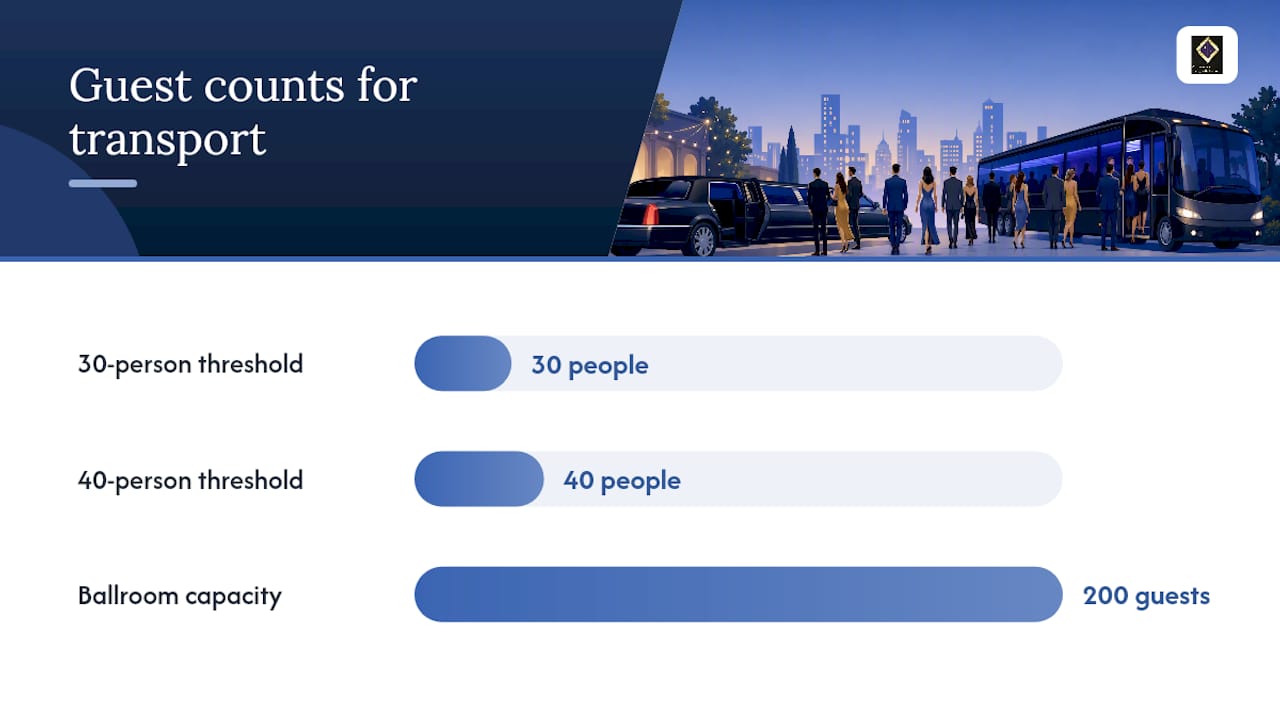
For guest lists heading past 30 or 40 people, a charter bus or minibus shuttle usually beats a party vehicle for pure logistics, since the goal shifts from atmosphere to getting everyone there on time without a parking-lot bottleneck. In a 6,000 square foot ballroom built for up to 200 guests, staggered arrivals matter more than most planners expect. Setting fixed drop-off windows, a single accessible unloading point, and a named contact for the transportation company keeps the front entrance from backing up.
Before booking, give your venue and transport operator:
- Confirmed arrival windows, not just a single time
- One point of contact who can adjust timing in real time
- An accessible drop-off location separate from general parking
- A timeline that accounts for photos, speeches, and any staggered group arrivals
Readers weighing overall venue capacity against transportation needs often find the two decisions are more connected than they first assumed.
A Simple Way to Decide Between the Two
Most of this decision collapses into one question: is the ride part of the event, or just the way you get to it? If people will be dancing, drinking, and taking group photos inside the vehicle itself, book the party bus. If the vehicle's job is to deliver someone looking sharp for a specific moment, book the limo.
The headcount rule is the fastest filter: under 10, default to a limo; over 20, default to a party bus; in between, let vibe and budget break the tie. Whatever you choose, get an itemized quote and confirm insurance before you pay a deposit. The next move is simple: call and ask for capacity and a written estimate, not a verbal ballpark.
— MARTIN
Let the Ambassador Club Help Coordinate Your Transportation
Booking the vehicle is only half the puzzle. The other half is making sure it arrives, unloads, and parks without turning your event's front door into a traffic jam. The Ambassador Club of Portsmouth coordinates transportation logistics for events booked in our 6,000 square foot hall, including recommendations for vetted shuttle and coach operators when your guest list runs large.

That coordination covers staging drop-off points, setting arrival windows so guests don't all show up at once, and lining up timing with your ceremony, speeches, or reception schedule. If you're planning a wedding, corporate event, or celebration for up to 200 guests and want the venue and transportation working from the same plan, start with our event venue and services page and tell us your guest count and arrival needs. For groups exploring lower-impact shuttle alternatives to a full party bus, Pedal Power Galway's guide to party bus alternatives is worth a look as well.
Sources
Vehicle capacity and pricing context in this article draw on industry guides from LimoCity and Luxury Bus NJ. Safety guidance for teen passengers references NHTSA and the CDC. Operator policy and state law can differ, so treat these as starting points, not final answers.
- Limo vs Party Bus: Which Is Right for Your Event? | LimoCity
- Party Bus vs Limo: Which Is Better for Your Event? | Luxury Bus NJ
- Parents: Talk to Your Teen Driver About Safe Driving | NHTSA
- Teen drivers: risk factors | CDC
FAQ
Is It Cheaper to Rent a Party Bus or a Limo?
For groups under 10, a limo is usually cheaper overall. Once a group passes roughly 10 to 15 people, a party bus typically becomes cheaper on a per-person basis, even though its hourly rate is higher.
Is a Party Bus Considered a Limo?
Not technically. A limo is a stretched sedan or SUV built for seated, low-capacity rides, while a party bus is a larger vehicle with standing room and group entertainment features, though both fall under the broader "limousine service" category many operators use commercially.
What Is the Difference Between a Party Bus and a Limo?
The core differences are capacity, layout, and purpose: limos seat 4 to 14 passengers for a polished, quiet ride, while party buses hold up to 50 and are built around standing room, lighting, and sound for an active, multi-stop night out.
Why Do People Not Use Limos as Often Anymore?
Group sizes for modern celebrations like bachelor parties and proms have grown, and party buses offer more room and entertainment at a lower per-person cost for those larger groups. Limos remain the better fit for smaller parties and formal arrivals, so the shift reflects group size trends more than any decline in limo quality.
How Do I Know Which One Fits My Venue?
Confirm parking and drop-off space with your venue first, since party buses need more room to stage than limos. If you're booking a hall like the Ambassador Club, check venue capacity guidelines and coordinate arrival windows directly with staff before locking in a vehicle.