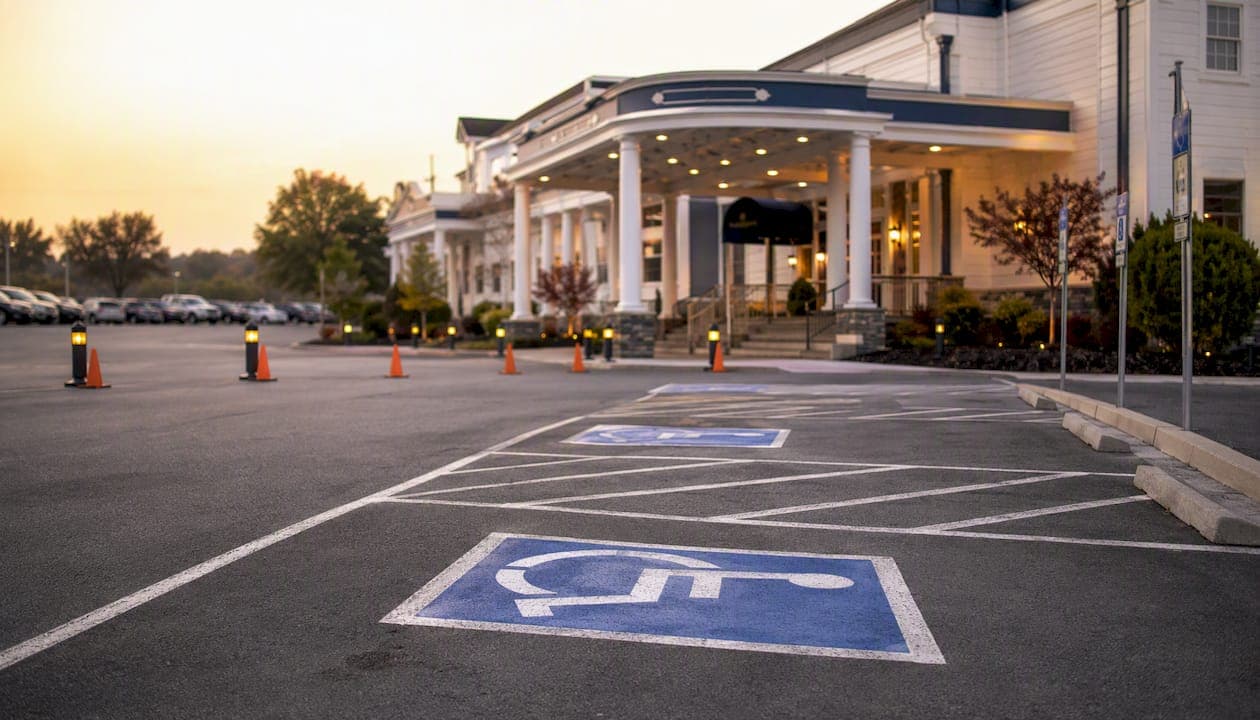
Parking is the bookend of your event. Get it right and guests arrive relaxed, the meal starts on time, and the last car pulls out without a hitch. Get it wrong and you're dealing with blocked driveways, late arrivals, and a grandmother who had to walk three blocks in heels. The role of parking at family gatherings goes far beyond finding a spot. According to Event 360, parking is the first operational touchpoint of any event, and poor management causes stressed or late arrivals that throw off the entire timeline.
Three things you can do right now, before a single guest shows up, following a trusted checklist for family events:
- Designate a drop-off and rideshare point at least 20 feet from the main entrance, clearly marked with a sign or cone line.
- Reserve your closest spaces for accessible guests, elderly relatives, and anyone arriving with young children.
- Assign two trained volunteers to manage driveway and street flow from 30 minutes before the first arrival through the first 45 minutes of the event.
These three steps alone will prevent the most common parking failures at private family events.
Table of Contents
- Why does parking matter so much at family gatherings?
- How do you assess your venue and estimate parking demand?
- How should you design parking zones and traffic routes?
- Which services and tools reduce parking friction most?
- How do you keep vulnerable guests safe in the parking area?
- What does a practical parking checklist look like?
- How does Ambassadorclubportsmouth handle parking for family gatherings?
- Key Takeaways
- The detail most hosts overlook
- Ambassadorclubportsmouth takes the parking stress off your plate
- Useful sources
- FAQ
Why does parking matter so much at family gatherings?
Parking creates the first and last impression guests carry away from your event. Parking & Mobility Magazine puts it plainly: well-organized parking increases guest satisfaction, while a poor exit experience can erase an otherwise positive memory of the whole day. That's a hard truth for hosts who spend weeks on food and decorations but give parking ten minutes of thought.
The impact of parking on family celebrations shows up most clearly in timing. When guests circle the block twice, park three streets away, and arrive flustered, the ripple effect hits your schedule. The meal gets pushed back. The kids get restless. The grandparents who drove two hours feel like an afterthought. A holiday gathering with parking delays pushing back the main meal is not remembered fondly, no matter how good the food was.
The first operational touchpoint of any event is parking. Inadequate planning causes stressed or late arrivals that delay event timelines and disrupt event flow. — Event 360
The importance of parking in gatherings also extends to safety. Unmanaged vehicle flow near pedestrian areas, especially when children are running around, creates real hazards. Planning is not optional. It's the difference between a gathering people talk about warmly and one they quietly dread next year.
How do you assess your venue and estimate parking demand?
Start with a site walk, not a guess. Before you can design zones or assign volunteers, you need a clear picture of what you're working with.
Site assessment checklist
- Count every on-site parking space, including the driveway and any shared lot access.
- Check curbside restrictions on adjacent streets (posted signs, fire hydrant clearances, no-parking zones).
- Note neighbor driveways that could be blocked by overflow parking.
- Identify ADA-accessible spaces or the closest flat, paved area that can serve as one.
- Confirm whether any guests are arriving by RV, van, or bus and whether there's room to stage them.
- Walk the pedestrian route from the farthest likely parking spot to the entrance.
- Check lighting along that route for evening or late-afternoon events.
Estimating how many vehicles to plan for
The FHWA's event site access and parking guidance recommends building a parking demand estimate from your guest count, adjusted for carpooling, rideshare, and shuttle use. A simple method:
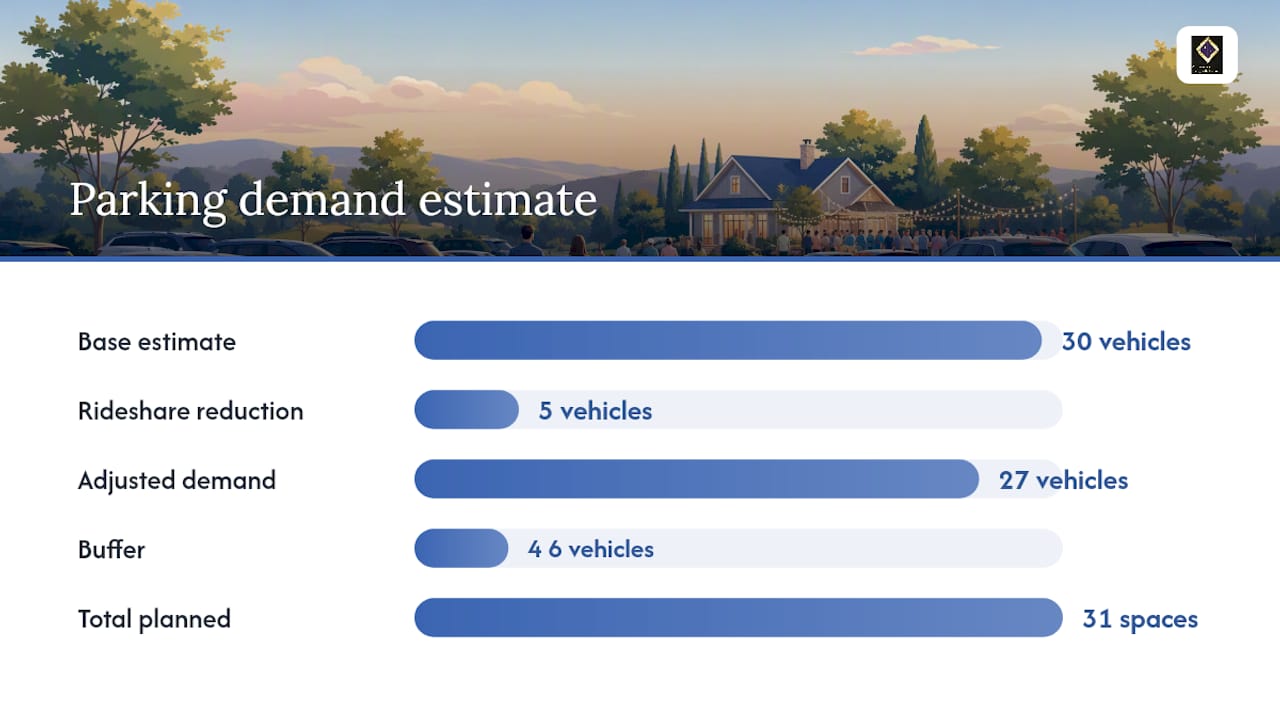
Sample calculation for 80 guests:
| Variable | Estimate |
|---|---|
| Total guests | 80 |
| Average carpool size | 2 persons/vehicle |
| Base vehicle estimate | 30 vehicles |
| Rideshare/shuttle reduction (15%) | minus 5 vehicles |
| Adjusted vehicle demand | about 27 vehicles |
| Buffer for vendors, late arrivals | add 4–5 vehicles |
| Total spaces to plan for | 31 spaces |
If your on-site capacity falls short of your estimated vehicle count, you need an overflow plan before the event, not during it. The FHWA guidance also recommends identifying secondary access points and overflow lots in advance, particularly when the primary lot could queue vehicles back onto a public road.
How should you design parking zones and traffic routes?
Separate your arrivals from your departures. That single principle, drawn from FHWA event parking operations guidance, prevents the most common traffic conflict at private gatherings: cars trying to enter while others are trying to leave, creating a standstill at the only driveway.
What to include on your site sketch
Draw this on paper or a shared Google Map before the event. Mark entrances and exits with arrows showing direction of flow, pedestrian paths and crossing points, cone lines separating vehicle lanes from walking areas, the location of each zone, and where each volunteer will stand. Share it with every attendant before they arrive.
Pro Tip: Label your sketch with the volunteer's name at their assigned position. When someone asks "where do I stand?" you hand them the map instead of explaining it three times.
What to cover in a 10-minute volunteer briefing
- How to guide a vehicle safely (stand to the side, use clear hand signals, never step in front of a moving car).
- What radio channel or phone group to use for real-time updates.
- How to place and move cones without creating a hazard.
- How to de-escalate a frustrated guest (stay calm, offer a solution, call the parking lead if it escalates).
- Where to stand for maximum visibility without standing in a travel lane.
Call law enforcement immediately if there is a vehicular injury, if emergency vehicle access is blocked, if a guest becomes physically aggressive, or if illegal parking is creating a public safety hazard. Don't try to manage those situations with volunteers.
Which services and tools reduce parking friction most?
Simple tools deliver the biggest return. According to the Mississauga Convention Centre's event parking logistics guide, clear signage, pre-assigned zones, and a single designated rideshare point consistently outperform more elaborate systems for events under 200 guests.
- Advance parking passes: Pre-purchased passes, whether paper or digital, reduce entry delays and let you forecast demand accurately. Parksy's event parking research shows that online reservations increase space utilization and reduce last-minute congestion.
For hosts who want digital tools, platforms like Vicinia offer app-free digital permits and real-time occupancy monitoring, while iParq supports online pre-sales and point-of-sale handheld verification at the lot entry. Both are worth a look for larger reunions where manual tracking gets unwieldy.
How do you keep vulnerable guests safe in the parking area?
Accessible parking and a short, well-lit pedestrian path are non-negotiable for any gathering that includes elderly relatives, guests with mobility impairments, or families with small children. The FHWA guidance specifically recommends reserving and labeling priority zones close to entrances and designing egress routes that allow these users to leave without crossing heavy pedestrian or vehicle traffic.
Accessibility checklist
- Reserve at least two spaces within 50 feet of the entrance for accessible guests, with a level curb cut or portable ramp if needed.
- Mark the pedestrian path from parking to the entrance with cones or rope barriers so vehicles can't drift into it.
- Confirm the path is lit for evening arrivals. Battery-powered LED pathway lights cost under $30 and take 10 minutes to set up.
- If guests are arriving by camper or large van, designate a flat, level pull-in spot that doesn't require backing across a pedestrian area.
- Place a drop-off point with level ground access for guests who cannot walk from a standard parking space.
Pedestrian safety during high-traffic periods
Speed is the main hazard. Post a 5 MPH sign at the driveway entrance. Use cones to narrow the travel lane, which naturally slows drivers. Assign your accessible-assist attendant to the crossing point between the parking area and the entrance during peak arrival and departure windows. For gatherings with young children, a temporary rope barrier along the pedestrian path keeps kids from wandering into the vehicle lane.
Lighting matters more than most hosts realize. A well-lit path from parking to the entrance reduces trip hazards and gives elderly guests the confidence to walk without assistance.
What does a practical parking checklist look like?
Use this as your working document. Print it, share it with your volunteers, and check items off as you go.
Pre-event tasks (48–72 hours before)
- Confirm overflow lot access with neighbor or property owner.
- Print and laminate directional signs.
- Share parking map and rideshare drop-off location with all guests via text or email.
- Brief all parking volunteers (roles, signals, radio/phone channel).
- Test lighting along pedestrian path.
Day-of tasks (1–2 hours before first arrival)
- Set cones and stanchions to define zones and pedestrian paths.
- Post directional signs at every turn from the main road.
- Confirm each volunteer is at their assigned position 30 minutes before arrival window opens.
- Activate overflow zone if on-site capacity is already at 80%.
Post-event tasks
- Keep two attendants on until the last car leaves.
- Remove all cones, signs, and barriers.
- Check for any vehicles blocking neighbor driveways and assist owners in resolving.
- Do a final sweep of the parking area for lost items, debris, or safety hazards.
Sample parking plan template
| Zone | Capacity | Attendant Assigned | Notes |
|---|---|---|---|
| Accessible/reserved | 2–4 spaces | Accessible-assist attendant | Closest to entrance, marked with signs |
| General parking | 20 spaces | Lane attendant 1 | Main lot or primary street section |
| Overflow | 9 spaces | Lane attendant 2 | Neighbor lot or secondary street |
| Drop-off/rideshare | Pull-through lane | Door steward | Separate from main flow, re-entry marked |
| RV/large vehicle | 2 spots | Parking lead | Perimeter, away from pedestrian paths |
Contingency notes
If guest count surges beyond your estimate, activate overflow immediately and text a parking update to guests still en route. If weather turns bad, shorten the pedestrian path with a covered drop-off point if possible, and add extra lighting. For a lost-key situation, keep the parking lead's phone number visible at the entrance. If emergency vehicles need access, your parking lead clears the driveway immediately and directs vehicles to the overflow zone.
How does Ambassadorclubportsmouth handle parking for family gatherings?
Ambassadorclubportsmouth uses a mixed approach that takes most of the parking burden off the host. The venue's on-site parking accommodates a significant portion of a standard guest list, with designated accessible stalls positioned close to the main entrance of the 6,000 sq ft hall. For larger events or when the guest list approaches the 200-person capacity, the venue coordinates a partner shuttle option to move guests from a nearby overflow location.
The venue's comprehensive packages include staffed setup, security personnel, and optional transportation services, which means the parking lead and attendant roles described in this guide can be covered by the venue's own team rather than recruited from family members. That's a real operational difference compared to managing a private-home event.
For hosts planning a family reunion or a larger celebration, the venue's team can walk you through a parking plan specific to your guest count and arrival window. The event hall options also remove the guesswork around site constraints that make home-event parking so complicated.
- On-site parking with accessible stalls near the entrance.
- Optional transportation and shuttle coordination for overflow needs.
- Security staff included in packages, covering parking area oversight.
- Setup team handles cone placement, signage, and pedestrian path marking.
- Planning support available to help hosts estimate demand and assign zones.
Key Takeaways
Parking shapes the first and last impression of any family gathering, and a simple plan covering zones, staffing, and communication prevents the most common failures.
| Point | Details |
|---|---|
| Separate ingress and egress | Use distinct entry and exit routes to prevent driveway standstills during peak arrivals. |
| Reserve accessible spaces first | Place at least two accessible spots within 50 feet of the entrance before assigning any general parking. |
| Staff two lane attendants | Assign a parking lead and two lane attendants for gatherings of 50–100 guests to maintain flow. |
| Communicate before the event | Share a Google Map pin and rideshare drop-off location with guests in advance. |
| Ambassadorclubportsmouth | The venue's packages include security, optional transportation, and staffed setup, covering most parking roles for hosts. |
The detail most hosts overlook
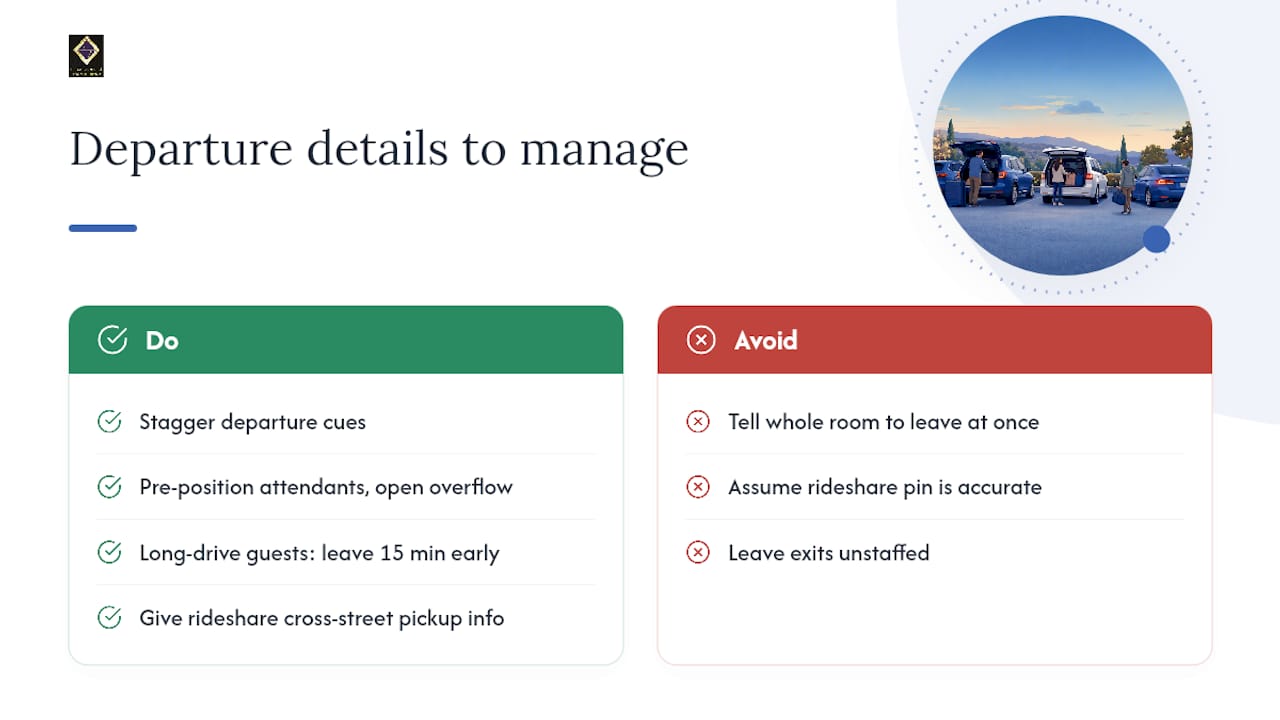
Most parking advice focuses on the arrival window, and that's where most guides stop. The departure is where events actually fall apart. Guests leave in waves, often all at once after a toast or a meal, and an unmanaged exit creates a gridlock that leaves people sitting in their cars for 20 minutes feeling annoyed after what was otherwise a great afternoon.
The fix isn't complicated, but it requires intention. Stagger your departure cues. Don't announce "feel free to head out" to the whole room at once. Instead, let the parking lead know when the event is winding down so they can pre-position attendants and open the overflow egress route before the rush. For larger gatherings, a staggered departure window, where guests with longer drives are encouraged to leave 15 minutes before the general wrap, cuts exit congestion significantly.
One tip that rarely appears in standard parking guides: give guests the nearest cross-street for rideshare pickup, not just the venue address. Rideshare apps often drop a pin at the wrong end of a property or on a one-way street. A single line in your pre-event text, "Uber/Lyft pickup: corner of [Street A] and [Street B]," saves a surprising amount of confusion at the end of the night. Parking & Mobility Magazine notes that the exit experience carries disproportionate weight in how guests remember an event. That's worth one extra line in your guest message.
Ambassadorclubportsmouth takes the parking stress off your plate
Planning a family gathering at a private home means you're also the parking coordinator, the traffic director, and the cone-setter. Ambassadorclubportsmouth is the alternative. The venue's historic 6,000 sq ft hall in Portsmouth, VA, comes with on-site parking, designated accessible stalls, and comprehensive packages that include security staff and optional transportation coordination. You don't need to recruit volunteers or laminate signs.
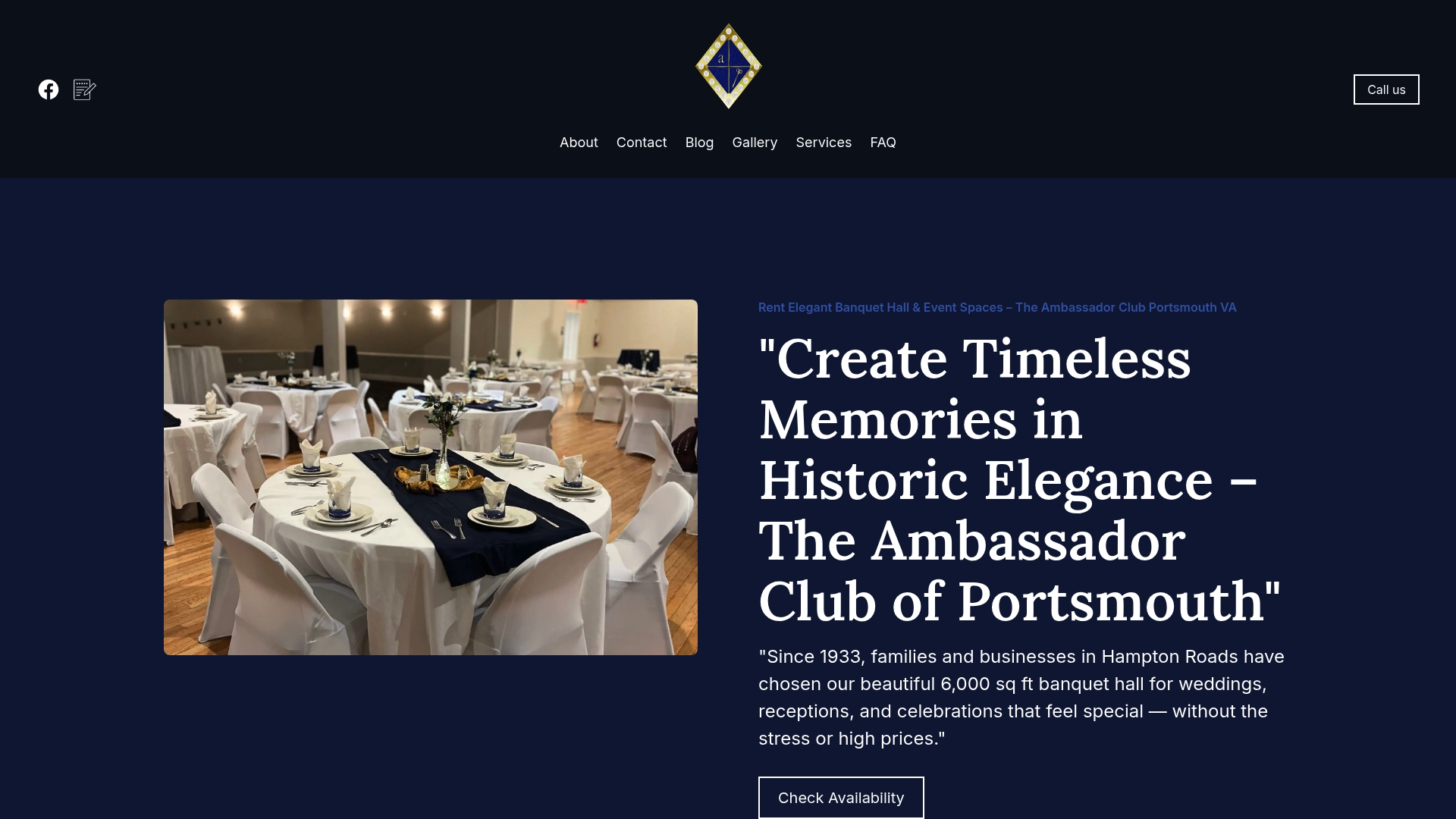
For families in the Hampton Roads area, the venue has been hosting events since 1933, and the team knows how to run a smooth arrival and departure for groups up to 200 guests. Optional shuttle coordination is available for larger reunions, and the setup team handles the physical logistics so you can focus on the gathering itself. Check availability and request a parking plan walkthrough at ambassadorclubportsmouth.com.
Useful sources
- Why Parking Is One of the Most Important Parts of Event Flow - Event 360
- Event Site Access and Parking Planning (FHWA chapter excerpt)
- Board Perspective | Event Parking - Parking & Mobility Magazine
- Event Parking Logistics Management: The Complete 2026 Guide - Mississauga Convention Centre
- Event parking planning and optimisation - Parksy blog
- Event parking management — Vicinia
- iParq Events — event parking module
- Rent Elegant Spaces at The Ambassador Club, Portsmouth.
FAQ
Why does parking affect how guests remember a family event?
Parking creates the first and last impression of any gathering. Parking & Mobility Magazine notes that a poor exit experience can erase an otherwise positive event memory, even when the program itself went well.
What are the three most important things family gatherings do for a family?
They strengthen relationships, create shared memories, and give family members a regular reason to reconnect across generations. Smooth logistics, including parking, remove friction that would otherwise overshadow those benefits.
How many parking spaces do you need for a family gathering of 80 guests?
Plan for about 31 parking spaces: estimate carpool size (2 persons per vehicle), subtract about 15% for rideshare and shuttle use, and add a buffer for vendors and late arrivals.
How do you handle unexpected parking problems during a family gathering?
Activate your overflow zone early, text a parking update to guests still en route, and keep your parking lead positioned at the driveway to redirect traffic in real time. Pre-planning an overflow location before the event is the single most effective contingency measure.
Can a venue like Ambassadorclubportsmouth handle parking for a large family reunion?
Yes. Ambassadorclubportsmouth's packages include security staff, on-site parking with accessible stalls, and optional transportation coordination for groups up to 200 guests, covering most of the roles a private-home host would need to staff themselves.