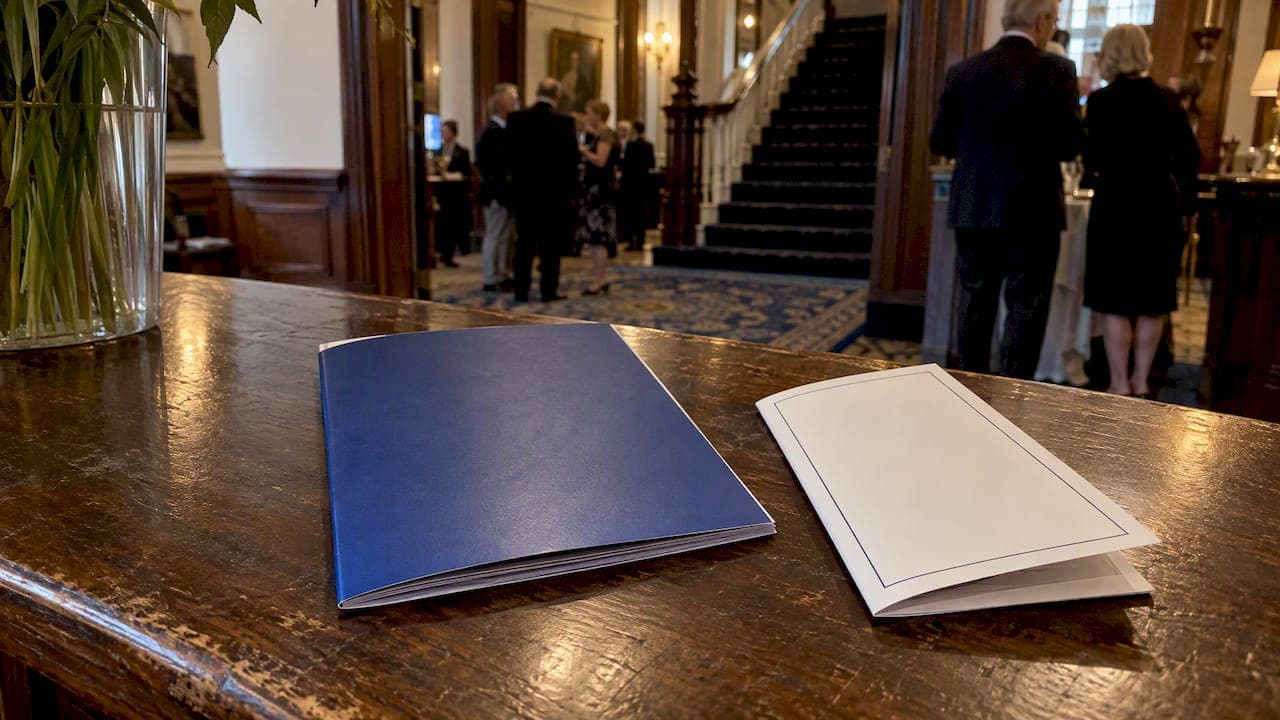
For most charity galas, a folded booklet program works best for formal, multi-course dinners, while a single sheet or digital PDF suits smaller or casual fundraisers. Every version needs a welcome message, schedule, speaker list, donor recognition, and a clear way to give. Pick the template that matches your format below, then adapt the run-of-show to your event.
TL;DR:
- Choose a four to eight page booklet for seated formal galas, a single sheet for cocktail or auction events, or an accessible digital PDF.
- Print approximate time blocks for guests because speeches and transitions often slip; give the stage manager and audio operator exact cue times separately.
- Set body text at 10 to 12 points, use images at 300 dpi, and maintain at least a 4.5:1 text contrast ratio for accessibility.
- Group sponsors by giving tier, keep peer logos the same size, and verify names against agreements; late commitments can go on an insert card.
- Print 10 to 15% more copies than the confirmed guest count, and test every QR code on a phone before the event.
Table of Contents
- Which program format fits your gala: booklet, sheet, or PDF?
- Program order and run of show you can copy into your template
- Design and formatting that make a program look professional
- Three short program templates you can copy and customize
- Notes from a working gala venue
- Tips for incorporating sponsor and donor recognition effectively
- Aligning program design with your event theme or cause
- Getting programs into guests' hands without a bottleneck
- Legal and compliance notices your program may need
- Checklist: final items to verify before sending a program to print
- Why hosting at The Ambassador Club simplifies your gala logistics
- FAQ
- Sources
Which program format fits your gala: booklet, sheet, or PDF?
The right format depends on your gala's formality, guest count, and how much time you have before print day.
A folded booklet, typically four to eight pages, works best for seated formal galas with multiple courses, several speakers, and a longer donor list to credit. It gives you room for a timeline, bios, sponsor logos, and a dedicated giving page without crowding the layout.
A single-sheet program, printed front and back or as a trifold, suits auction-heavy or cocktail-style fundraisers where guests move around and don't sit through a long program. It keeps the schedule and key appeal points visible without extra pages to manage.
A digital PDF or mobile-friendly program works well when you want to cut printing costs or reach guests before they arrive. Emailing it ahead of the event, or placing a QR code at each table that links to it, lets people follow along on their phones. For accessibility, make sure the PDF includes readable text (not just scanned images) so screen readers can parse it.
Whichever format you choose, certain sections belong in every gala program:
- Title and branding that reflects your organization or cause
- A short welcome message from a host or board member
- The event schedule or run of show
- Speaker and honoree names with brief bios
- Donor and sponsor recognition
- Clear instructions for giving, whether by text, QR code, or paddle raise
Program order and run of show you can copy into your template
Most galas follow a predictable sequence, whether the event runs 90 minutes or stretches past three hours. Build your printed program around whichever version matches your event length.
For a compact 60 to 90 minute reception-style fundraiser:
- Doors open, cocktail hour and registration (20 minutes)
- Welcome remarks from the host organization (5 minutes)
- Mission moment or honoree recognition (10 minutes)
- Live or silent auction appeal (20 minutes)
- Closing thanks and call to give (10 minutes)
For a 2.5 to 3 hour seated formal gala:
- Cocktail hour and silent auction browsing (45 minutes)
- Welcome and dinner service begins (15 minutes)
- Keynote speaker or honoree story (15 minutes)
- Live auction (30 minutes)
- Paddle raise or fund-a-need appeal (15 minutes)
- Dessert and closing remarks (15 minutes)
- Entertainment or dancing (remaining time)
For guest-facing programs, use approximate time blocks ("Cocktail Hour, 6:00 to 6:45 PM") rather than exact minute marks, since speeches and transitions rarely run on schedule. Save precise cue times for your internal run sheet, not the printed piece guests take home.
Sample copy you can adapt: a welcome line might read, "Thank you for joining us tonight in support of [cause]. Your presence alone makes a difference." A toast could simply note, "Please raise your glass to another year of impact." An auction appeal might say, "Every bid tonight funds a scholarship, a meal, or a second chance."
Pro Tip: Give your AV operator and stage manager a copy of the printed program with exact cue times written in the margins, so the room's pacing matches what guests are reading.
Design and formatting that make a program look professional
A program's design should guide the eye without demanding attention from the content itself. Pair a clean serif or slab serif for headings (18 to 24 point) with a simple sans serif for body text (10 to 12 point) to keep sections easy to scan.
Photos should be at least 300 dpi at final print size to avoid blurring, and any image that bleeds to the edge of the page needs an extra 0.125 inch of bleed built into the file. Standard margins of 0.5 inch keep text from feeling cramped on folded booklets. For paper, 80 to 100 lb cover stock holds up well for a booklet cover, while 70 lb text weight works for interior pages.
Contrast matters more than most planners expect. A minimum 4.5:1 contrast ratio between text and background is the widely cited accessibility benchmark for readable print and digital documents, and it is worth checking your color choices against that standard before you finalize a layout.
When you're ready to send files to a printer, they'll typically expect:
- A print-ready PDF saved as PDF/X format
- Images embedded at 300 dpi, not linked
- Crop marks and bleed included if any element touches the page edge
- Fonts embedded or converted to outlines to avoid substitution errors
Three short program templates you can copy and customize
Formal booklet cover and welcome page: "An Evening of Hope: The [Organization Name] Annual Gala" followed by a short welcome paragraph, a keynote introduction line ("Please welcome tonight's speaker, [Name], who will share [cause]'s impact firsthand"), and a donor page listing giving tiers by name.
Auction-focused single sheet: an item highlight block ("Item 12: Weekend Getaway, donated by [Business Name], estimated value $[amount]"), bidding instructions ("Bid using paddle number or text GIVE to [number]"), and a clearly marked paddle area with the rules printed in small type at the bottom.
Compact one-sheet for casual events: a condensed two-column schedule, a QR code placed in the lower corner linking directly to your donation page, and a row of sponsor logos along the footer rather than a full dedicated page.

Notes from a working gala venue
Running the logistics behind a printed program gets easier when the room itself is already handled. A full commercial kitchen and included setup, cleaning, and security mean fewer moving pieces for a planner juggling auction tables and a 50-item donor list. One layout tip worth building into your silent auction pages: spacing tables farther apart tends to slow guests down and encourages more deliberate bidding, so leave room in your program for clear table-number references next to each item.
— MARTIN
Tips for incorporating sponsor and donor recognition effectively
Sponsor and donor recognition is often the section guests and sponsors scrutinize most closely, so accuracy and visibility both matter. Group recognition by giving tier (Presenting Sponsor, Gold, Silver, in-kind) rather than listing every name in one undifferentiated block, since tiered recognition reflects the actual commitment level and gives higher-tier sponsors the visibility they were promised.
Logos should appear at consistent sizes within each tier so no single sponsor looks bigger or smaller than peers at the same level, which avoids awkward conversations after the event. For individual donors, a simple "In Honor Of" or "In Memory Of" line near the appeal section adds a personal touch without requiring a full page.
Double-check every sponsor name, logo file, and spelling against the actual sponsorship agreement before sending the program to print. A misspelled name or an outdated logo is one of the fastest ways to lose a repeat sponsor, and it's an easy mistake to catch with one more proofread. If a sponsor's commitment came in after your program deadline, a last-minute insert card or a verbal mention during remarks keeps the relationship intact without reprinting everything.

Aligning program design with your event theme or cause
A program's visual identity should echo the cause it's raising money for, not just the venue's aesthetic. A health-focused gala might use a clean, clinical color palette and photography that shows real program outcomes, while an arts organization's program can afford bolder typography and more creative layout choices.
Color choices carry meaning for some causes: a children's charity might lean toward warmer, approachable tones, while a veterans' organization often uses more formal, restrained colors that match the event's tone. Ticket pricing often follows this same formality pattern: health and veterans causes tend to command higher median ticket prices, often because those causes host more formal galas with higher production value, while student groups and casual causes price lower and favor simpler, less formal programs.
Keep your organization's mission statement or a short impact story somewhere in the first few pages, since that context shapes how guests read everything that follows, from the auction items to the final appeal. Consistency between your invitation, signage, and program (same fonts, same color palette, same logo treatment) reinforces that the whole event was planned with the cause in mind.
Getting programs into guests' hands without a bottleneck
Distribution matters as much as design once the printed pieces exist. Placing programs on chairs before guests arrive works well for seated dinners, since it avoids a check-in line bottleneck and lets people start reading during cocktail hour if programs are available at a welcome table instead.
For standing or reception-style events, a stack at the entrance with a greeter handing them out as guests check in tends to work better than a passive table, since a person handing over the program also delivers a quick verbal welcome. If you're using a digital version, emailing the PDF the morning of the event, alongside a QR code printed on table tents, gives guests two ways to access it without printing extra copies for latecomers.
Always print a reasonable buffer (about 10 to 15% more than your confirmed guest count) to cover last-minute additions, replacements for damaged copies, and a few keepsakes for major donors or press.
Legal and compliance notices your program may need
Most galas include a brief tax-deductibility notice near the giving or donation section, since guests who purchase tickets or make donations often need that information for their own records. A simple line such as "A portion of your ticket price may be tax-deductible; please consult your tax advisor" covers the disclosure without requiring exact figures that can vary by purchase.
If your event includes a raffle, check your state's raffle licensing requirements before printing any mention of odds, prizes, or ticket pricing, since rules vary by state and by nonprofit status. Auction items with a stated fair market value should list that value clearly, since the deductible portion of any winning bid is generally limited to the amount paid above that value.
If your organization is a registered nonprofit, including your EIN or tax-exempt status line in small print near the giving section is a common practice that reassures donors their contribution is going to a verified charity.
Checklist: final items to verify before sending a program to print
- Proofread every name, title, and sponsor logo against the final confirmed list.
- Confirm photo permissions and test every QR code on an actual phone.
- Lock the final page count with your printer and schedule a proof before the full run.
Pro Tip: Match each silent auction item's printed page number to its physical table placement so guests can find items as easily as they can read about them.
Why hosting at The Ambassador Club simplifies your gala logistics
Hosting your gala in a space that already includes setup, cleaning, and security frees up the hours you'd otherwise spend managing those details alongside your program. Our 6,000 sq ft hall and full commercial kitchen accommodate up to 200 guests, formal dinner service, and an auction layout in the same room, so your program's run-of-show matches the space without last-minute adjustments.
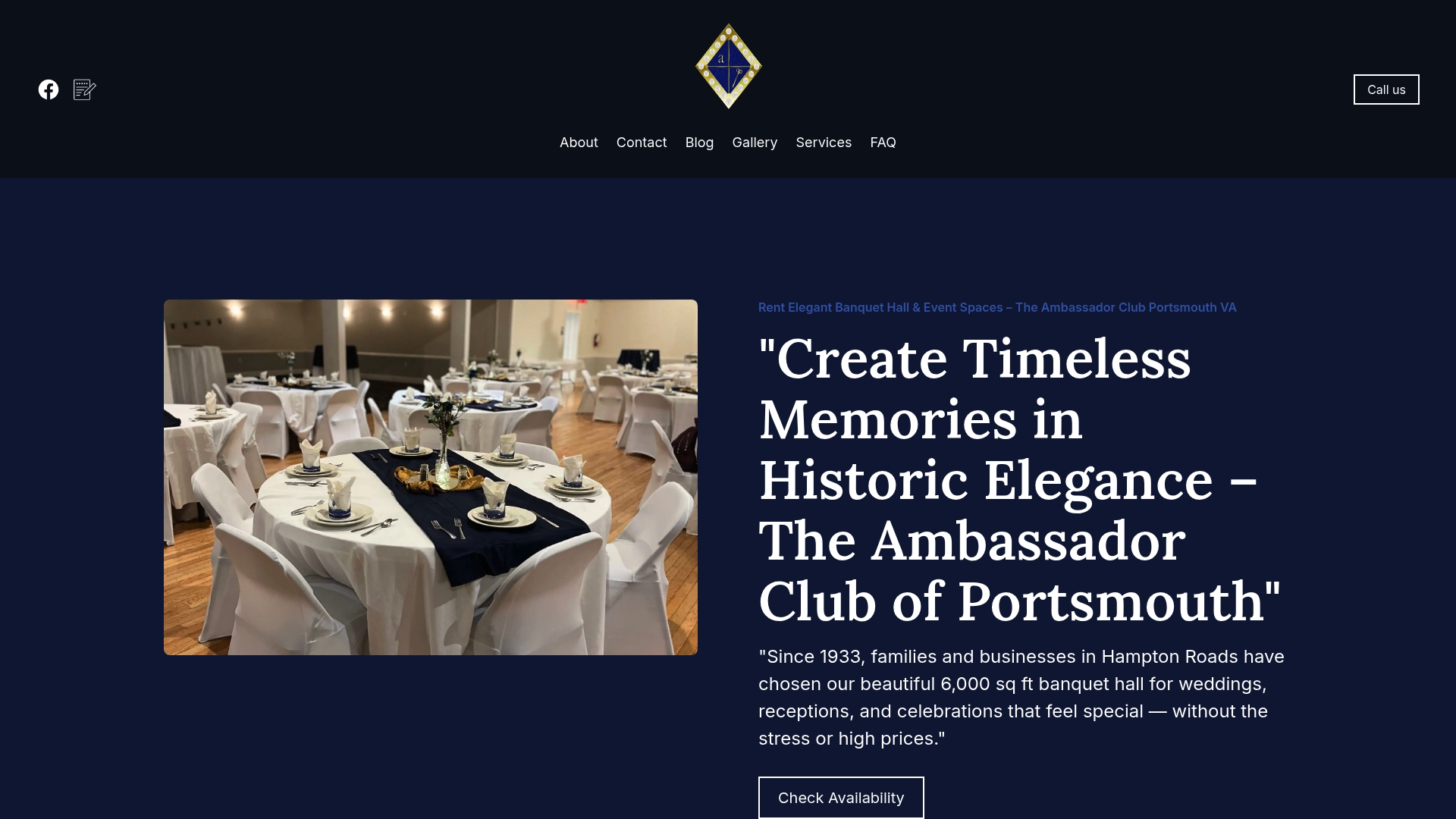
Our team can also point you toward reliable local printers and vendors once your date is set, so the program is one less thing competing for your attention that week, including experts in fundraising gala balloons that elevate event decor and atmosphere. Visit our services page to see what's included in a charity event booking, or reach out to check availability for your date.
FAQ
What do you do at a charity gala?
A charity gala typically includes a cocktail hour, a welcome address, a program highlighting the cause, a meal or reception, a live or silent auction, and a closing appeal for donations. The exact order varies by event length and format, but most galas follow some version of that structure.
How much does a charity gala cost?
Costs vary widely by cause, guest count, and venue, but ticket-price benchmarks by cause show health-related galas averaging around $199 per ticket and veterans' causes around $198, while student group events average closer to $84. These figures are useful as a pricing reference, not a guarantee for any specific event.
What is a charity gala called?
"Charity gala" and "fundraising gala" are the most common terms, though some organizations call theirs a benefit dinner, a fundraising dinner, or simply a benefit depending on the format and tone of the event.
What does "charity gala" mean?
A charity gala is a formal fundraising event, usually involving dinner, a program, and often an auction, where ticket sales and donations support a nonprofit's mission. The format tends to be more formal than a casual fundraiser, which is reflected in both the program design and the ticket price.