
Wedding venue location is the single most important factor that determines whether your wedding day flows smoothly or falls apart under logistical pressure. Couples often spend months debating centerpieces and color palettes, yet the venue's physical placement shapes every experience their guests have, from the moment they park to the final dance. Venue hire alone accounts for 25–30% of total wedding spend, with catering pushing that figure to 40–45%. Understanding why wedding venue location matters gives you the clearest possible foundation for every other planning decision you make.
Why does wedding venue location matter most?
Location is the infrastructure your entire wedding runs on. Décor can be swapped, flowers can be upgraded, but a venue in the wrong place creates problems no amount of styling can fix. A venue's location dictates guest arrival experience, parking availability, and vendor efficiency, and those three factors ultimately determine whether your day feels smooth or stressful.
Think of your venue as a co-host. A well-placed venue supports your guests and your vendors without anyone having to fight the space. A poorly located one forces everyone to work around it, and that friction shows up in late arrivals, confused guests, and frazzled caterers. The venue's position on a map is not a background detail. It is the operating system your wedding runs on.

Booking 12–18 months in advance is the standard recommendation for securing preferred dates at well-located venues. That timeline exists because the best-positioned venues, those near transit hubs, hotels, and major roads, fill up fastest. Couples who treat location as a primary filter rather than an afterthought consistently report less day-of stress.
How does venue location affect guest accessibility and attendance?
Guest attendance is directly tied to how easy it is to reach your venue. Locations near hub-airport cities with non-stop flights for 80% or more of guests increase attendance by 12–18 percentage points compared to remote resort destinations. That gap is significant. It means roughly one in eight guests who would have attended a convenient venue simply does not show up to a hard-to-reach one.
Travel time, accounting for traffic and transit complexity, is a more accurate measure of accessibility than raw distance. A venue 15 miles away on a congestion-free route can be far more accessible than one 8 miles away through downtown traffic on a Saturday afternoon. Couples who stress-test their venue's travel time during peak hours before booking avoid one of the most common day-of surprises.
Remote or resort destinations carry a specific risk worth naming directly. Resort venues may offer glamour but often suffer from higher travel friction and distraction, which reduce both attendance and event focus. Guests who travel far tend to arrive tired, leave early, or skip the event entirely when a conflict arises. Convenience is not a compromise. It is a gift to the people you most want there.
Key accessibility factors to evaluate before signing any contract:
- Proximity to major airports or train stations for out-of-town guests
- Parking capacity on-site or within a short walk
- Public transit options for guests who do not drive
- Hotel availability within a mile or two for overnight guests
- Traffic patterns on your specific wedding day and time
How does venue location shape your wedding day flow?
A well-located venue does more than get guests through the door. It keeps the day moving without dead time between moments. Single-roof venue layouts that connect ceremony, reception, and accommodation spaces minimize transit dead-time and improve guest participation across every part of the event. When guests do not have to drive between a church, a cocktail hour location, and a reception hall, they stay engaged and present.
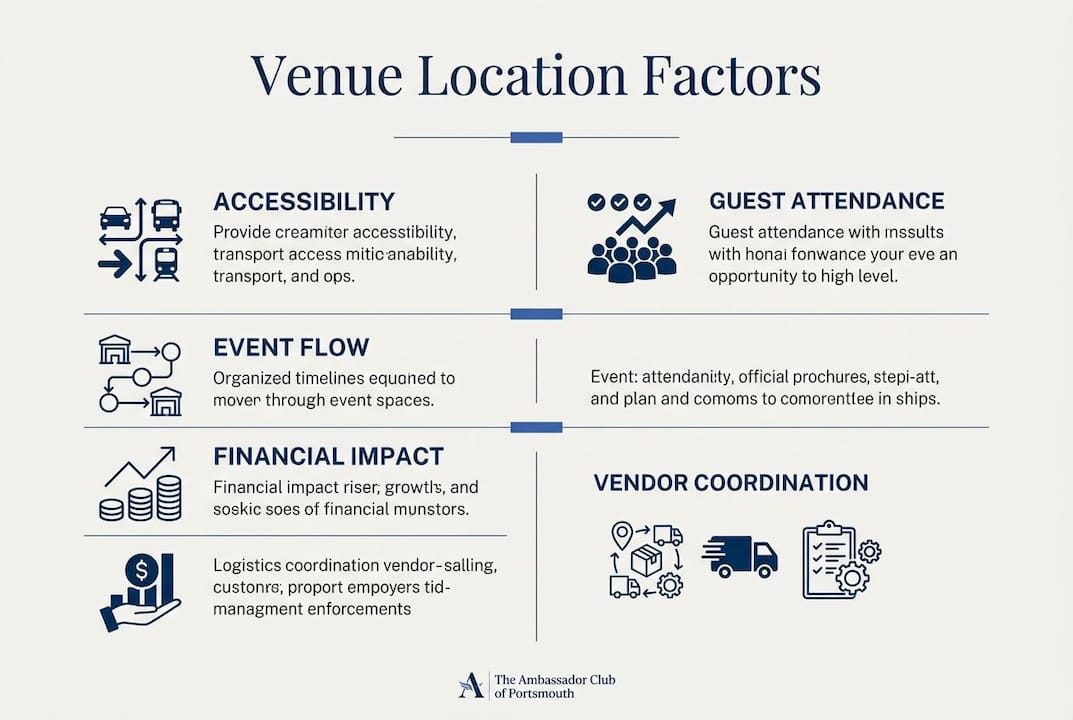
Venue layout affects whether organizers work with or against the space. Poor layouts create friction between vendors and the physical environment, leading to guest confusion and operational delays. A caterer who cannot get a delivery truck close to the kitchen, or a photographer who has to navigate three separate buildings, produces worse results than one working in a well-designed, accessible space.
Event planning professionals consistently prioritize physical flow, meaning the actual movement of guests, vendors, and staff, over visual aesthetics when evaluating venues. A beautiful ballroom at the end of a confusing corridor system costs you more in stress than it gains in photographs. The best venues make movement feel natural and effortless.
Pro Tip: Visit your shortlisted venues at the same time of day and day of week as your wedding. Watch how traffic moves, where people naturally walk, and whether the space guides guests intuitively from one area to the next.
What is the financial impact of choosing a venue by location?
Location shapes your budget in ways that go well beyond the rental fee listed on the contract. Fully loaded venue costs include mandatory catering minimums, service charges, and vendor restrictions, and these additions often raise total expenses far beyond the base rental figure. A venue that appears affordable based on its headline price can end up costing significantly more once all required add-ons are factored in.
Venues in premium locations, near city centers or waterfront areas, frequently impose exclusive vendor lists. That means you pay their preferred caterer's rates rather than shopping for value. Venues in less accessible locations sometimes offset lower rental costs with higher mandatory minimums, knowing couples have fewer alternatives once they have committed to a remote site.
| Cost category | What to ask before booking |
|---|---|
| Base rental fee | Is this the full cost, or are there required add-ons? |
| Catering minimum | Is there a mandatory spend, and does it include service charges? |
| Vendor restrictions | Can you bring outside vendors, or must you use their approved list? |
| Parking and transport | Are there fees for parking, shuttles, or valet? |
| Overtime charges | What happens if the event runs past the contracted end time? |
Calculate the fully loaded cost of every venue before comparing options. A venue that costs $3,000 more in base rental but allows outside catering can save you far more than that difference in total spend. Location-driven cost decisions require full transparency on every line item, not just the number at the top of the proposal.
How do you evaluate venue options to create a memorable celebration?
Choosing the right venue location requires a structured evaluation, not just a gut feeling after a tour. The most memorable weddings come from venues where every practical element works in harmony with the atmosphere couples want to create. Use the following process to assess any venue you are seriously considering:
- Map guest origins. Identify where the majority of your guests are traveling from and calculate realistic travel times to each venue on your list.
- Check hotel proximity. Confirm that affordable accommodation exists within a mile or two for out-of-town guests. Venues near hotel clusters reduce coordination stress significantly.
- Assess weather exposure. Outdoor or partially outdoor venues require a credible backup plan. Confirm the venue has one before you fall in love with the garden.
- Walk the vendor path. Trace the route a caterer, florist, and band would take from their vehicles to their setup areas. Friction in that path becomes your problem on the day.
- Evaluate the site flow. Confirm that guests can move naturally from parking to ceremony to cocktail hour to reception without needing a map or a guide.
- Test the atmosphere at event time. A venue that feels calm at 2:00 PM on a Tuesday may sit next to a busy road or a loud venue at 7:00 PM on a Saturday.
Pro Tip: Ask the venue coordinator to describe the last three events that ran into problems. Their answer tells you more about the location's real-world performance than any tour or brochure.
Couples who book event halls with a clear checklist in hand consistently report fewer surprises and a smoother day. Atmosphere and aesthetics matter, but they work best when the location's practical foundation is already solid. The role of venue aesthetics is real, but it amplifies a good location rather than compensating for a bad one.
Key Takeaways
Wedding venue location determines the success of your day more than any other single factor, because it shapes guest attendance, vendor efficiency, event flow, and total cost simultaneously.
| Point | Details |
|---|---|
| Location drives attendance | Hub-city venues increase guest attendance by 12–18 percentage points over remote alternatives. |
| Travel time beats distance | Measure accessibility by realistic travel time, not miles, especially during peak traffic hours. |
| Single-roof layouts win | Connected ceremony and reception spaces eliminate transit dead-time and keep guests engaged. |
| Hidden costs add up fast | Always calculate fully loaded venue costs including catering minimums, service charges, and vendor restrictions. |
| Evaluate flow before aesthetics | Walk the guest and vendor paths in person before committing to any venue contract. |
Location is the decision you cannot undo
After years of watching couples plan weddings, I have seen one pattern repeat itself more than any other. Couples who prioritize aesthetics over location spend their wedding day managing problems. Couples who get the location right spend it celebrating.
The most common regret I hear is not about the flowers or the food. It is about guests who did not make it because the venue was too far, or about a reception that lost its energy because people had to drive between locations. Those are location decisions, and they are made months before the wedding day.
My honest advice: lock in your location criteria before you tour a single venue. Decide how far is too far for your guests, what transit options matter, and whether you need everything under one roof. Then tour with those filters already in place. A venue that fails your location criteria is not a contender, no matter how beautiful the ballroom looks in the photos.
The Hampton Roads venue options available in the region prove that accessible, well-located spaces do not require sacrificing elegance. The right venue is out there. Start with location, and everything else becomes easier to decide.
— MARTIN
A venue worth the location conversation
Ambassadorclubportsmouth has served the Hampton Roads area since 1933, and its position in Portsmouth, VA, reflects exactly what couples need from a well-located venue. The club sits within easy reach of major roads, hotels, and transit options that serve both local guests and those traveling from across the region.

The 6,000 sq ft hall accommodates up to 200 guests, and the full commercial kitchen supports flexible catering arrangements that keep your fully loaded costs transparent from the start. Packages are designed to remove the guesswork from vendor coordination, so your wedding day runs on the venue's infrastructure rather than against it. Couples planning a celebration that feels effortless for their guests can explore elegant spaces at Ambassadorclubportsmouth and request availability for their date.
FAQ
Why does venue location matter more than decoration?
Location determines the infrastructure your entire wedding runs on, including guest arrival, vendor access, and event flow. Decoration enhances an experience that location either enables or undermines.
How far in advance should couples book a wedding venue?
Booking 12–18 months ahead is the standard recommendation, particularly for well-located venues near transit hubs and hotels, which fill up fastest.
What is the best way to measure venue accessibility?
Measure travel time during peak hours on the same day of the week as your wedding, not just distance. A venue 15 miles away on a clear route can be more accessible than one 8 miles away through heavy traffic.
How much of a wedding budget goes to the venue?
Venue hire typically accounts for 25–30% of total wedding spend. Combined with catering, that figure rises to 40–45% of the overall budget.
What hidden costs should couples watch for when choosing a venue?
Mandatory catering minimums, service charges, and exclusive vendor restrictions are the most common sources of budget overruns beyond the base rental fee.