
A hotel room block is a set of rooms a hotel holds for your wedding guests under one group agreement, and for most weddings, the smartest starting point is a courtesy block rather than a contracted one. Courtesy blocks carry no financial risk to you, since hotels typically treat group requests of nine or more rooms as group business with negotiated rates but no penalty if guests don't book. Contracted blocks lock in stronger perks and pricing but make you financially responsible for unbooked rooms.
Here's what to do this week if you're just starting:
- Call hotel sales departments (not the front desk) at two or three properties near your venue and ask specifically for "group sales" or "catering and events."
- Aim to have a signed agreement in place 9 to 12 months before your wedding date, earlier if you're marrying during peak season or in a popular destination.
Key Takeaways
Hotel room blocks work best when couples start with a low-risk courtesy block, reserve rooms 9 to 12 months ahead, and negotiate mitigation clauses before signing anything contracted.
| Point | Details |
|---|---|
| Choose the right block type | Courtesy blocks carry no financial risk; contracted blocks trade risk for better rates and perks. |
| Book early | Reserve rooms 9 to 12 months before the wedding, earlier for peak season or destination dates. |
| Watch attrition and cutoff | Know your dollar exposure and confirm the cutoff date, usually 30 days out, before signing. |
| Track pickup actively | Request weekly, then daily, pickup reports and send a cutoff reminder roughly six weeks before cutoff. |
| Pick a venue that eases coordination | The Ambassador Club helps couples plan shuttle timing and nearby lodging alongside their event. |
Table of Contents
- What Is a Hotel Room Block and How Do the Two Main Types Differ?
- When Should You Reserve Rooms and How Many Should You Block?
- What Contract Terms Actually Cost You Money?
- How Do You Manage the Block Once It's Signed?
- What Mistakes Do Couples Make With Room Blocks?
- How the Ambassador Club Supports Guest Lodging Around Your Wedding
- When a Room Block Actually Makes Sense (And When It Doesn't)
- Ready to Simplify Your Venue and Lodging Planning?
- Sources
- FAQ
What Is a Hotel Room Block and How Do the Two Main Types Differ?
A room block is a reserved inventory of rooms a hotel sets aside for a specific event, tied to a discounted rate and a booking window guests use to reserve individually. Most hotels start treating a booking as "group business" once it hits nine rooms, which is the threshold that triggers a dedicated sales contact instead of a standard reservation agent.
There are two structures you'll encounter, and the difference matters more than most couples realize going in.
- Courtesy blocks hold rooms at a group rate with no signed commitment and no financial exposure. If guests don't book, the hotel simply releases the unused rooms back into general inventory. The tradeoff is weaker leverage. Hotels often give courtesy blocks a shorter shelf life and fewer perks.
- Contracted (guaranteed) blocks require a signed agreement, often a deposit, and an attrition clause that holds you financially responsible for a percentage of unbooked rooms. In exchange, you typically get better rates, locked-in room types, and stronger concessions like comp rooms or breakfast.
Think of it as risk versus leverage. A courtesy block protects your wallet; a contracted block protects your rate and your guests' room availability, at a price if pickup falls short.
When Should You Reserve Rooms and How Many Should You Block?
Contact hotel sales 9 to 12 months out, and push that earlier, sometimes 12 to 18 months, if you're planning a destination wedding or a date during a citywide event, holiday weekend, or convention season. Wedding planners consistently recommend having a block in place before save-the-dates go out, since guests will start searching for hotels the moment they get the date, and you want them landing on your group rate instead of booking at random.
Figuring out how many rooms to reserve trips up more couples than any other part of this process. A workable formula:
- Estimate your total out-of-town guest count and assume roughly two guests per room on average.
- Block 30 to 40 percent of that lodging need if you want a comfortable cushion, or start conservatively at 20 to 30 percent if you'd rather add rooms later than risk attrition penalties.
- Reserve blocks at two price tiers when your guest list spans budgets, one mid-range hotel and one higher-end option, so guests self-select without you managing complaints about cost.
Pro Tip: If your date falls during a local event calendar collision, football weekends, graduation season, a downtown festival, call sales departments and ask directly whether other groups are competing for inventory that weekend. Hotels will often tell you, and it changes how aggressively you should lock in rooms.
Destination and peak-season weddings deserve their own math. When guests are already absorbing flight costs, a shortage of rooms at the group rate pushes them toward pricier last-minute bookings, which creates real friction before anyone even arrives. If your venue sits in a town with limited hotel inventory, researching nearby properties early and contracting a second overflow hotel before your date fills up protects you from a scramble three months out.
What Contract Terms Actually Cost You Money?
This is the section that separates a smooth wedding weekend from a surprise invoice mailed to you a month after the reception. Four terms determine your financial exposure in a contracted block, and every one of them is negotiable before you sign.
Attrition is the percentage of blocked rooms you must fill or pay for anyway. A typical contract might set attrition at a high percentage, meaning if your blocked rooms aren't fully booked, you could owe the hotel for the unfilled rooms, which may represent a significant financial amount depending on your rate and stay length.
Cutoff date is the deadline, usually about 30 days before your event, after which unbooked rooms release back to the general public and the discounted rate disappears. Guests who miss it pay standard rates, if rooms are even still available.
Mitigation and resale clauses are the single most underused protection in these contracts. A mitigation clause credits rooms the hotel resells to other guests against your attrition liability, which can wipe out a penalty entirely if the hotel fills your unused rooms with unrelated bookings. Ask for mitigation and resale clause language explicitly, as it's often not offered by default.
Deposit versus master bill determines who pays what. Your deposit typically secures the block itself and may apply toward a group event if you're also hosting a rehearsal dinner or brunch there. Individual guests pay their own room charges and incidentals directly to the hotel at checkout, not through you, unless you've specifically arranged a master bill covering certain rooms.
A signed contract with no review date is one of the most common regrets couples report after their wedding weekend ends.
Before signing anything, verify these five items sit in writing:
- The exact attrition percentage and the dollar exposure it represents at your room count and rate.
- A firm cutoff date and confirmation of what happens to the rate (not just availability) after it passes.
- A mitigation or resale clause crediting resold rooms against attrition.
- A review date, ideally 60 to 90 days before arrival, allowing you to reduce the block without penalty if pickup is slow.
- Which concessions are included: hotels commonly offer one comp room per 25 to 40 booked, free breakfast, parking, or shuttle service as standard negotiation levers, and all of these are worth asking for even at smaller block sizes.
Negotiate the concessions list before you negotiate the rate. Sales managers have far more flexibility on perks than on the number itself, and a free shuttle or waived parking fee for out-of-town guests often matters more to your group than a five-dollar discount per night.
How Do You Manage the Block Once It's Signed?
Signing the contract is the beginning of the work, not the end of it. Someone, you, your planner, or a designated point person, needs to own pickup tracking from the day the block opens until the final reconciliation after checkout.
- Request a pickup report from your sales contact on a set cadence. Weekly reports are standard early on, shifting to daily updates in the final two to three weeks before cutoff for any date carrying real attrition risk.
- Watch pacing, not just totals. A block that's 40 percent booked with two months left is on track; the same number with two weeks left is a warning sign to send reminders or request a review-date reduction.
- If bookings are running ahead of pace, call sales and ask to add rooms while inventory allows. Most hotels will expand a block rather than turn away confirmed group business, which is exactly why starting conservative and growing the block beats overcommitting up front.
- Test the booking method yourself before sharing it with guests. Whether it's a group booking link, a group code entered at checkout, or a rooming list you submit directly, book a mock reservation (or have a friend try it) to confirm the discounted rate actually appears and the dates are correct.
Pro Tip: Send one dedicated reminder email to your guest list roughly six to eight weeks before the cutoff date, separate from any other wedding update. A reminder folded into a longer newsletter gets skimmed and forgotten; a standalone message about the deadline gets acted on.
Guest communication needs to happen in at least three places: your wedding website, your save-the-date or invitation suite, and a direct reminder as the cutoff nears. Include the hotel name, the booking link or group code, the rate, and the exact deadline in each one. If you're also coordinating shuttle service or welcome bags, loop the hotel's front desk in on delivery timing and guest arrival windows so nothing gets lost at check-in. A hotel's own front desk workflow often determines whether welcome bags actually reach guests the night they arrive, so a quick call to confirm the process beats assuming it'll work itself out.

What Mistakes Do Couples Make With Room Blocks?
Over-blocking is the single most expensive mistake in this entire process. Couples get excited, block 40 rooms for a guest list that realistically needs 15, and end up owing attrition penalties on rooms nobody ever intended to fill. Start conservative. You can almost always add rooms later; you can rarely erase a signed commitment.
A close second: signing a contract without doing the attrition math first. If you don't know your dollar exposure at a given percentage and room rate, you're negotiating blind. Run the numbers before the meeting, not after you're already committed.
Other recurring errors worth flagging:
- Forgetting to send a cutoff reminder, which leaves guests paying full rate or scrambling for rooms elsewhere.
- Never testing the booking link or code, which means you find out it's broken only after a guest complains.
- Skipping the mitigation clause entirely because nobody thought to ask for it.
- Treating hotel coordination as separate from venue staffing instead of syncing both teams on arrival times and event-day logistics.
Bring this checklist into your first meeting with hotel sales: confirm the group threshold and rate, choose courtesy or contracted based on your risk tolerance, pin down attrition percentage and cutoff date, request a mitigation clause and a review date, negotiate concessions before the room rate, and assign one person to own pickup tracking through checkout.
| Point | Details |
|---|---|
| Block type | Courtesy blocks avoid financial risk; contracted blocks trade risk for better rates and perks. |
| Room count | Block 20 to 40 percent of expected lodging need, leaning conservative if unsure. |
| Attrition math | Know your dollar exposure at your contract's attrition percentage before signing. |
How the Ambassador Club Supports Guest Lodging Around Your Wedding
Venues rarely book hotel rooms themselves, but the right venue makes the coordination around lodging far less painful. At The Ambassador Club in Portsmouth, VA, staff regularly point couples toward nearby hotels, help think through shuttle logistics for out-of-town guests, and factor lodging proximity into event-day timing since the venue accommodates up to 200 guests in its historic 6,000-square-foot hall.
A typical lodging coordination timeline looks like this:
- Nine to twelve months out: couple identifies nearby hotels; venue shares distance and drive-time notes.
- Six months out: couple finalizes block details; venue confirms event timing for shuttle scheduling.
- Two weeks out: venue and hotel front desk sync on arrival windows and any welcome-bag drop-offs.
Guests remember whether getting to and from the hotel felt easy far more than they remember the room rate they paid.
When a Room Block Actually Makes Sense (And When It Doesn't)
Room blocks earn their keep when a large share of your guest list is traveling from out of town, when your date lands during a busy season with limited local inventory, or when you want guests staying close enough to share rides and cut down on drunk-driving risk after the reception. Weddings with 40 or more out-of-town guests almost always benefit.
Where blocks stop making sense: very small weddings, under about 20 total guests, or markets where short-term rentals dominate the lodging options and guests would rather split an Airbnb than pay hotel rates anyway. I've seen couples burn weeks negotiating a 10-room contracted block for a wedding where eight of those guests were already sharing two rental houses. The energy would have gone further into vendor coordination.
The test I'd apply: if you can't picture guests needing a shuttle or a group meeting point, you probably don't need a contract, just a courtesy block or a simple hotel recommendation on your wedding website.
— MARTIN
Ready to Simplify Your Venue and Lodging Planning?
The Ambassador Club solves a problem most couples don't think about until they're deep in hotel negotiations: your venue choice shapes how hard the lodging coordination has to be. A historic hall in a walkable area with hotels nearby means shorter shuttle runs, simpler timing, and fewer guests asking you for directions at 11 p.m.
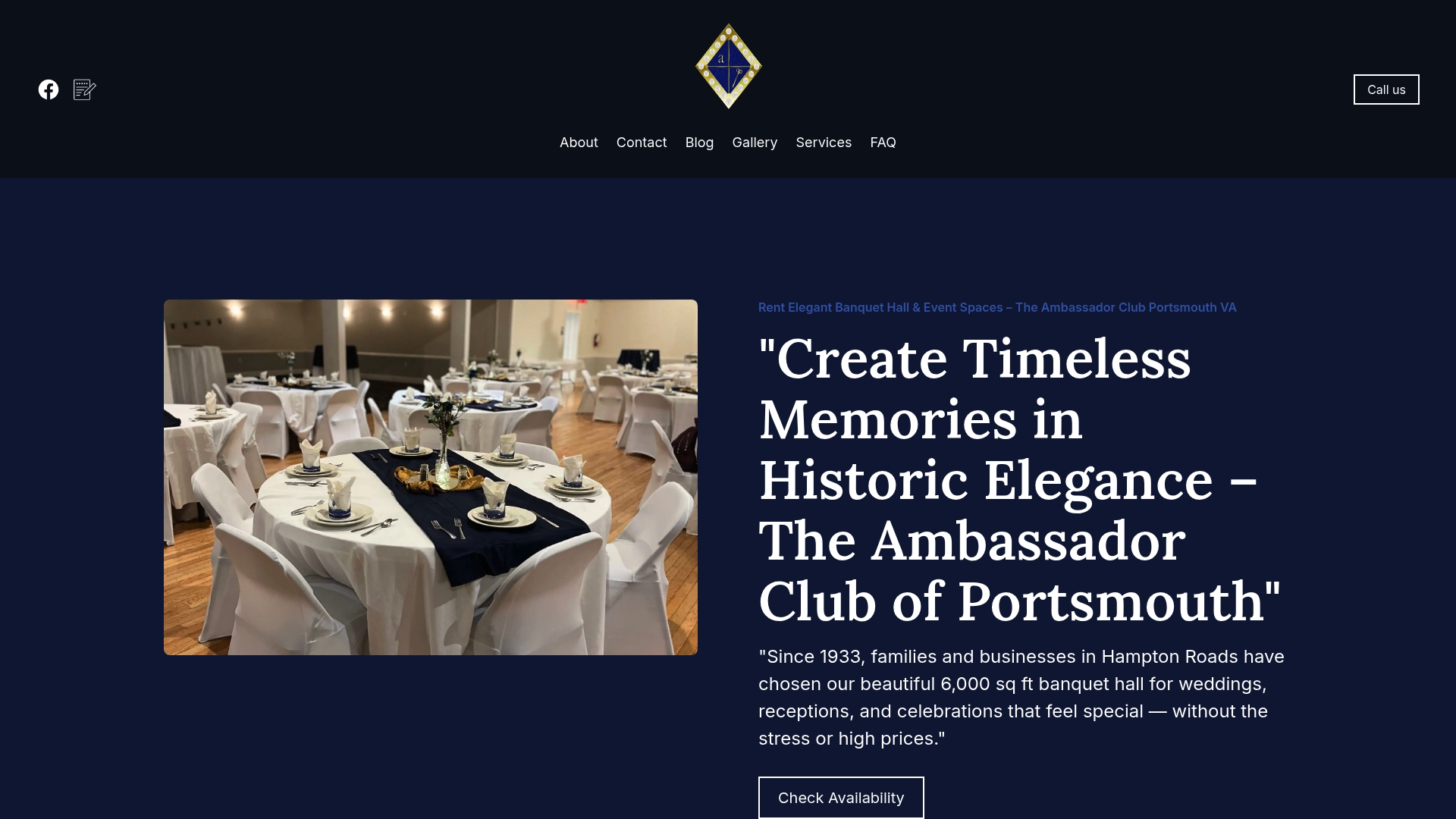
At The Ambassador Club, you get a 6,000-square-foot venue with a full commercial kitchen, flexible outside catering policies, and comprehensive packages covering setup, cleaning, and security, so the parts of your wedding you can control are handled while you focus on guest logistics like room blocks. Reach out through the venue's booking page to check date availability and start planning your event around a space built to make the rest of the weekend easier on you and your guests.
Sources
- Hotel Room Blocks: How They Work and How to Book One (2026) | Engine
- How to Book a Wedding Hotel Block With Ease
- Hotel Blocks: Complete Guide To Rates & Contracts 2026
- How to Book a Hotel Room Block for Your Wedding (2026 Guide) - Joy
FAQ
What Are Hotel Room Blocks Called?
They're commonly called room blocks, group blocks, or block bookings, and hotels typically route them through a group sales or catering and events contact rather than standard reservations.
Are Hotel Room Blocks Actually Cheaper?
Group rates are often discounted compared to standard pricing, but the savings vary by hotel and season. Contracted blocks tend to unlock stronger rates than courtesy blocks because you're offering the hotel a financial commitment in return.
Does It Cost Money to Set Up a Room Block at a Hotel?
A courtesy block typically costs nothing to set up since there's no signed commitment. A contracted block usually requires a deposit and may carry attrition penalties if guests don't book enough rooms by the cutoff date.
Are Hotel Room Blocks Necessary for a Wedding?
They're not required for every wedding. Blocks add real value when a large share of guests are traveling from out of town or your date falls during a busy season, but very small weddings or markets where guests prefer short-term rentals often don't need one.