A solo DJ running a controller and laptop draws a low amount of watts, a typical wedding rig uses a moderate wattage commonly suitable for small generators, and a full setup with lighting and effects can require significantly more power, often reaching several kilowatts. The math is simple once you have real numbers: add up your watts, convert to amps, build in headroom, and pick a generator whose continuous rating clears your running load with room to spare. Start tonight by pulling the nameplate wattage off every piece of gear you own.
TL;DR:
- Most DJ gear, including laptops, controllers, and speakers, typically draws far less power than manufacturer peak ratings suggest, so actual wattage should be measured for accurate planning.
- Add a safety margin of 20 to 30 percent to your total wattage and size your generator based on continuous power needs, not peak ratings, to ensure reliability.
- Proper power distribution planning, including dedicated circuits, sub-distribution panels, and avoiding shared outlets, is critical to prevent trips and failures during events.
- A site walkthrough with venue staff to confirm circuit locations and capacity significantly reduces power-related issues, more so than simply increasing generator size.
- Using appropriately rated high-power cables, locking connectors, and GFCI protection ensures safe operation and prevents hazards at live event setups.
Table of Contents
- What Are Typical DJ Power Requirements by Component?
- How Do You Calculate Amps From Your Total Wattage?
- How Do You Size a Generator for Continuous and Surge Load?
- How Should You Plan Power Distribution for an Event?
- Portable Power Stations vs Generators: Which Do You Need?
- What Safety and Code Steps Should You Check Before Load-In?
- What Do Real DJ Event Scenarios Look Like in Watts?
- What Should DJs Ask Venues About Power Before Booking?
- Why Does Power Factor Matter for Generator Sizing?
- Do DJs Need Battery Backup or a UPS?
- How Much Extra Power Do LED Lights Save Over Incandescent?
- What Cables and Connectors Handle High-Power DJ Setups Safely?
- An Editorial Take on Power Planning for Mobile DJs
- Coordinating Power Needs With Your Venue
- Sources
- FAQ
What Are Typical DJ Power Requirements by Component?
Before you touch a calculator, you need real numbers for every device in your setup. Marketing spec sheets love to advertise peak or "program" wattage, which has almost nothing to do with what a device actually pulls from the wall during a four-hour reception.
| Component | Typical wattage |
|---|---|
| Laptop | 60–100 watts |
| DJ controller or mixer | 30–80 W |
| Powered 12" top speaker (each) | 300–500 watts |
| Powered subwoofer | 800–2,000 W |
| LED wash uplight | 80–200 watts |
| Moving head fixture | 150–500 watts |
| Haze machine | 800–1,500 W |
| Wireless mic receiver | 20–50 W |
These ranges track what EcoFlow's DJ power guide lays out for common gear, and they line up with how QSC's own training material explains the gap between amplifier output ratings and actual input draw. A speaker rated at 1,000 watts of amplifier power might only pull 350 watts from the wall at typical DJ volume levels. Always check the rear panel label or spec sheet for the input power figure in watts or amps, not the headline number on the box.
Pro Tip: A $25 Kill-A-Watt meter pays for itself the first time you catch a haze machine or hazer pulling twice what the spec sheet claimed.
How Do You Calculate Amps From Your Total Wattage?
Once you have real numbers, the process is mechanical:
- List every device you're bringing, from laptop to haze machine.
- Pull nameplate watts for each, or use the ranges above where a label isn't available.
- Sum the running watts for everything that will be on at once.
- Add a 20 to 30 percent safety margin, per the planning guidance in event power calculators. Push that margin higher for anything you can't afford to lose mid-event, like a wedding ceremony mic feed.
- Convert to amps: Amps = Watts ÷ Volts. On a standard 120V single-phase circuit, 1,200 watts works out to 10 amps.
Treat peak or inrush draw (the split-second spike when a subwoofer amp or hazer motor kicks on) separately from continuous draw. A standard 15A/120V circuit provides 1,800 watts on paper, but sustained use should stay near 80% of the breaker rating, or roughly 1,440 watts, to avoid nuisance trips during your first dance.
How Do You Size a Generator for Continuous and Surge Load?
Generator spec sheets list two numbers, and confusing them is the single most common mistake mobile DJs make when renting or buying power.
- Continuous (running) watts is what the generator can sustain for hours. This number has to clear your total calculated load with margin.
- Surge (starting) watts is a short burst the generator can handle when a motor or amplifier first powers on, usually two to three times the continuous rating.
- For a 1,000 watt running load, look for a generator rated 1,200 to 1,500 watts continuous with adequate surge headroom.
- For a 1,500 watt running load with high-inrush gear like moving heads or hazers. Plan for surge capacity closer to 3,000 watts.
- Target actual loading at 50 to 75% of rated continuous capacity during the event, a range event power sizing guides recommend for both fuel economy and mechanical reliability.
Running a generator above 80% for hours invites overheating and voltage sag right when your amplifiers need clean power most. On the other end, diesel units run continuously below roughly 30% load risk wet-stacking, a buildup of unburned fuel that fouls the engine over time.
How Should You Plan Power Distribution for an Event?
Generator size gets all the attention, but distribution is where events actually fail. A banquet hall with plenty of amperage on paper can still trip a breaker if your subwoofer and the caterer's warming trays share a circuit nobody mapped in advance.
- Main power should flow to a sub-distro panel before it splits to individual circuits for sound, lighting, and video, not one shared strip feeding everything.
- Cam-lock connectors and rated feeder cable move high-amperage power from generator to distro safely; household extension cords are not a substitute at this scale.
- Three-phase power shows up mainly at larger festivals and multi-vendor productions; a competent electrician or rental company breaks it into balanced single-phase circuits for individual speaker and lighting runs.
- Dedicate separate circuits by department (audio, lighting, catering, video) whenever the panel allows it, a practice detailed in event power distribution guides.
- Test every outlet you plan to use during load-in, before guests arrive, not after the first blackout.
Pro Tip: Ask the venue coordinator for a labeled circuit map before load-in day. A five-minute conversation prevents the "who's on this breaker" scramble that ruins a first dance.
Portable Power Stations vs Generators: Which Do You Need?
Battery-based power stations have become a real option for smaller DJ rigs, but sizing one wrong leaves you dark mid-set.
Runtime math is straightforward: usable watt-hours divided by average watts equals hours of operation. A 3,000 Wh station running a 1,000 watt load lasts roughly three hours, matching the example EcoFlow's power planning guide walks through, though real-world runtime shifts with inverter efficiency and how hard you're pushing bass.
- Portable stations suit quiet indoor sets, cocktail hours, short ceremony audio, and any venue that won't allow a combustion generator.
- Reach for a fuel generator when you're running heavy lighting rigs, hazers, or any event stretching past three or four hours of continuous heavy draw.
- Check continuous output rating and surge rating separately. A station can hold plenty of capacity and still shut down if its inverter can't handle a subwoofer's startup spike.
- Confirm the unit outputs pure sine wave power. Modified sine wave inverters can introduce audible hum into sensitive audio gear.
- Plan your recharge path (wall outlet, solar, or vehicle) if the event runs long enough to need a top-up mid-shift.
What Safety and Code Steps Should You Check Before Load-In?
A few checks at load-in prevent the kind of failure that ends careers, not just reputations.
- Ask the venue for panel specs and confirm which circuits are dedicated to your equipment before you plug in a single cable.
- Never tie a portable generator into a building's electrical system without a transfer switch installed by a qualified electrician; OSHA's grounding guidance is explicit on this point.
- Confirm GFCI protection on every circuit feeding your rig, especially outdoors or anywhere near moisture.
- Verify a proper driven ground at the generator or distro panel, use weatherproof connectors outdoors, and match cable gauge to your amperage.
- Label every circuit, carry spare GFCI units and heavy-duty extension cords, and keep fuel and combustion equipment away from guest traffic.
What Do Real DJ Event Scenarios Look Like in Watts?
Seeing the math applied to actual gigs makes the planning process click faster than any formula alone.
| Scenario | Estimated connected watts | Recommended generator size |
|---|---|---|
| Solo street or small bar set | 100–200 watts | Portable power station or 1–2 kW generator |
| Small wedding DJ setup | 1,000–1,500 W | 3–5 kW continuous generator |
| Banquet hall with full lighting | 6,000–12,000 watts | 10–20 kW generator |
| Mid-size outdoor festival | 25,000–40,000 watts | 45–60 kilowatt generator, possibly multiple units |
These figures track the scenario ranges in event power sizing guides, and every one assumes you've confirmed nameplate wattage rather than guessed. Once an event pushes past the banquet hall tier, three-phase service and a professional distro company usually replace anything you'd rent yourself.
What Should DJs Ask Venues About Power Before Booking?
Every banquet hall handles power differently, and the questions you ask during your site visit determine whether load-in day runs smooth or turns into a breaker-tripping scramble.
Ask where the electrical panel sits relative to your stage position, what amperage each nearby circuit carries, and whether any other vendor, caterer included, shares those same breakers. Confirm the venue's policy on outside generators if you're bringing backup power, and request a short walkthrough before the event date, not the morning of. Reviewing the venue's AV checklist for load-in and circuit mapping alongside a walkthrough of dance floor and layout logistics tends to catch issues a phone call misses.
[brand_signal] A historic banquet hall hosting events for decades often coordinates panel access for touring DJs and house bands as a routine part of preparing for bookings.
A short pre-event technical walkthrough, confirming outlet locations, breaker labels, and load-in timing with venue staff, resolves most surprises before they become problems.
Why Does Power Factor Matter for Generator Sizing?
Watts and volt-amps aren't always the same number, and the gap between them is called power factor. It's the ratio of real power (watts, what actually does work) to apparent power (volt-amps, what the generator or circuit has to supply). Most modern DJ gear, especially switching power supplies in laptops, controllers, and LED fixtures, has a power factor somewhere between 0.9 and unity, so the difference is often small enough to ignore for a solo setup.
Older or cheaper amplifiers and lighting ballasts can drag power factor down toward 0.6 or 0.7, meaning the generator has to supply noticeably more apparent power than the watts you calculated on paper would suggest. If your rig leans on budget powered speakers or older moving-head fixtures, that mismatch is worth building into your margin rather than discovering it live.
The practical fix is simple: when in doubt, size your generator and circuits a step larger than the raw wattage math suggests, especially for older gear with unknown power factor ratings. A generator rated in watts already accounts for a assumed power factor near 0.8, which is one reason the 20 to 30 percent planning margin recommended by event power calculators exists in the first place. It's not just a cushion for miscounted devices. It's a cushion for the electrical characteristics those devices don't advertise.
Do DJs Need Battery Backup or a UPS?
Yes, for anything that can't tolerate even a half-second interruption. A generator hiccup, a breaker trip, or a momentary drop when another vendor's equipment kicks on can knock a laptop offline mid-set or, worse, cause a mixer to reboot during a ceremony processional.
A compact uninterruptible power supply (UPS), the same category used to protect desktop computers, sits between your gear and the wall and bridges those gaps instantly using an internal battery. For DJ use, a UPS rated for 300 to 600 watts is usually enough to protect a laptop, controller, and mixer, the components where a reboot is catastrophic and the power draw is modest. Running a full PA through a UPS gets expensive fast since amplifiers demand far more sustained power than a battery bridge is built to handle affordably.
Portable power stations serve a dual role here too. Beyond straight runtime, a station's battery buffer means a brief generator stumble or fuel top-off doesn't necessarily kill your sound if the station is wired inline with, or as a backup to, the primary source.
For ceremony audio, corporate presentations, or any moment where silence isn't an option, put the mission-critical low-wattage gear, laptop, mixer, wireless receivers, on a UPS and treat your speakers and subwoofers as the part of the rig that can tolerate the main power source directly. That split protects what matters most without paying UPS prices for amplifier-level wattage.
How Much Extra Power Do LED Lights Save Over Incandescent?
The lighting portion of your rig is where switching technology saves the most power, often more than DJs expect. A traditional incandescent PAR can fixture draws 300 to 575 watts per unit for a modest amount of light output. An LED PAR fixture producing comparable brightness typically pulls 30 to 80 watts, a reduction that can turn a lighting rig that once demanded its own generator into something your main unit absorbs without strain.
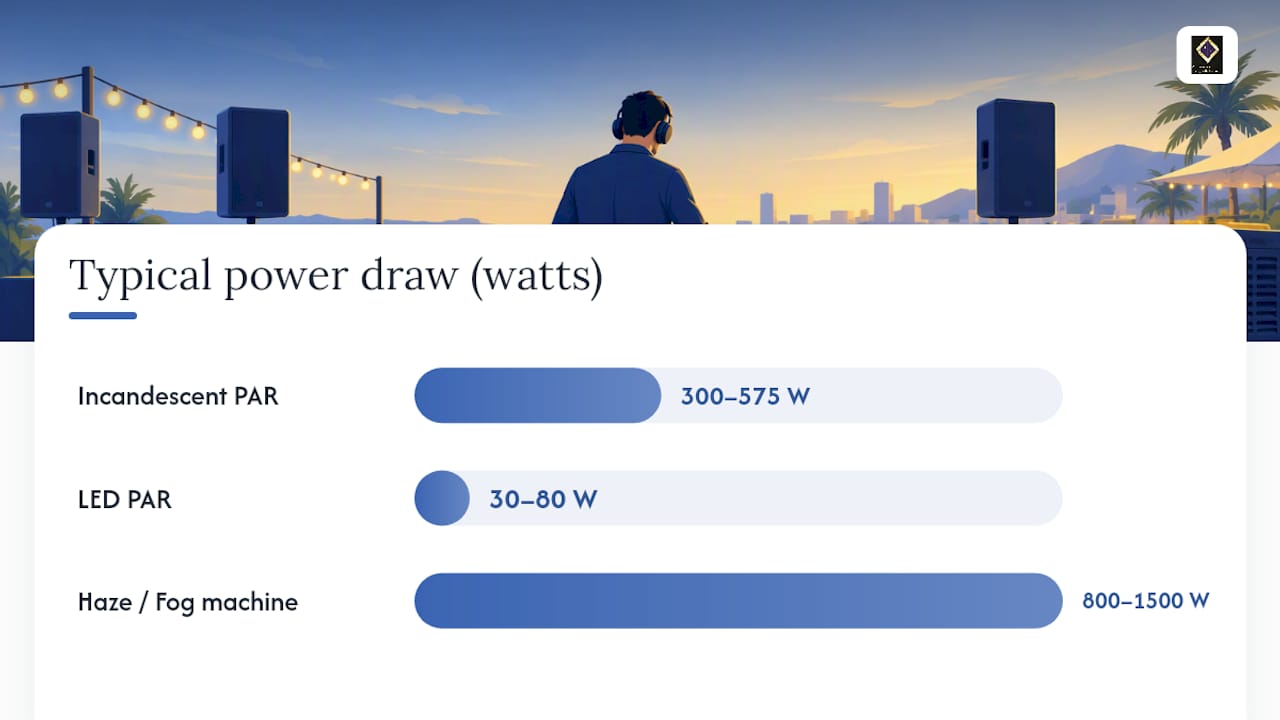
Run that difference across a typical wedding lighting package, say eight uplights plus two moving heads, and the gap between incandescent and LED fixtures can mean the difference between needing a dedicated 5 kW lighting generator and folding lighting into your existing audio circuit entirely. Haze and fog machines don't follow this trend; they're motor and heating-element driven, so LED conversion doesn't reduce their 800 to 1,500 watt draw at all.
LED fixtures also run cooler, which matters for two practical reasons beyond the electric bill. Less heat means less strain on dimmer packs and less risk of a fixture derating its own output on a hot outdoor gig. If your inventory still includes older incandescent wash lights, that's usually the first upgrade to pay for itself in reduced generator rental costs alone, since a smaller generator rents cheaper and burns less fuel per hour.
What Cables and Connectors Handle High-Power DJ Setups Safely?
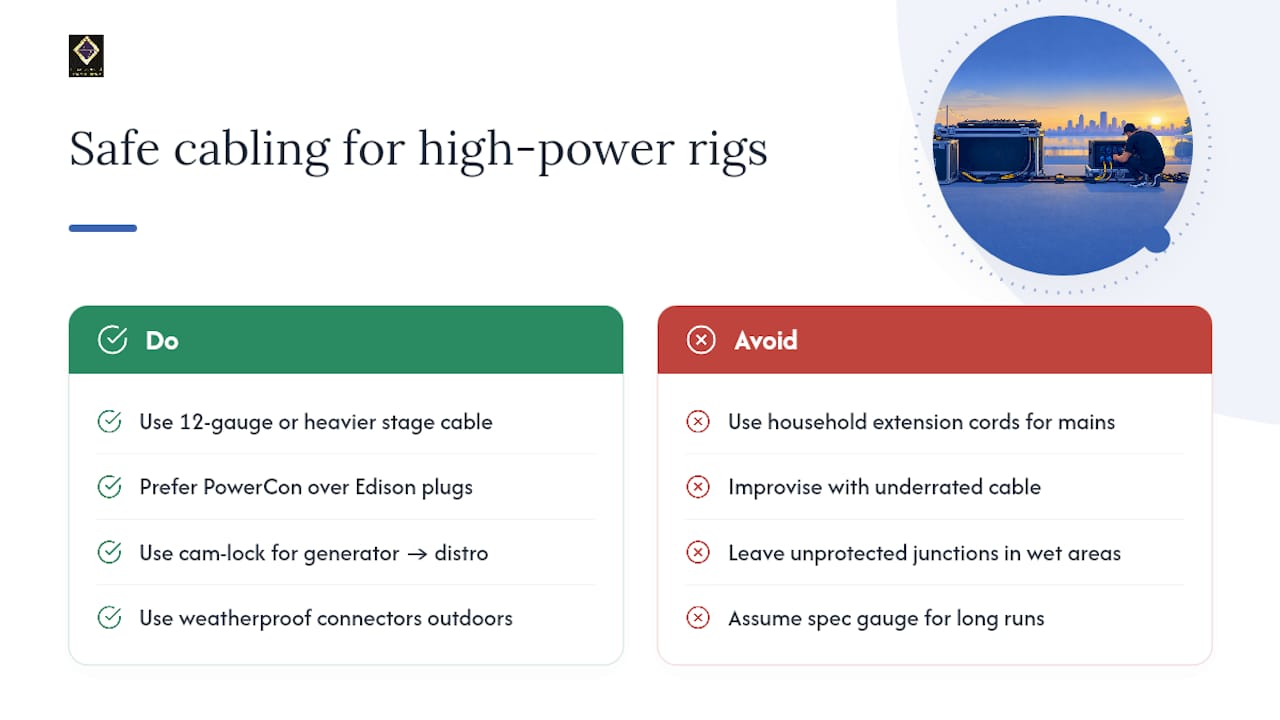
Standard household extension cords aren't rated for what a mobile DJ rig actually draws, and using them anyway is a common way distro problems turn into real hazards. For runs carrying real amperage, from generator to distro or distro to a subwoofer stack, 12-gauge or heavier stage-rated cable with molded connectors is the baseline, not the exception.
PowerCon connectors, the twist-lock connector standard on most modern powered speakers, are worth prioritizing over bare Edison plugs wherever your gear supports them; the locking mechanism prevents a cable from working loose during a set. For feeding a distro panel from a generator, cam-lock connectors handle the higher amperage safely and are the standard in professional event power setups, as event distribution guides note. Household plugs simply aren't built for that current.
Match wire gauge to both amperage and cable length: a long run to a rear-of-room subwoofer needs heavier gauge than the spec sheet's minimum, since voltage drop over distance reduces the power actually reaching the device. For outdoor events, every connector in the chain needs a weatherproof rating, not just the ones near visible moisture. A single unprotected junction in wet grass is enough to trip a GFCI repeatedly or, worse, not trip when it should.
Keep a couple of heavy-duty extension cords and spare connectors in your kit for the outlet that turns out to be father from the stage than the walkthrough suggested. That gap shows up more often than DJs expect, and improvising with underrated cable is how a manageable event turns into a mid-set outage.
An Editorial Take on Power Planning for Mobile DJs
The conventional advice treats generator size as the whole problem. It isn't. Distribution failures, not undersized generators, cause most mid-event power trips, and no amount of extra kilowatts fixes a shared breaker nobody mapped ahead of time.
Here's what the research actually supports: DJs who inventory nameplate watts, calculate real amperage, and walk the venue's circuits beforehand rarely have power problems, regardless of whether they're running a 2,000 watt generator or a battery station. DJs who guess based on amplifier marketing numbers or trust "the venue said it's fine" get burned even with plenty of rated capacity sitting unused two rooms away.
If you take one thing from this guide, make it the site walkthrough. A five-minute conversation with venue staff about panel location and shared circuits prevents more disasters than any generator upgrade. Buy the Kill-A-Watt meter, ask for the circuit map, and treat your headroom margin as non-negotiable for anything with a live microphone attached to it. Everything else is arithmetic.
— MARTIN
Coordinating Power Needs With Your Venue
Ambassador Club gives DJs and AV teams something a lot of rental halls don't bother with: real panel specs and a coordinator who'll walk the room with you before your booking date, not the morning of. That means fewer surprises about shared circuits, closer outlets, or where your subwoofers can actually sit relative to the nearest breaker.

A historic Portsmouth, VA venue has hosted weddings, corporate events, and celebrations in a large hall, with bookings typically including access to staff who can assist with power and logistics questions prior to load-in. If you're planning a reception or event and want to lock down power details early, browse the full lineup of event packages and coordination options and request a site visit to confirm panel location, circuit access, and load-in timing for your date.
Sources
- Portable Power Station for DJ Setup
- Event Power Distribution Calculator
- OSHA portable generator grounding and safety guidance
- Event Power Calculator: Sizing Guide for 2026
FAQ
What Is the Rule of 32 in DJing?
The "rule of 32" isn't a power planning standard. It's a DJ mixing convention unrelated to power calculations or generator sizing.
How Much Should a DJ Charge for a Three-Hour Event?
Pricing varies widely by market, experience, and what's included (lighting, MC duties, setup time), so there's no single national rate to quote here. Ambassador Club doesn't set DJ rates, but couples booking a reception can find venue package details on the services page.
What Is the Best Power Conditioner for DJ Equipment?
There's no single best model, and the right choice depends on your rig's total draw and whether you need surge protection, voltage regulation, or both. Look for a conditioner rated above your calculated running watts with a pure sine wave output if it also handles battery backup duty.
Does a DJ Need an Amplifier?
Not if you're running powered speakers, which have amplifiers built into each cabinet, the standard setup for most mobile DJs today. Passive speakers need a separate amplifier, and that amp's own power draw has to be added to your total wattage calculation.
How Do I Calculate Total Power Requirements for My DJ Setup?
Add up the nameplate watts for every device you're running simultaneously, then apply a 20 to 30 percent safety margin as recommended by event power planning tools. Convert the result to amps by dividing watts by volts, and match that number against your circuit or generator's continuous rating.