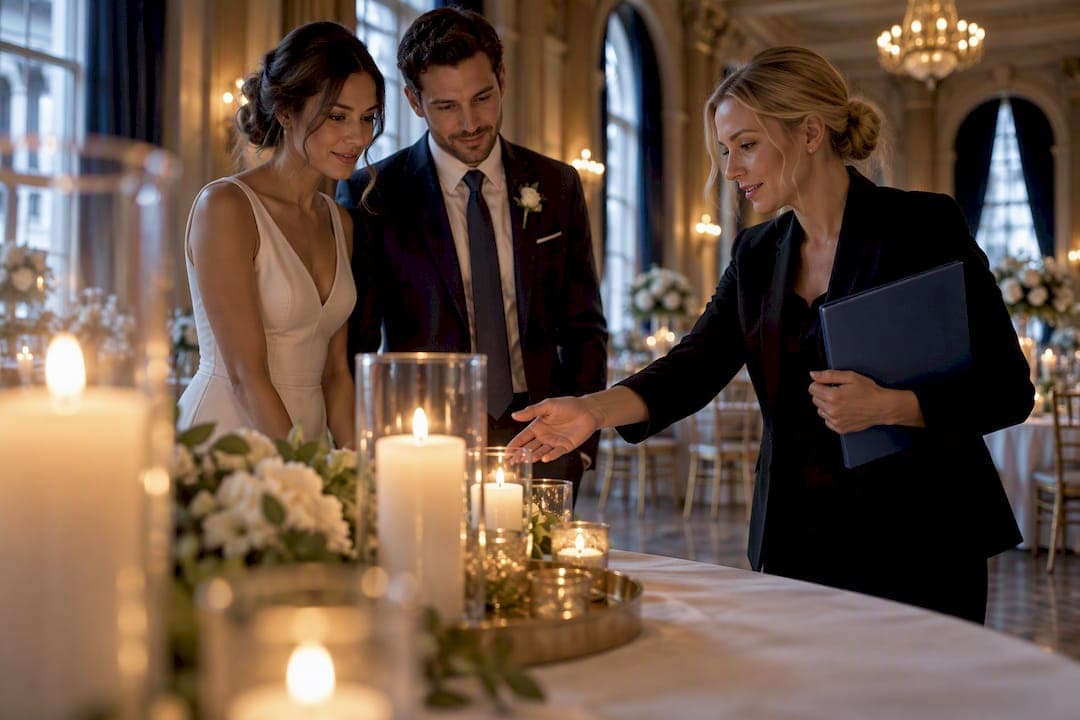
You can often use candles at weddings, but most venues that permit them require enclosed containers, minimum clearances, or advance written approval. If your venue forbids open flame entirely, high-quality LED alternatives cover most of the same ground. The one step that matters most: check your contract, then get the answer in writing.
TL;DR:
- Most venues restrict open flames to enclosed holders or prohibit them entirely, especially in historic or high-occupancy spaces, due to fire hazards and insurance policies.
- Candles placed within 12 inches of combustibles and using weighted, dripless holders are standard safety rules, with supervision typically required during use to prevent fires.
- LED flameless candles are a safe, popular alternative when open flame is forbidden, provided they have realistic flicker, warm color, and sufficient battery life for the event.
- Securing written approval includes providing photos, placement maps, and event timing to the venue weeks in advance, ensuring compliance with fire codes and insurance stipulations.
- Proper candle setup involves using hurricane vases, anchoring candles in sand or water, placing drip trays under tapers, and maintaining at least a two-inch gap from the flame to the rim of the container.
Table of Contents
- What venues typically allow or prohibit
- Common restrictions and safety rules venues enforce
- Unity candle ceremony: what venues expect and safe alternatives
- How to check the venue policy and secure written approval
- Safe candle options and practical setup tips
- Ambassador Club Portsmouth: how a professional venue handles candle safety and approvals
- Planner perspective: balancing ambiance with safety
- How Ambassador Club Portsmouth can help
- Sources
- FAQ
What venues typically allow or prohibit
Candle rules split into a few recognizable categories, and knowing which one applies to your venue saves you a last-minute scramble. Some venues allow open flame with conditions attached, like enclosed holders or a required staff supervisor. Others prohibit open flame outright, usually because of sprinkler systems, historic building materials, or how their insurance policy classifies the space. A third group allows enclosed flame only, meaning votives inside glass or hurricane containers but nothing exposed. A fourth allows flameless candles exclusively.
The drivers behind these categories are consistent across venue types:
- Older or historic buildings often restrict open flame because of wood paneling, drapery, or a lack of modern fire suppression.
- Insurance carriers frequently dictate the policy, not the venue staff, since a candle-related claim affects the building's coverage.
- Occupancy classification (how many people the space is rated to hold) can trigger stricter fire code requirements.
- Outdoor and tented spaces sometimes get more flexibility than indoor rooms, though wind and fabric proximity introduce their own risks.
Ceremony spaces and reception spaces within the same venue can carry different rules, so never assume one room's policy applies to the whole property. If your venue has a tent, ask whether that counts as "indoor" or "outdoor" for their fire policy. It usually matters.
Common restrictions and safety rules venues enforce
Most venues that allow any open flame borrow their standards directly from fire safety guidance, and the numbers behind those rules are worth knowing before you argue for an exception.
A substantial proportion of residential candle fires happen because the candle was placed too close to something flammable, according to FEMA's candle fire statistics. That single fact is why almost every venue rule traces back to distance and containment.
The rules you'll run into most often:
- Keep any open flame at least 12 inches from combustibles, a standard drawn from the U.S. Fire Administration's candle safety guidance.
- Use sturdy, weighted holders, not tapers balanced in narrow candlesticks that tip easily.
- Favor dripless, unscented candles so wax doesn't stain linens or trigger allergies at the table.
- Skip floor-level candles in walkways, near draped fabric, or along the aisle, since foot traffic and floor length gowns increase tipping risk.
- Limit the number of open flames per table, often one or two enclosed votives rather than a cluster.
Venues that allow flame almost always require a designated person to extinguish every candle at a set time, usually right after the reception ends or when staff begins breakdown. Unattended candles are a common factor in fires, which is part of why supervision requirements exist in the first place.
Unity candle ceremony: what venues expect and safe alternatives
The traditional unity candle setup uses two tapers and one central pillar. According to ceremony guidance from The Celebrant Directory, the ritual typically runs three to five minutes: each partner (sometimes with a parent) lights a taper, then together they light the pillar to symbolize joining two families.
Venues tend to worry about three things during this moment: wind if the ceremony is outdoors, open flame near a crowd of seated guests, and florist arrangements placed too close to the candle table. Each has a straightforward fix.
- Use hurricane vases or glass chimneys outdoors, and keep a long-reach lighter on hand in case wind extinguishes a taper.
- Position the candle table where the couple can stand slightly to the side, keeping veils and loose sleeves away from the flame.
- Ask your florist to keep arrangements at least a few inches back from any lit taper.
If your venue bans open flame in the ceremony space, LED unity candles preserve the visual without the risk. A sand ceremony, where each partner pours colored sand into a shared vessel, accomplishes the same symbolism with zero fire involved.
How to check the venue policy and secure written approval
Verbal reassurance from a coordinator isn't enough. Get the policy in writing and attach it to your contract, since venue candle rules are usually tied to fire code and insurance requirements that a staff member can't waive on their own.
- Ask whether open flame is allowed at all, or only enclosed and flameless options.
- Ask whether a staff supervisor or fire watch is required during candle use.
- Ask whether the venue needs a permit or extra insurance rider for your setup.
- Ask who is responsible for lighting and extinguishing candles on the day.
- Request the house rules, fire safety policy, and a written approval or contract addendum spelling out what's allowed.
Once you have a tentative yes, bring photos of your planned holders, a placement map showing table and aisle positions, and your ceremony timing. Submit this package several weeks before the event, since some municipal guidelines require documentation review before sign-off. If the venue denies real flame, ask about LED alternatives before assuming candlelight is off the table entirely.
Pro Tip: Get any candle approval added as a line item in your signed rental agreement, not just a text or email thread, so it's enforceable if staff changes before your date.
Safe candle options and practical setup tips
Hurricane vases and glass cylinders remain the most venue-friendly way to get real candlelight. Size the container so the flame sits at least a couple of inches below the rim, which keeps it shielded from drafts and out of reach of sleeves or centerpiece greenery.
- Anchor pillar candles in sand or water inside the vase to prevent tipping and catch drips.
- Choose weighted lantern bases for outdoor aisles or walkways where wind or guests might bump a stand.
- Place drip trays under any taper not fully enclosed in glass.
- Choose LED flameless candles when the venue restricts real flame. Look for realistic flicker, a soft warm color temperature, and a battery life that covers your full event.
On setup day, walk the room with a placement map, confirm who's lighting and extinguishing candles and when, keep a few spare batteries or bulbs for flameless units, and reconfirm the extinguishing plan with your venue contact.
Pro Tip: If you want the send-off glow without the fire risk, flameless sparkler alternatives work indoors where sparklers are typically banned.

Ambassador Club Portsmouth: how a professional venue handles candle safety and approvals
At Ambassador Club Portsmouth, candle questions get handled the same way any fire safety question should: through written rules, not guesswork. The venue offers event packages with staff support that can include supervision for open-flame elements when they're part of a booking. Responsibilities like extinguishing candles, maintaining an approved holder list, and post-event cleanup are part of the venue's operational practices.
If you're planning your ceremony or reception here, bring your candle photos and holder specs early so the written policy can be confirmed well before your date. Our guide to venue amenities covers what staff support typically includes.

Planner perspective: balancing ambiance with safety
LED wins when a venue restricts flame or when a ceremony space is packed tight with guests and fabric. Enclosed real flame is worth the extra paperwork when the room calls for warmth a battery light can't quite match. Either way, coordinating your florist, caterer, and venue staff on the same rule set early avoids conflicting setups on the day. Get approvals in writing, and know who's putting the flame out before the first candle is lit.
— MARTIN
How Ambassador Club Portsmouth can help
Planning a reception where candlelight matters shouldn't mean guessing at what's allowed. Ambassador Club Portsmouth can walk you through its written candle policy, confirm which holders and setups are approved, and coordinate supervision as part of your event package, all inside a historic hall built for exactly this kind of celebration.

If you're weighing venues for a wedding, reception, or celebration that calls for candlelight done right, check the Standard Event Package or explore the full range of wedding and event services to schedule a visit and get your questions answered directly.
Sources
- Candle fire safety | U.S. Fire Administration
- Candle-related fire statistics | FEMA/USFA report
- Unity Candle Ceremony: How it works | The Celebrant Directory
- How to check venue candle rules before your event | Sortra
FAQ
How many candles for a 100-person wedding?
There's no fixed rule since it depends on table count and venue policy rather than guest count, but many venues cap open flame to one or two enclosed candles per table. Check your venue's written policy first, since some spaces limit total open flames regardless of table number.
What is the protocol for a candle lighting ceremony?
A typical unity candle ceremony uses two tapers and one central pillar, with each partner lighting a taper before both light the pillar together, a sequence described by The Celebrant Directory. The moment usually lasts three to five minutes and often includes a reading or music.
What is the circle of safety rule for candle use?
The rule is to keep lit candles at least 12 inches from anything that can burn, a standard set by the U.S. Fire Administration. This distance, combined with a sturdy holder, is the baseline most venues use when approving candle setups.
Who lights the unity candle at a wedding?
Typically the couple lights the tapers themselves, though some ceremonies have parents light the tapers first before handing them to the couple. The couple then lights the shared pillar candle together as the symbolic final step.
Are sparklers allowed indoors at a wedding venue?
Most indoor venues prohibit sparklers because of smoke and open flame near guests, though policies vary by property. LED alternatives, including flameless sparkler options, give couples a similar send-off look without violating an indoor fire policy.