
Flexible venues are defined as multi-use event spaces that adapt their layout, catering terms, and booking windows to fit different event types and budgets. This adaptability is the core reason why flexible venues save money compared to traditional fixed-layout halls. Venue budgets typically represent 25%–40% of total event spend, making the venue the single largest line item in most event budgets. Choosing a space that bends to your needs rather than forcing you to rent multiple rooms, hire extra staff, or pay inflated catering markups changes the entire financial picture. For event organizers in 2026, this is not a nice-to-have. It is the most direct path to a tighter budget and a better event.
Why flexible venues save money more than traditional spaces
The financial case for flexible venues comes down to three things: lower rental fees, reduced labor costs, and catering freedom. Traditional fixed venues charge for the full space regardless of how much of it you use. Flexible venues let you rent only what you need, for only as long as you need it.
Here is where the numbers get interesting:
- Rental consolidation: Using a single flexible venue for multiple event segments, such as a ceremony and a reception, cuts rental periods and labor fees by 15–20% of the total event budget. Renting two separate spaces means two setup crews, two teardown fees, and two sets of logistics.
- Catering flexibility: Venues that allow external caterers or support bring-your-own-food policies give you better budget transparency by removing inflated in-house food and beverage margins. You pay the actual cost of the food, not the venue's markup on top of it.
- Staffing efficiency: Modular setups with built-in audio/visual equipment, movable partitions, and retractable seating reduce the number of outside vendors you need to hire. That directly cuts labor costs.
- Avoided operational complexity: Multiple setups, redundant transportation, and second rental periods add 15–20% to event budgets when organizers split events across rigid spaces. A single adaptable venue eliminates all three.
Pro Tip: Ask your venue contact for an itemized quote that separates the space rental from add-on services. This one step reveals exactly where the markup is hiding.
The industry term for this model is "multi-use venue design." The flexible venue label is the common shorthand, but multi-use design is what venue operators and architects actually build toward. Both terms describe the same cost-saving principle: one space, many configurations, fewer bills.
How do flexible venues improve time efficiency for event planners?
Time is money in event planning, and the booking process alone can drain both. 77% of consumers prioritize fast venue communication, and venues that fail to respond quickly lose bookings. That lost time cascades into rushed decisions, higher last-minute costs, and stressed planners.
Flexible venues address this through digital tools and modular infrastructure. Here is how the time savings stack up in practice:
- Instant booking and automated Welcome Kits reduce back-and-forth emails and speed up event confirmations. Faster booking responsiveness through digital tools directly reduces lost clients and compresses the planning timeline.
- Modular changeover capability means a venue can flip from a corporate breakfast to an evening reception in hours rather than days. Retractable seating and movable walls reduce setup labor and increase the number of events a venue can host per week.
- Structured sourcing processes cut planning time significantly. 42% of event planners report 10–30% cost reductions when using a structured RFP process, and 97% of the 1,650 planners surveyed saw measurable savings. That figure reflects how much time and money gets wasted when planners shop venues without a clear framework.
- Single-vendor coordination replaces the need to manage multiple venue contacts, reducing the number of calls, contracts, and confirmations you handle before the event date.
The time savings from planner-friendly venues compound quickly. Every hour you save on venue logistics is an hour you can spend on guest experience, entertainment, or decor.
Flexible vs. traditional venues: a cost and logistics comparison
The clearest way to see the financial difference is side by side. Flexible venues and traditional fixed venues diverge on nearly every cost driver.
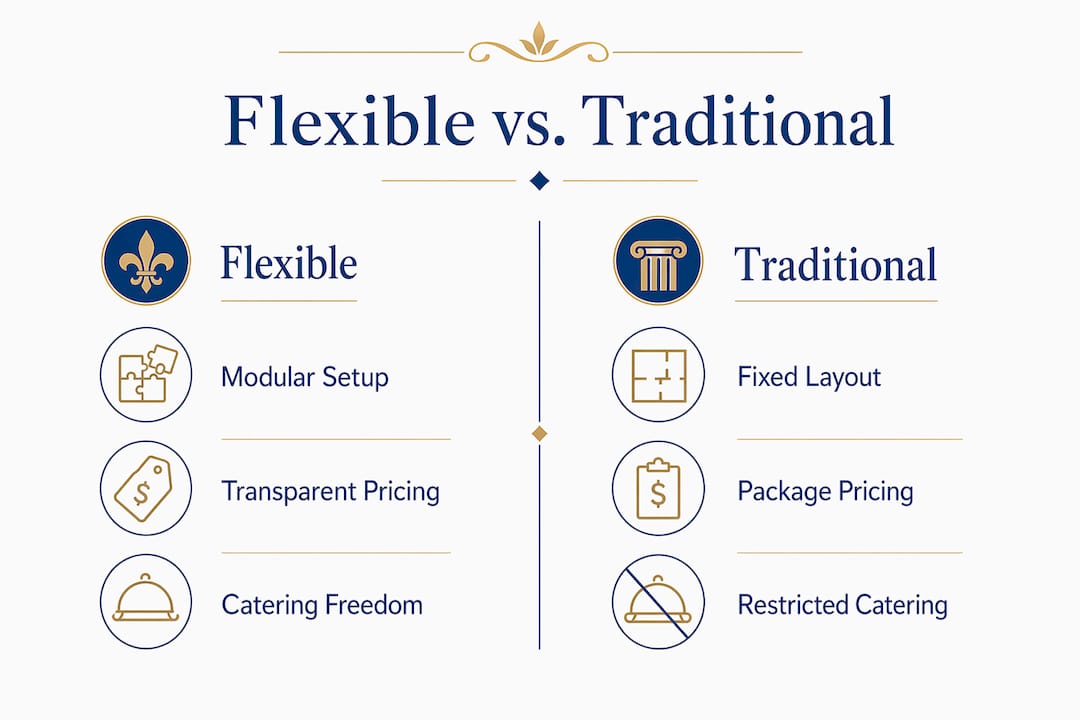
| Feature | Flexible venue | Traditional fixed venue |
|---|---|---|
| Rental structure | Pay for space and time you use | Full-space flat fee regardless of use |
| Catering policy | External caterers often permitted | In-house only, with markups |
| Setup and changeover | Modular, fast, lower labor cost | Custom builds, longer setup, higher labor |
| Audio/visual equipment | Often built in | Usually rented separately |
| Guest capacity adjustment | Reconfigurable for 20 or 200 guests | Fixed layout, fixed capacity |
| Multi-event consolidation | One space covers ceremony and reception | Separate rentals required |
| Budget transparency | Itemized, predictable | Bundled, harder to audit |
Modular venue features like retractable seating do more than reduce labor. They increase venue utilization, which is why flexible venues can price more competitively. A venue that hosts three events per week charges less per event than one that hosts one. That savings passes directly to you.
The guest experience also improves. A space that scales to your actual guest count feels full and energetic rather than sparse and cavernous. That atmosphere is not just aesthetic. It affects how guests perceive the event and how long they stay engaged. Budget-conscious organizers who save on the venue can reallocate those funds toward entertainment, decor, or catering quality, which guests notice far more than the room dimensions.
Venues in the Hampton Roads area, including those in Portsmouth, Virginia, have increasingly adopted this model. Spaces like Ambassadorclubportsmouth, operating since 1933 in a 6,000 sq ft hall, demonstrate that historic elegance and flexible pricing are not mutually exclusive. The club accommodates up to 200 guests with a full commercial kitchen and flexible catering options, which is a direct application of the multi-use venue model. For multi-state families choosing venues, the financial and logistical advantages of multipurpose spaces are a primary decision factor.
Practical tips to maximize savings at flexible venues
Knowing that flexible venues save money is only half the equation. Getting the most out of them requires deliberate choices before and during the booking process.
- Book during off-peak windows. Venues charge premium rates for Saturday evenings in peak seasons. A friday evening or a sunday afternoon at the same flexible space can cost significantly less for an identical experience.
- Negotiate catering terms upfront. Ask directly whether the venue allows external caterers or a bring-your-own-food arrangement. This single conversation can cut food and beverage costs by a meaningful margin.
- Build a long-term planner-venue relationship. Experienced planners emphasize venue partnerships as the best way to preempt costly last-minute fixes. Venues prioritize repeat clients with better rates and faster service.
- Use the venue's built-in equipment. Renting external audio/visual gear, lighting rigs, or staging adds up fast. Flexible venues with built-in modular infrastructure save thousands per event by eliminating custom construction and equipment rentals.
- Request an itemized contract. Bundled pricing hides markups. An itemized contract lets you identify and remove services you do not need.
Pro Tip: When comparing venues, calculate the total cost per guest rather than the flat rental fee. A venue that costs more upfront but includes audio/visual, tables, and chairs often comes out cheaper per head than a bare-bones space with add-on fees.
Venue partnerships with planners also create proactive issue resolution. When a venue team knows your preferences and your event style, they catch problems before they become expensive surprises. That relationship is worth more than any single discount.
Key Takeaways
Flexible venues save money by consolidating rental costs, removing catering markups, and reducing labor through modular design, making them the most cost-effective choice for budget-conscious event organizers.
| Point | Details |
|---|---|
| Venue cost is the biggest budget line | Venue spend represents 25%–40% of total event budgets, so flexibility there has the largest impact. |
| Consolidation cuts 15–20% of costs | Using one flexible space for multiple event parts eliminates duplicate rental and labor fees. |
| Catering freedom lowers food costs | Venues permitting external caterers remove in-house markups and give organizers full budget control. |
| Modular design saves time and labor | Built-in audio/visual and movable walls reduce setup time and eliminate costly equipment rentals. |
| Structured sourcing delivers real savings | 42% of planners using structured RFPs report 10–30% cost reductions across their events. |
What I have learned about venue flexibility after years of event planning
The conversation about flexible venues almost always starts with aesthetics. Planners want to know if the space looks good. That is the wrong first question. The right first question is: what does this venue let me control?
Operational complexity is the hidden cost that destroys event budgets. I have watched planners book beautiful fixed-layout venues and then spend more on the logistics of making that space work than they saved on the rental fee. A second truck for equipment transport, a custom stage build, an extra hour of labor because the room could not be reconfigured quickly. These costs are invisible in the initial quote and brutal in the final invoice.
The venues that genuinely save money are the ones that are transparent about what is included and what is not. That transparency is a feature, not a formality. When a venue gives you an itemized quote and tells you exactly what their catering policy is before you sign, that is a venue that respects your budget.
My honest advice: prioritize functionality over atmosphere on your first pass through venue options. A space with movable walls, built-in sound, and a commercial kitchen will serve you better than a stunning room that requires three outside vendors to make it work. You can always add atmosphere with decor. You cannot add a commercial kitchen after the fact.
The planners I have seen get the best results are the ones who build real relationships with venue operators. They are not just booking a room. They are working with a team that knows their standards and catches problems early. That relationship is the most underrated cost-saving tool in event planning.
— MARTIN
How Ambassadorclubportsmouth delivers flexible elegance at competitive rates
Event organizers in the Hampton Roads area have a direct option for cost-effective event spaces that do not sacrifice quality.
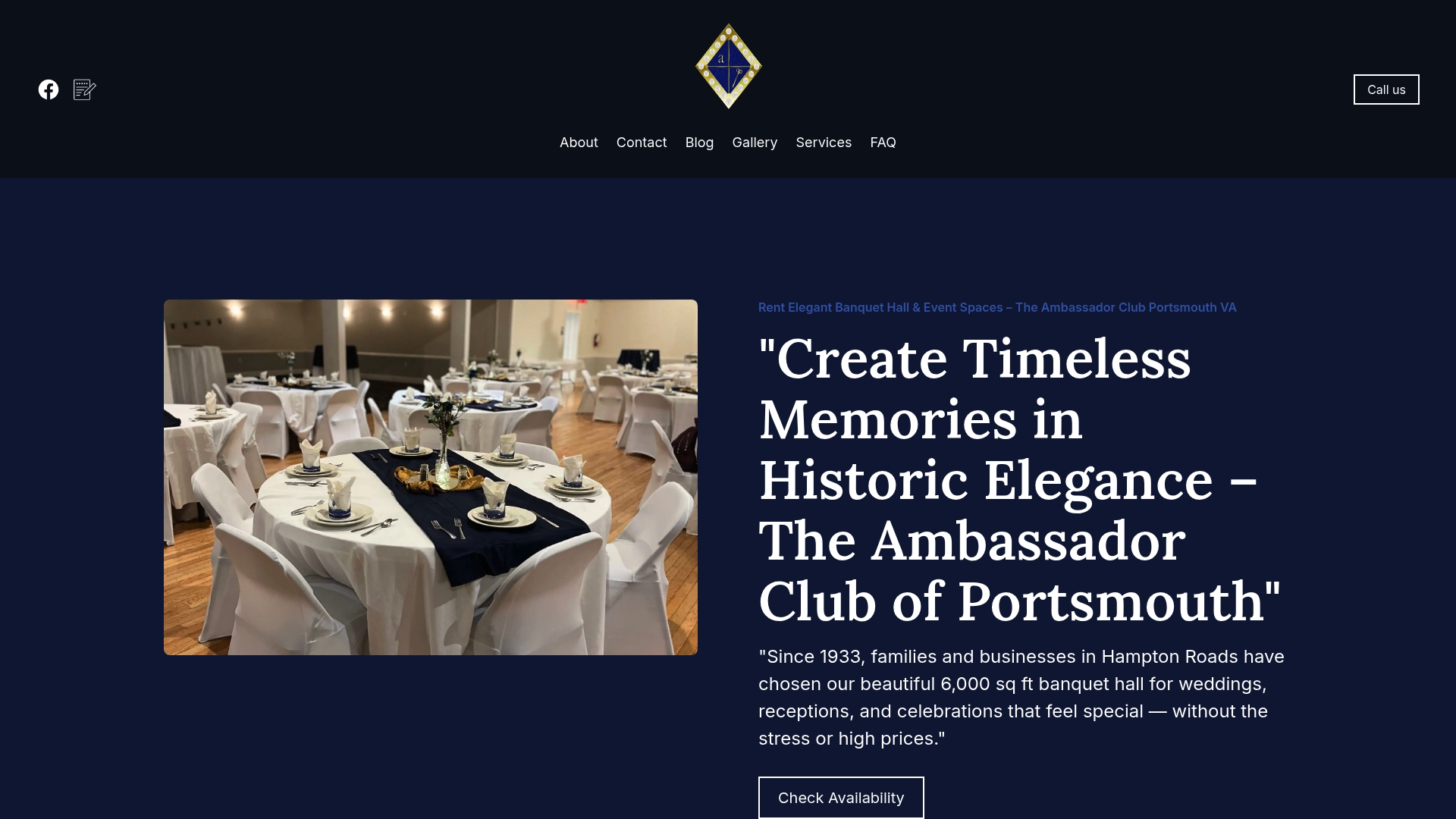
Ambassadorclubportsmouth has operated since 1933 in Portsmouth, VA, offering a 6,000 sq ft hall with flexible layout options, a full commercial kitchen, and customizable catering packages. The space accommodates up to 200 guests and is designed for weddings, receptions, corporate events, and private celebrations. Competitive pricing and comprehensive packages mean you get the full experience without the hidden fees that inflate costs at rigid traditional venues. Explore elegant venue rentals at Ambassadorclubportsmouth and see how the multi-use model works in practice for your next event.
FAQ
Why do flexible venues cost less than traditional venues?
Flexible venues reduce costs by consolidating rental periods, offering catering freedom, and using modular setups that lower labor fees. Using one adaptable space instead of multiple fixed rooms can cut 15–20% from a total event budget.
How much of an event budget should go toward the venue?
Venue costs typically represent 25%–40% of total event spend. Choosing a flexible venue with transparent pricing and built-in amenities keeps that percentage at the lower end of the range.
What features make a venue truly flexible?
Movable walls, retractable seating, built-in audio/visual equipment, and open catering policies are the core features of a genuinely flexible venue. These elements reduce the need for outside vendors and custom builds, which are the primary sources of unexpected costs.
How does booking speed affect event planning costs?
Slow venue responses push planners toward rushed decisions and last-minute alternatives, both of which cost more. Venues using digital booking tools and automated confirmations reduce this risk and compress the planning timeline.
Can flexible venues work for large events like weddings?
Yes. Flexible venues with commercial kitchens, configurable layouts, and capacity for 150–200 guests handle weddings and large receptions effectively. The key is confirming that the venue's modular features cover your specific event requirements before signing a contract.
Recommended
- Rent Elegant Spaces at The Ambassador Club, Portsmouth.
- The Ambassador Club of Portsmouth | The Ambassador Club of Portsmouth is a historic, community-focused civic and social organization proudly serving Portsmouth, Virginia, for over 70 years. Located at 364 Peninsula Avenue, the club is dedicated to strengthening the local community through meaningful public service, charitable contributions, and neighborly support—whether through donations, volunteer efforts, or direct aid to families, children, parents, and seniors in need. As a cornerstone of Portsmouth's social fabric, the Ambassador Club operates as a welcoming, member-driven group that fosters networking, fellowship, and positive impact. It also serves as a premier event venue, offering a beautifully renovated, spacious banquet hall of approximately 4,000 square feet (including over 3,000 square feet of dance floor), a full kitchen, stylish dry bar, large projection wall, and flexible meeting areas. The venue comfortably accommodates up to 200 guests seated or standing, making it an ideal, affordable, and elegant choice for: Weddings and receptions Holiday parties and family reunions Community dances and social gatherings Corporate trainings, meetings, and professional functions Banquets and other special celebrations With ample free parking and a reputation for exceptional value, the Ambassador Club combines timeless charm with modern amenities to create unforgettable experiences while continuing its legacy of giving back to the Portsmouth community.
- The Ambassador Club of Portsmouth | The Ambassador Club of Portsmouth is a historic, community-focused civic and social organization proudly serving Portsmouth, Virginia, for over 70 years. Located at 364 Peninsula Avenue, the club is dedicated to strengthening the local community through meaningful public service, charitable contributions, and neighborly support—whether through donations, volunteer efforts, or direct aid to families, children, parents, and seniors in need. As a cornerstone of Portsmouth's social fabric, the Ambassador Club operates as a welcoming, member-driven group that fosters networking, fellowship, and positive impact. It also serves as a premier event venue, offering a beautifully renovated, spacious banquet hall of approximately 4,000 square feet (including over 3,000 square feet of dance floor), a full kitchen, stylish dry bar, large projection wall, and flexible meeting areas. The venue comfortably accommodates up to 200 guests seated or standing, making it an ideal, affordable, and elegant choice for: Weddings and receptions Holiday parties and family reunions Community dances and social gatherings Corporate trainings, meetings, and professional functions Banquets and other special celebrations With ample free parking and a reputation for exceptional value, the Ambassador Club combines timeless charm with modern amenities to create unforgettable experiences while continuing its legacy of giving back to the Portsmouth community.
- The Ambassador Club of Portsmouth | The Ambassador Club of Portsmouth is a historic, community-focused civic and social organization proudly serving Portsmouth, Virginia, for over 70 years. Located at 364 Peninsula Avenue, the club is dedicated to strengthening the local community through meaningful public service, charitable contributions, and neighborly support—whether through donations, volunteer efforts, or direct aid to families, children, parents, and seniors in need. As a cornerstone of Portsmouth's social fabric, the Ambassador Club operates as a welcoming, member-driven group that fosters networking, fellowship, and positive impact. It also serves as a premier event venue, offering a beautifully renovated, spacious banquet hall of approximately 4,000 square feet (including over 3,000 square feet of dance floor), a full kitchen, stylish dry bar, large projection wall, and flexible meeting areas. The venue comfortably accommodates up to 200 guests seated or standing, making it an ideal, affordable, and elegant choice for: Weddings and receptions Holiday parties and family reunions Community dances and social gatherings Corporate trainings, meetings, and professional functions Banquets and other special celebrations With ample free parking and a reputation for exceptional value, the Ambassador Club combines timeless charm with modern amenities to create unforgettable experiences while continuing its legacy of giving back to the Portsmouth community.