
Venue rental is defined as paying for the use of an event space along with a standard set of amenities and basic services required to hold an event. Most packages cover the physical space, basic furniture, and core utilities for a set block of time. What does venue rental include beyond that depends entirely on the package type you choose. Catering, decor, audio-visual equipment, and staffing are almost always separate costs. Knowing this distinction before you sign anything prevents the most common and expensive planning mistakes.
What does venue rental include as standard?
Standard event venue rentals include access to the space for a defined block of time, generally 5–8 hours, along with overhead lighting and restrooms. That time block is the foundation of every rental agreement, regardless of price or venue type.
Within that window, most venues provide:
- Tables and standard chairs. Basic furniture like folding chairs and rectangular or round tables is included in most packages. Specialty linens, chiavari chairs, or custom layouts typically cost extra.
- Restrooms and parking access. Clean restroom facilities and available parking are standard. Valet service or reserved parking spots are separate charges.
- Basic overhead lighting and power outlets. The venue's built-in lighting system and standard electrical outlets are included. Theatrical lighting rigs or custom uplighting are not.
- WiFi and internet access. Standard WiFi is typically included, but high-bandwidth needs for live streaming or large-scale presentations may require a paid upgrade.
- Setup and breakdown time. This is where most planners get surprised. The rental period usually covers the event itself. Setup and teardown by outside vendors may fall outside that window unless you negotiate it explicitly.
The industry classifies venue rentals into three tiers: Bare Rental, Venue Plus Services, and All-Inclusive. Bare Rental gives you the room and almost nothing else. Venue Plus Services adds furniture and basic amenities. All-Inclusive bundles catering, staffing, and decor into one contract. Knowing which tier you are buying prevents mismatched expectations before the event date arrives.
Pro Tip: Ask the venue coordinator to send you a written list of every item included in your rental tier before you review the contract. Verbal confirmations are not enforceable.

What is typically NOT included in a venue rental fee?
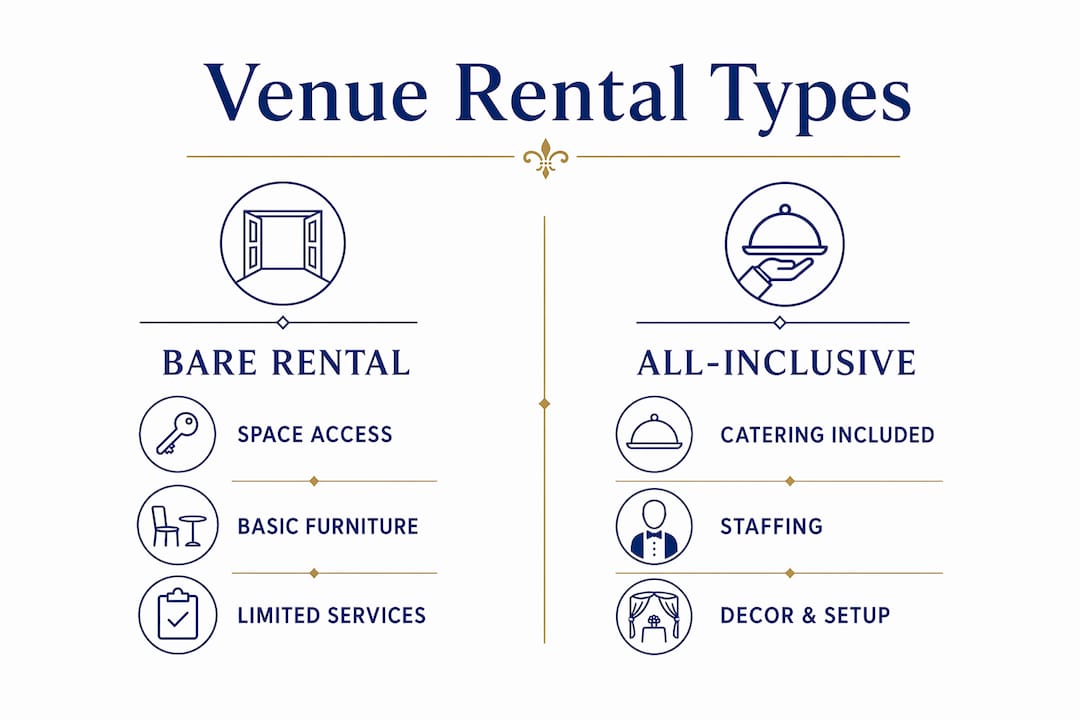
The base rental fee covers the space. Everything that makes the space feel like your event is usually extra. Venue rental fees rarely cover high-production services such as event coordinators, security, or customized audio-visual support.
Here is what you should expect to budget for separately:
- Event staffing. Coordinators, security personnel, and technical operators are billed independently. Security fees range from $15 to $50 or more per hour. A dedicated event coordinator can add hundreds to thousands of dollars to your total.
- Catering and bar service. Food and beverage are almost never included in a base rental fee. You will either use the venue's in-house catering, hire an approved outside caterer, or bring your own if the venue permits it.
- Decor and linens. Centerpieces, draping, specialty tablecloths, and floral arrangements are your responsibility unless you book an all-inclusive package.
- Audio-visual equipment and technician fees. A projector or sound system may be listed as "included," but AV equipment listed as included often requires hiring a technician to operate it, or the venue charges a separate tech fee. That fee can range from $500 to $5,000 or more depending on event complexity.
- Cleaning fees. Standard post-event cleaning is sometimes included, but deep cleaning or damage-related cleanup is billed separately.
- Valet and reserved parking. If your venue is in a dense urban area, expect to pay for parking management on top of the base rental.
Many venues also restrict which outside vendors you can bring in. Some require you to use their approved vendor list for catering, florals, or entertainment. Violating those restrictions can result in penalties or loss of your deposit.
Pro Tip: Request the venue's approved vendor list before you book. If your preferred caterer or DJ is not on it, factor in the cost of switching vendors or negotiating an exception fee.
All-inclusive vs. à la carte: which package type fits your event?
The two dominant venue rental structures are all-inclusive packages and à la carte rentals, sometimes called dry hire. Each has real financial and logistical consequences.
All-inclusive venue packages bundle catering, bar service, staffing, and decor into one contract. The appeal is cost predictability. You pay one price and most logistics are handled. The tradeoff is vendor restriction and mandatory spending minimums. Food and beverage minimums in these contracts are legally binding. You owe that amount regardless of how much your guests actually consume.
Dry hire venues provide a blank canvas. The room, basic furniture, WiFi, restrooms, and a site contact are typically all you get. You source every other element independently. This gives you full creative control and the freedom to choose your own caterer, florist, and entertainment. The downside is that coordinating multiple vendors multiplies your planning workload significantly.
| Feature | All-Inclusive Package | À la Carte (Dry Hire) |
|---|---|---|
| Cost predictability | High | Low to moderate |
| Vendor flexibility | Limited | Full |
| Planning effort | Lower | Higher |
| Creative control | Restricted | Complete |
| Food and beverage minimums | Common and binding | Not applicable |
| Best for | Weddings, corporate galas | DIY events, branded activations |
The right choice depends on your event scale and your tolerance for logistics. A 150-person wedding reception benefits from the coordination an all-inclusive package provides. A 40-person corporate workshop may be better served by a dry hire space where you control every vendor relationship.
What should you check in a venue rental contract?
A venue rental agreement is a liability document, not just a booking confirmation. Venue contracts are complex liability documents, and reading for force majeure, insurance, and overtime clauses is the only way to avoid surprise costs.
The most important contract terms to review before signing:
- Rental period definition. Confirm whether setup and teardown time for outside vendors is included in your rental block or billed as overtime. Failure to clarify vendor access timing risks overtime penalties that can add 10–20% to your total event cost.
- Overtime charges. Most venues charge a flat hourly rate if your event runs long. Know that rate before you finalize your event timeline.
- Force majeure and cancellation policy. Understand what happens if the venue cancels due to circumstances outside their control. Know your refund or credit options.
- Insurance requirements. Many venues require event liability insurance. Some require you to name the venue as an additional insured on your policy. This is a real cost that first-time planners frequently overlook.
- Food and beverage minimums. If your contract includes a catering component, the minimum spend is binding. Unaccounted fees from minimums and service charges can add 10–20% to your event budget unexpectedly.
- Service fees and gratuities. A 20–22% service charge on top of catering costs is standard at many venues. This is separate from a tip and is often non-negotiable.
- Corkage fees. If you bring outside alcohol, expect a per-bottle corkage fee. These fees vary widely and can make outside alcohol more expensive than the venue's bar package.
Read every line of the inclusions and exclusions section. If something is not written in the contract, assume it is not included.
Key takeaways
A venue rental agreement covers the space and basic amenities, but every service beyond that requires a separate budget line and written confirmation in the contract.
| Point | Details |
|---|---|
| Standard inclusions | Space access for 5–8 hours, tables, chairs, restrooms, basic lighting, and WiFi are typically included. |
| Common exclusions | Catering, AV technicians, decor, staffing, and valet parking are almost always billed separately. |
| Package types matter | All-inclusive bundles convenience but restricts vendors; dry hire gives freedom but multiplies planning tasks. |
| Contract review is non-negotiable | Overtime, insurance, and food and beverage minimums can add 10–20% to your total cost if overlooked. |
| Get everything in writing | Verbal inclusions are unenforceable; request a written amenities list before signing any agreement. |
What i have learned after years of watching venue contracts go wrong
The most expensive mistake I see event planners make is assuming that "included" means the same thing at every venue. It does not. At one venue, "AV included" means a projector on a cart. At another, it means a full sound system with a technician on call. The word "included" in a venue rental agreement is only as reliable as the written description behind it.
The second mistake is underestimating setup time. Planners book a 6-hour rental, then discover their florist needs 3 hours to set up and their caterer needs 2. That is 5 hours of vendor access before the first guest arrives. If the contract only covers the event block, you are paying overtime before the party starts. I have seen this single oversight cost clients $800 to $1,500 in unexpected fees on the day of their event.
My honest advice: treat the venue rental checklist as a negotiation tool, not just a planning reference. Ask the venue to extend your rental window to include vendor setup time. Many will accommodate this at no charge if you ask before signing. Once the contract is executed, that flexibility disappears.
The planners who have the smoothest events are not the ones with the biggest budgets. They are the ones who read the contract, asked the uncomfortable questions, and confirmed every inclusion in writing before the deposit cleared.
— MARTIN
How Ambassadorclubportsmouth makes venue rental straightforward
Planning an event is complicated enough without decoding a confusing rental agreement. Ambassadorclubportsmouth takes the guesswork out of what is included by offering transparent packages in a 6,000 sq ft historic hall in Portsmouth, VA, with capacity for up to 200 guests.

Since 1933, Ambassadorclubportsmouth has served families and businesses across the Hampton Roads area with clear, competitive rental options that include furniture, lighting, restrooms, and access to a full commercial kitchen. Flexible catering arrangements mean you are not locked into a single vendor or a binding food and beverage minimum you cannot control. If you are ready to see exactly what is covered in your event space rental, Ambassadorclubportsmouth makes it easy to get started without surprises.
FAQ
What does a basic venue rental typically include?
A basic venue rental includes access to the event space for a defined block of time, generally 5–8 hours, along with tables, standard chairs, restrooms, basic overhead lighting, and standard power outlets. WiFi and parking access are also commonly included where available.
What is a venue catering agreement?
A venue catering agreement is a contract clause or separate document that defines the food and beverage terms between the client and the venue, including approved caterers, minimum spend requirements, corkage fees, and service charges. These minimums are legally binding regardless of actual consumption.
What does a venue rental agreement mean for setup and teardown?
A venue rental agreement typically covers only the event hours, not vendor setup or teardown time. Clients must confirm in writing whether outside vendor access before and after the event is included or billed as overtime, since unplanned overtime can add 10–20% to total event costs.
What is the difference between all-inclusive and dry hire venue rental?
All-inclusive packages bundle catering, staffing, and decor into one contract with mandatory spending minimums. Dry hire, also called à la carte rental, provides the space and minimal amenities only, giving clients full control over every vendor they hire.
What does a venue contract include beyond the rental fee?
A venue contract typically includes clauses on overtime charges, force majeure, cancellation policy, insurance requirements, food and beverage minimums, service fees, and vendor restrictions. Reviewing these terms before signing is the most effective way to prevent unexpected costs.