
A local event space rental contract is a legally binding document that defines the terms under which a venue is rented for an event, including fees, usage rules, liability, and timing. Think of it as the rulebook for your event. Without it, you have no legal protection if the venue double-books your date, keeps your deposit, or denies access to your vendors. Resources like LawDepot, Contract Counsel, and LawyerDrafted all confirm that this agreement is the foundation of any successful venue rental. Whether you are planning a wedding, a corporate reception, or a community fundraiser, understanding this document before you sign is the single most important step you can take.
What key terms must a local event space rental contract include?
A well-written venue rental agreement covers six core areas. Miss any one of them and you risk financial loss, legal exposure, or a ruined event day. Contract Counsel confirms that clarity in payment schedules, usage permissions, access timing, and cancellation policies is what prevents most disputes.
The six core sections every contract must contain:
- Event description. Date, start time, end time, guest count, and the specific spaces you are renting. Vague descriptions create room for disputes.
- Fees and payment terms. Total cost, deposit amount, payment schedule, and accepted payment methods. Confirm whether the quoted price is all-in or subject to add-ons.
- Cancellation and refund policy. Refund tiers based on how far in advance you cancel. A contract that says "no refunds" with no tiers is a red flag.
- Insurance and liability. Who carries event liability insurance, what coverage limits apply, and when certificates of insurance must be submitted.
- Rules and restrictions. Noise limits, alcohol policies, approved vendor lists, decoration rules, and cleanup responsibilities.
- Legal compliance. Ignoring local laws can void a contract or trigger fines, so the agreement should reference zoning requirements, permits, and applicable ordinances.
Pro Tip: Read the access timeline before you read the price. Many planners focus on the rental fee and miss that their contract only covers four hours of event time with no setup window included.
The cancellation policy deserves extra attention. A tiered refund structure, where you recover 75% if you cancel 90 days out and 25% if you cancel 30 days out, is standard and fair. A flat "no refund" clause is not standard. Push back on it.
How do you review and negotiate a venue rental agreement?
The most financially significant negotiation in any venue contract is the liability and insurance language. Contract Counsel's deep knowledge confirms that this section determines who pays for injury, property damage, and third-party claims. Read it twice.

Use this checklist when reviewing any event space rental agreement:
| Area to verify | What to confirm |
|---|---|
| All-in pricing | Are cleaning fees, service charges, and minimum spends included or added later? |
| Cancellation tiers | Does the refund scale with how far in advance you cancel? |
| Alcohol licensing | Does the venue hold the license, or do you need a separate permit? |
| Insurance deadlines | When must your certificate of insurance be submitted? |
| Damage deposit | What is the amount, and what is the return timeline after the event? |
| Force majeure | Does the clause cover pandemics, weather, and government orders? |
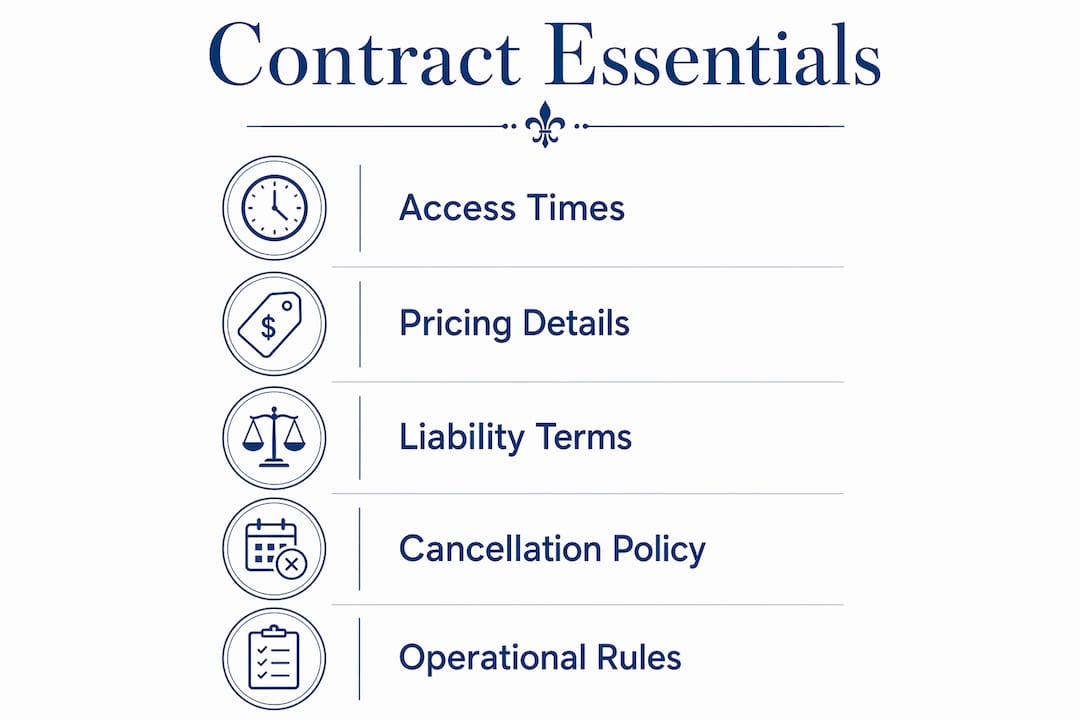
Hidden fees are the most common surprise in venue contracts. Pricing may include cleaning charges, mandatory staffing fees, or vendor buyout costs that are buried in the fine print. Always ask the venue to confirm the total cost in writing before you sign.
Force majeure clauses became critical after 2020. A well-written clause covers government-ordered closures, natural disasters, and public health emergencies. A poorly written one covers only "acts of God" and leaves you with no recourse if a city ordinance shuts down your event.
Pro Tip: Photograph every inch of the venue at load-in before your team touches anything. Time-stamp the photos. This is your best defense against a venue claiming damage you did not cause.
Negotiating a contract is normal and expected. Venues negotiate terms regularly. The areas most open to negotiation are the damage deposit return timeline, the cancellation refund tiers, and the vendor exclusivity clauses.
What operational details should the contract confirm?
Contracts must align event time with access time to avoid overtime charges or denied setup. This is one of the most frequently overlooked details in local venue booking. Your event runs from 6 PM to 10 PM, but your caterer needs to arrive at 3 PM and your florist at 2 PM. If the contract only grants access from 5 PM, you have a problem.
Operational details that must appear in the contract:
- Setup and teardown windows. Exact times when vendors can enter and when everything must be cleared. Overtime fees for running past these windows should be stated clearly.
- AV and production rules. Whether you can bring outside AV vendors or must use the venue's in-house system. Technical contracts must explicitly cover AV, lighting, power, rigging, and vendor exclusivity.
- Power availability. Amperage limits and whether outside generators are permitted. Bands and production crews often need more power than a venue's standard outlets provide.
- Preferred vendor lists. Some venues require you to use their approved caterers, bartenders, or rental companies. Others charge a fee if you bring outside vendors. Know this before you book.
- Parking and amenities. Whether parking is included, how many spaces are available, and whether Wi-Fi, tables, chairs, and linens are part of the rental or billed separately.
A 72-question venue checklist from Zkipster covers these operational areas in detail. Working through a checklist like this before signing prevents the last-minute surprises that blow budgets and timelines.
How do local laws and permits affect your event contract?
Local legal requirements directly shape what your contract can and cannot allow. Contracts paired with local compliance checks for zoning, permits, ADA access, and noise ordinances are the only contracts that hold up when something goes wrong.
Key legal areas that intersect with venue contracts:
- Zoning restrictions. Not every building is zoned for public events. Confirm the venue holds the correct zoning classification for your event type before signing.
- Alcohol licensing. The contract must state clearly who holds the liquor license. If the venue does not hold one, you may need a separate permit. In the United Kingdom, regulations like Temporary Event Notices (TEN) limit attendance and event duration and require advance notice. American jurisdictions have equivalent temporary permit systems with their own deadlines and caps.
- Noise ordinances. Most municipalities enforce quiet hours, typically between 10 PM and 7 AM. Outdoor events face stricter limits. Confirm the venue's history of compliance before booking.
- ADA accessibility. Federal law requires public venues to meet Americans with Disabilities Act standards. Confirm that entrances, restrooms, and event spaces are fully accessible.
- Health and safety codes. Venues must pass fire marshal inspections and meet occupancy limits. Ask for the venue's current occupancy certificate.
"Contracts must be paired with local compliance checks on zoning, permits, ADA access, and noise to avoid voiding and fines." — LawyerDrafted
Consulting a local attorney or your city's permitting office before signing a contract for a large or complex event is not excessive caution. It is standard practice for any event with alcohol, amplified sound, or more than 100 guests.
Key Takeaways
A venue rental agreement protects your event only when it explicitly covers pricing, access timing, liability, and local legal compliance before you sign.
| Point | Details |
|---|---|
| Read access times first | Confirm setup and teardown windows match your vendor schedule before reviewing price. |
| Verify all-in pricing | Ask for total cost in writing, including cleaning fees, staffing, and vendor charges. |
| Negotiate liability language | Insurance and liability clauses carry the most financial risk and are open to negotiation. |
| Check local permits | Confirm zoning, alcohol licensing, noise rules, and ADA compliance before signing. |
| Photograph at load-in | Time-stamped photos at venue entry protect you from false damage claims after the event. |
What I have learned from years of reviewing event contracts
The biggest mistake planners make is treating a venue contract as a formality. It is not. It is a risk allocation map. Every clause answers one question: who pays when something goes wrong?
The liability and insurance section is where most planners stop reading carefully. That is exactly where they should slow down. A clause that places all liability on the renter, with no cap on damages, is not a standard clause. It is a trap. Push for mutual liability language and confirm that your event insurance policy covers the specific risks the venue requires.
Timeline clarity is the second area where I see planners lose money. The gap between your public event hours and your full venue access window is where overtime charges live. Build a buffer. If your event ends at 10 PM, your contract should grant access until midnight for breakdown. Venues rarely volunteer this language. You have to ask for it.
Vendor exclusivity clauses are the third area worth fighting for. Some venues require you to use their in-house catering at a premium rate. Others allow outside vendors but charge a fee. Know the full cost of vendor restrictions before you commit. A venue that looks affordable at the base rate can become expensive once mandatory vendor fees are added.
The planners who have the smoothest events are the ones who treated the contract negotiation as seriously as the event design. A clear contract does not just protect you legally. It removes the ambiguity that causes stress on event day.
— MARTIN
Ambassadorclubportsmouth makes venue rental straightforward
Planning a local event should not mean deciphering a confusing contract on your own. Ambassadorclubportsmouth has been serving families and businesses in the Hampton Roads area since 1933, and its rental agreements are built around transparency, not surprises.

The club's 6,000 sq ft hall accommodates up to 200 guests and includes a full commercial kitchen, flexible catering options, and clear package pricing. There are no hidden vendor fees or ambiguous cancellation terms. The team walks every client through the contract before signing so you understand exactly what is included. If you are looking for an elegant event space in Portsmouth, VA, with straightforward rental terms and professional support, Ambassadorclubportsmouth is the place to start your planning.
FAQ
What is a local event space rental contract?
A local event space rental contract is a legally binding agreement between a renter and a venue that defines fees, usage rules, access times, and liability. LawDepot describes it as the license to use the space and the document that reduces disputes.
What are the most common red flags in a venue contract?
The most common red flags are unclear all-in pricing, flat no-refund cancellation policies, and vague language about who holds the alcohol license. Always ask for total cost confirmation in writing.
Do I need a permit to hold an event at a rented venue?
Permits depend on your event type and local regulations. Events with alcohol, amplified sound, or large guest counts often require separate licenses or permits beyond what the venue contract covers.
How do I protect myself from damage deposit disputes?
Photograph the venue at load-in with time-stamped photos before any setup begins. This creates a clear record of the venue's condition before your event and protects you from claims for pre-existing damage.
What should I negotiate in an event space rental agreement?
Focus on three areas: the cancellation refund tiers, the damage deposit return timeline, and vendor exclusivity clauses. These terms are the most negotiable and carry the highest financial impact if left unclear.
Recommended
- Rent Elegant Spaces at The Ambassador Club, Portsmouth.
- The Ambassador Club of Portsmouth | The Ambassador Club of Portsmouth is a historic, community-focused civic and social organization proudly serving Portsmouth, Virginia, for over 70 years. Located at 364 Peninsula Avenue, the club is dedicated to strengthening the local community through meaningful public service, charitable contributions, and neighborly support—whether through donations, volunteer efforts, or direct aid to families, children, parents, and seniors in need. As a cornerstone of Portsmouth's social fabric, the Ambassador Club operates as a welcoming, member-driven group that fosters networking, fellowship, and positive impact. It also serves as a premier event venue, offering a beautifully renovated, spacious banquet hall of approximately 4,000 square feet (including over 3,000 square feet of dance floor), a full kitchen, stylish dry bar, large projection wall, and flexible meeting areas. The venue comfortably accommodates up to 200 guests seated or standing, making it an ideal, affordable, and elegant choice for: Weddings and receptions Holiday parties and family reunions Community dances and social gatherings Corporate trainings, meetings, and professional functions Banquets and other special celebrations With ample free parking and a reputation for exceptional value, the Ambassador Club combines timeless charm with modern amenities to create unforgettable experiences while continuing its legacy of giving back to the Portsmouth community.
- The Ambassador Club of Portsmouth | The Ambassador Club of Portsmouth is a historic, community-focused civic and social organization proudly serving Portsmouth, Virginia, for over 70 years. Located at 364 Peninsula Avenue, the club is dedicated to strengthening the local community through meaningful public service, charitable contributions, and neighborly support—whether through donations, volunteer efforts, or direct aid to families, children, parents, and seniors in need. As a cornerstone of Portsmouth's social fabric, the Ambassador Club operates as a welcoming, member-driven group that fosters networking, fellowship, and positive impact. It also serves as a premier event venue, offering a beautifully renovated, spacious banquet hall of approximately 4,000 square feet (including over 3,000 square feet of dance floor), a full kitchen, stylish dry bar, large projection wall, and flexible meeting areas. The venue comfortably accommodates up to 200 guests seated or standing, making it an ideal, affordable, and elegant choice for: Weddings and receptions Holiday parties and family reunions Community dances and social gatherings Corporate trainings, meetings, and professional functions Banquets and other special celebrations With ample free parking and a reputation for exceptional value, the Ambassador Club combines timeless charm with modern amenities to create unforgettable experiences while continuing its legacy of giving back to the Portsmouth community.
- The Ambassador Club of Portsmouth | The Ambassador Club of Portsmouth is a historic, community-focused civic and social organization proudly serving Portsmouth, Virginia, for over 70 years. Located at 364 Peninsula Avenue, the club is dedicated to strengthening the local community through meaningful public service, charitable contributions, and neighborly support—whether through donations, volunteer efforts, or direct aid to families, children, parents, and seniors in need. As a cornerstone of Portsmouth's social fabric, the Ambassador Club operates as a welcoming, member-driven group that fosters networking, fellowship, and positive impact. It also serves as a premier event venue, offering a beautifully renovated, spacious banquet hall of approximately 4,000 square feet (including over 3,000 square feet of dance floor), a full kitchen, stylish dry bar, large projection wall, and flexible meeting areas. The venue comfortably accommodates up to 200 guests seated or standing, making it an ideal, affordable, and elegant choice for: Weddings and receptions Holiday parties and family reunions Community dances and social gatherings Corporate trainings, meetings, and professional functions Banquets and other special celebrations With ample free parking and a reputation for exceptional value, the Ambassador Club combines timeless charm with modern amenities to create unforgettable experiences while continuing its legacy of giving back to the Portsmouth community.